AI cybersecurity for small business USA 2026 is no longer optional — it's a necessity. Let's be honest: running a small business in the US right now means wearing about fifteen hats at once. You're managing clients, chasing invoices, training staff, and somewhere in the back of your mind, you're hoping your systems don't get hit by hackers while you sleep.
That last worry? It's not paranoia. It's a legitimate threat — and it's growing.
According to the 2025 Verizon Data Breach Investigations Report, small businesses accounted for 46% of all cybersecurity breaches globally. Most of them didn't have the budget for a full-time security team. Many didn't even know they'd been compromised until weeks later.
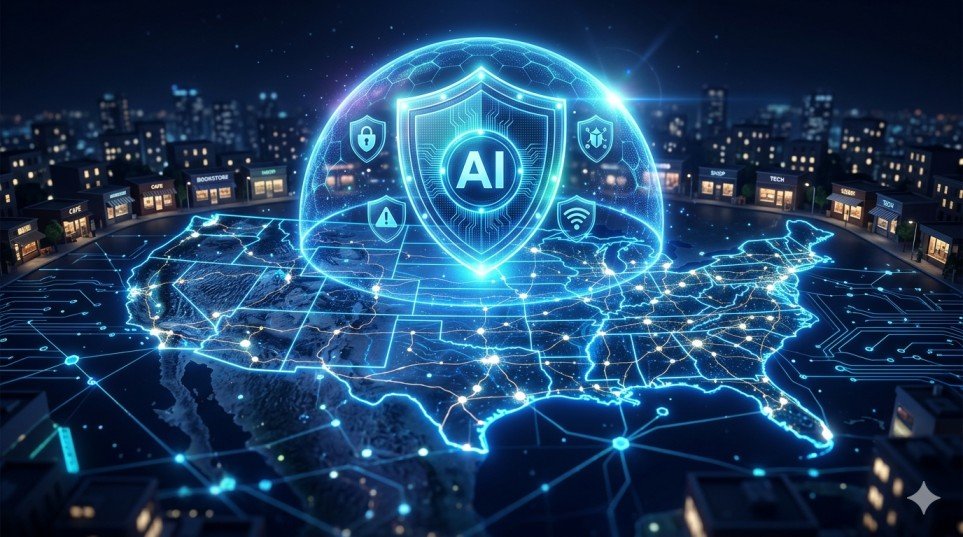
Here's where things are shifting in 2026: AI is becoming the great equalizer in cybersecurity. It's no longer just for enterprise giants. Small businesses across the USA are now using AI-powered tools to detect threats, respond to attacks, and protect customer data — at a fraction of what it used to cost.
This post breaks down exactly how AI cybersecurity for small business USA 2026 works, what tools are making a real difference, and what your business should be doing right now.
Why AI Cybersecurity for Small Business USA 2026 Matters More Than Ever
Before we get into the AI part, let's talk about why small businesses keep ending up in the crosshairs.
It's not because attackers specifically hate your pizza shop or accounting firm. But without proper AI cybersecurity for small business USA 2026 in place, you're an easy mark. It's because small businesses tend to:
- Use outdated or unpatched software
- Lack dedicated IT or security staff
- Rely on weak or reused passwords
- Store sensitive customer data without proper encryption
- Operate without employee cybersecurity training
Hackers run automated tools that scan thousands of systems per hour, looking for the lowest-hanging fruit. This is exactly why AI cybersecurity for small business USA 2026 has become a critical investment. Small businesses, with their leaner defenses, often fit that profile perfectly.
When it comes to AI cybersecurity for small business USA 2026, the Capslock team has worked with dozens of US-based SMBs over the years, and one thing we see constantly: business owners assume that because they're "not big enough to be a target," they're safe. That assumption is exactly what attackers count on.
What's Changed: AI Enters the Cybersecurity Arena in 2026
When we talk about AI cybersecurity for small business USA 2026, the starting point is understanding how dramatically things have shifted. Traditional cybersecurity worked like this: you set up a firewall, installed antivirus software, and waited to see what happened. The problem? Threats evolved faster than rule-based systems could keep up.
AI flips the script. And that's the core promise of AI cybersecurity for small business USA 2026 — moving from reactive to proactive defense.
Instead of waiting for a known threat to match a pattern in a database, AI systems learn normal behavior and flag anomalies in real time. They can detect a phishing attempt that's never been seen before. They can notice that an employee account logged in from Lahore and Sacramento in the same hour, and lock it down automatically.
Here's a practical way to think about it: traditional security is like a lock on your front door. AI-powered security is like having a security guard who's watched thousands of hours of footage, knows every regular visitor, and gets suspicious the moment something seems off — even if they can't explain exactly why.
How AI Cybersecurity Actually Works for Small Businesses
1. Threat Detection and Real-Time Monitoring
AI tools monitor your network 24/7, analyzing traffic patterns, login behavior, file access, and more. When something deviates from the norm — say, a user downloading an unusual amount of data at 2 AM — the system flags or blocks it before damage is done.
For small businesses, this replaces the need for a round-the-clock security operations center. You get enterprise-grade monitoring at a manageable monthly cost.
Key tools doing this in 2026:
- Darktrace — Uses self-learning AI to detect threats across email, cloud, and endpoints
- CrowdStrike Falcon Go — Lightweight EDR (endpoint detection and response) designed for SMBs
- SentinelOne — AI-native endpoint protection with autonomous response capabilities
2. AI-Powered Phishing Protection
Phishing is still the #1 entry point for breaches — but it's gotten a lot more sophisticated. In 2026, attackers are using AI to generate convincing fake emails, deepfake voice messages, and spoofed websites that are nearly indistinguishable from the real thing.
Fortunately, AI defenders are keeping pace.
Modern email security platforms use natural language processing (NLP) to analyze the actual content of emails — not just headers and links — to spot deceptive patterns. They learn your company's internal communication style and flag anything that deviates from it.
Quotable fact: According to IBM's 2025 Cost of a Data Breach Report, phishing was the most common attack vector, responsible for 15% of all breaches, with an average cost of $4.88 million per incident.
For small businesses, even a fraction of that damage can be existential.
3. Automated Incident Response
When a breach or intrusion does occur, the first few minutes matter enormously. Every second of delay gives attackers more time to move laterally through your systems, encrypt files, or exfiltrate data.
AI-powered security platforms now include automated incident response — the ability to isolate compromised devices, revoke credentials, and alert administrators without waiting for a human to act.
Think of it as a smoke detector that also automatically seals the vents, calls the fire department, and texts you — all before you've even smelled smoke.
4. Vulnerability Scanning and Patch Prioritization
One of the most unglamorous but critical parts of cybersecurity is keeping your software updated. Unpatched vulnerabilities are the root cause of a staggering number of breaches.
AI tools now continuously scan your systems for vulnerabilities and prioritize which ones to patch first based on real-world threat intelligence. Instead of a generic list of 200 "medium severity" issues, you get a clear action plan: "Fix these three things this week."
This is especially valuable for small businesses where IT resources are limited and every hour spent on maintenance competes with core operations.
5. Employee Behavior Analytics
Most breaches involve a human element — whether it's a phishing click, a weak password, or a disgruntled employee misusing access.
AI-powered user and entity behavior analytics (UEBA) tools establish a behavioral baseline for each user: what systems they typically access, when they log in, what files they open. Any significant deviation triggers an alert.
This isn't about spying on employees — it's about protecting the business from compromised accounts, whether the threat comes from outside or inside.
A Quick Look: Traditional Security vs. AI-Powered Security
| Feature | Traditional Security | AI-Powered Security |
|---|---|---|
| Threat Detection | Signature-based (known threats only) | Behavioral (known + unknown threats) |
| Response Time | Manual, hours to days | Automated, seconds to minutes |
| Scalability | Requires more staff as you grow | Scales with your data, not headcount |
| Cost for SMBs | High (dedicated team needed) | Accessible monthly SaaS pricing |
| False Positives | High | Significantly reduced over time |
| Phishing Detection | Basic link/header scanning | NLP-based content analysis |
Real-World Example: A Small Accounting Firm in Texas
Here's a scenario the Capslock team has seen play out more than once.
A 12-person accounting firm in Austin, Texas was using basic antivirus and a shared Gmail account for client communications. One employee clicked a link in a spoofed IRS email. The attacker gained access to the firm's shared drive, which contained years of client tax returns, social security numbers, and financial records.
The firm discovered the breach six weeks later, when a client reported suspicious activity on their accounts.
If they'd had an AI-powered email security tool — even a basic one at $15/user/month — the phishing email would likely have been flagged before it ever reached the inbox. The NLP analysis would have caught the unusual sender domain, the urgency language, and the mismatched link URL.
Six weeks of undetected access versus zero minutes. That's the difference AI cybersecurity for small business USA 2026 can make in a real-world attack scenario.
What Small Businesses Should Do Right Now
The good news is you don't need to rebuild your IT infrastructure overnight. Here's a practical, prioritized action plan:
Start here (low cost, high impact):
- Enable multi-factor authentication (MFA) on all accounts — email, banking, cloud services. This is step one in any AI cybersecurity for small business USA 2026 strategy.
- Deploy an AI-powered email security tool (Abnormal Security, Proofpoint Essentials, or Microsoft Defender)
- Run a basic vulnerability scan using free tools like OpenVAS or a trial of Tenable.io
Next steps (mid-tier investment):
4. Implement an EDR solution on all business devices (CrowdStrike, SentinelOne, or Malwarebytes ThreatDown)
5. Set up cloud access monitoring if you use Google Workspace or Microsoft 365
6. Conduct a quarterly AI cybersecurity for small business USA 2026 review with a professional
Ongoing practices:
7. Train employees regularly on AI cybersecurity for small business USA 2026 best practices — most AI tools also include simulated phishing tests
8. Review user access permissions every 6 months; remove old accounts immediately when staff leave 9. Have an AI cybersecurity for small business USA 2026 incident response plan in writing — even a one-page document helps
According to Capslock Agency: "The businesses that suffer the worst breaches are rarely the ones with no security at all — they're the ones that thought their existing setup was 'good enough.' A 2026 cybersecurity audit takes one afternoon and can prevent months of recovery."
How Capslock Helps Small Businesses Stay Protected
At Capslock Agency, we work with small and mid-sized businesses across the USA to build digital infrastructure that doesn't just look good — it holds up under pressure.
Our AI cybersecurity for small business USA 2026 services are designed specifically for businesses that don't have a full IT department but still handle sensitive customer data, process payments online, or rely on cloud-based tools to run their operations.
We help with:
- Cybersecurity audits — identifying your current vulnerabilities before attackers do
- AI tool selection and setup — matching you with the right platforms for your size and industry
- Ongoing monitoring and reporting — so you're never flying blind
- Employee training programs — turning your team from a liability into a line of defense
Whether you're a solo consultant or a 50-person firm, the Capslock team can build a cybersecurity layer that grows with your business. Get in touch with us to schedule a free consultation.
Conclusion: AI Isn't the Future of Cybersecurity — It's the Present
If there's one thing 2026 has made clear, it's this: the cyber threat landscape isn't slowing down, and neither is the AI that's helping businesses fight back.
Small businesses in the USA no longer have to choose between affordability and security. AI cybersecurity for small business USA 2026 has made enterprise-grade protection genuinely accessible. AI-powered tools have brought enterprise-grade protection within reach — and the businesses that adopt them now will be far better positioned than those still waiting for the "right time."
The Capslock team has seen firsthand how a simple, well-configured AI security stack can transform a vulnerable small business into one that's genuinely hard to compromise. It doesn't require a massive budget. It requires the right strategy, the right tools, and a partner who knows the landscape.
Don't wait for a breach to take AI cybersecurity for small business USA 2026 seriously. Start with one tool, one audit, one conversation — and build from there.
Ready to transform your business with tailored AI? Explore our Custom AI Solutions & Services designed to automate workflows and scale your growth.
FAQ: AI Cybersecurity for Small Businesses
Q1: Is AI cybersecurity for small business USA 2026 affordable?
Yes. Many AI-powered security tools are offered as monthly SaaS subscriptions starting at $10–$20 per user. This is far more cost-effective than the average $120,000+ cost of recovering from a ransomware attack.
Q2: Do I need technical expertise to use AI security tools?
Most modern platforms are designed for non-technical users. They provide dashboards, plain-language alerts, and automated responses that don't require a security degree to interpret. Working with a managed service provider like Capslock can also bridge any gaps.
Q3: Can AI completely replace human cybersecurity professionals?
Not entirely — and it shouldn't. AI handles speed and scale exceptionally well: detecting anomalies, responding in real time, processing millions of data points. But human judgment is still essential for strategy, policy, and complex incident response. Think of AI as a force multiplier for your security team, not a replacement.
Q4: What's the biggest cybersecurity mistake small businesses make in 2026?
Skipping AI cybersecurity for small business USA 2026 entirely, assuming they're too small to be targeted. Automated attack tools don't discriminate by company size — they target vulnerabilities. Any business with customer data, payment processing, or cloud access is a potential target.
Q5: How do I know if my business has already been compromised?
Common signs include: slower-than-usual systems, unexpected password resets, unfamiliar user accounts, unusual outbound network traffic, or clients reporting phishing emails that appear to come from you. If you suspect a breach, contact a cybersecurity professional immediately and avoid using potentially compromised systems.
If you're ready to take the next step, the Capslock Agency team is here to help. We specialize in building smart, affordable cybersecurity strategies for small and mid-sized businesses across the USA. From initial audits to full AI-powered security stack setup, our cybersecurity services are tailored to businesses that want enterprise-level protection without the enterprise price tag. Let's secure your business before the next threat finds it — reach out today and get a free consultation.