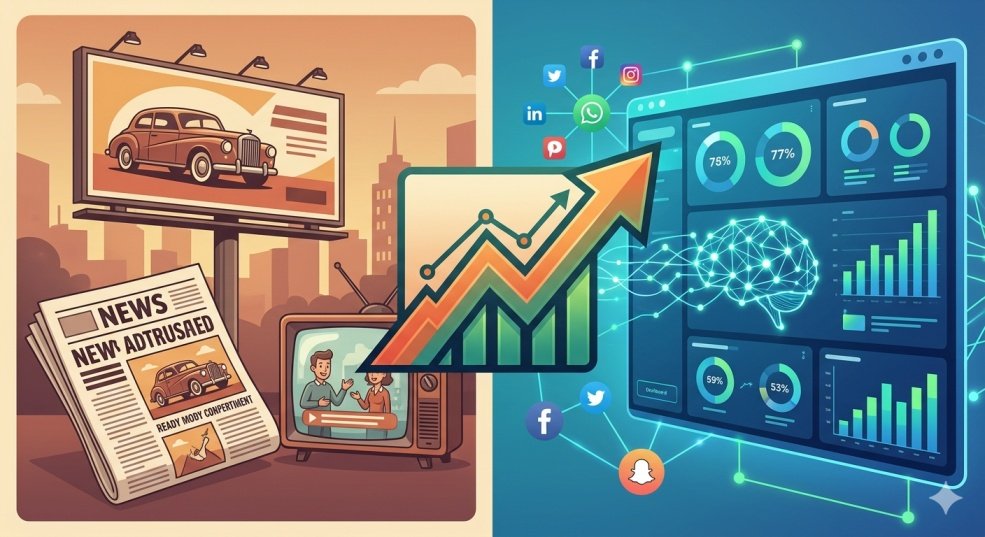
AI marketing vs traditional marketing ROI is one of the most debated questions among US business owners right now — and for good reason. Companies that adopted AI-driven marketing strategies reported 3–5× higher ROI compared to those relying solely on traditional channels, and that gap is only widening in 2026.
So, is traditional marketing dead? No. But it’s no longer the default answer when budgets are tight and results need to be trackable. The real question for US businesses today is not whether to choose one over the other — it’s about knowing when each approach earns its place in your strategy.
In this article, the Capslock Agency team breaks down the full picture of AI marketing vs traditional marketing ROI across real-world scenarios, so you can decide what makes sense for your business right now.
What Exactly Is “Traditional Marketing”?
When comparing AI marketing vs traditional marketing ROI, the first step is understanding what traditional actually means — any promotional effort using offline or pre-digital channels like television commercials, radio spots, print ads, billboards, direct mail, and in-person events. For decades, these were the only tools businesses had, and many of them still work depending on the context.
A local plumbing company running ads in a regional newspaper, or a national brand airing a Super Bowl commercial, are both using traditional marketing. The appeal is familiarity and broad reach — you put your message in front of a large audience and hope enough of them become customers.
The core limitation in any AI marketing vs traditional marketing ROI discussion? Measurement. Traditional marketing has always struggled to answer: “Did this ad actually drive sales?” Brand lift surveys and anecdotal evidence are still the primary tools for proving ROI in traditional channels — which is a tough sell in a data-driven business environment.
What Is AI Marketing — and Why Does It Matter Now?
AI marketing vs traditional marketing ROI is not just a technology gap — it’s a fundamental shift in how businesses reach customers. AI marketing goes well beyond running Google Ads or posting on Instagram. It’s a full ecosystem of tools and strategies powered by machine learning, predictive analytics, natural language processing, and automation — all designed to reach the right person with the right message at the right time.
Here’s what AI-powered marketing looks like in practice:
- Predictive analytics — Identifying which leads are most likely to convert before you spend a dollar targeting them
- Dynamic content personalization — Automatically adjusting website copy, email subject lines, and ad creatives based on user behavior
- AI-driven SEO — Using machine learning to identify keyword gaps, optimize content, and forecast search trends
- Automated social media campaigns — Running multi-platform campaigns that self-optimize based on performance data
- Chatbots and conversational AI — Qualifying leads 24/7 without adding headcount
“According to Capslock Agency’s client work across B2B and B2C sectors, businesses that integrate AI into their marketing funnel typically reduce their customer acquisition cost (CAC) by 20–40% within the first six months.”
The shift is not just about automation — it’s about intelligence. AI tools learn from your audience data, improve targeting over time, and provide the granular reporting that makes it possible to justify every marketing dollar.
AI Marketing vs Traditional Marketing ROI: Head-to-Head Comparison
| Factor | Traditional Marketing | AI-Powered Digital Marketing |
|---|---|---|
| Cost | High upfront (TV, print, billboards) | Scalable; pay-per-click or monthly retainers |
| Targeting | Broad demographic groups | Hyper-targeted (behavior, intent, location) |
| Measurability | Difficult; estimated reach only | Real-time tracking, attribution, and analytics |
| Speed of Results | Slow; campaigns take weeks to launch | Fast; campaigns live within hours |
| Personalization | One-size-fits-all messaging | Dynamic, personalized content at scale |
| ROI Visibility | Low; hard to trace conversions | High; clear data-to-revenue mapping |
| Adaptability | Fixed once published | A/B testable; optimized in real time |
| Audience Reach | Local/national mass audiences | Global or hyper-local, your choice |
Traditional marketing wins on brand presence and emotional storytelling at scale. AI marketing wins on precision, accountability, and efficiency. The smarter strategy, in most cases, is combining both — using AI to handle performance-driven activity while traditional methods build long-term brand equity.
Breaking Down ROI: What Does the Data Say?
ROI comparisons between traditional and AI marketing can be tricky because the metrics differ. Traditional marketing measures brand recall and reach. AI marketing measures clicks, conversions, and revenue. That said, here’s how they stack up across common US business scenarios:
| Marketing Channel | Avg. Cost (US) | Time to Results | ROI Measurement |
|---|---|---|---|
| TV / Radio Ad Campaign | $15,000–$50,000 | 3–9 months | Hard to quantify; brand lift surveys |
| Print / Outdoor Advertising | $5,000–$20,000 | 4–8 weeks | Estimated impressions only |
| AI-Driven SEO Campaign | $1,500–$5,000/mo | 3–6 months | Organic traffic, leads, revenue |
| AI Social Media Marketing | $1,000–$4,000/mo | 2–4 weeks | Engagement, conversions, ROAS |
| AI-Powered Email Campaigns | $500–$2,000/mo | 1–2 weeks | Open rates, clicks, direct revenue |
A Real-World Example
One of Capslock’s clients — a mid-sized e-commerce brand in the US — was spending $18,000 per month on traditional print and radio advertising, generating roughly $40,000 in attributed revenue. After shifting $10,000 of that budget into an AI-powered SEO and paid social campaign, attributed revenue climbed to $72,000 — a near-doubling of ROI at a lower spend.
That’s not a unique story. It’s a pattern the Capslock team has seen repeatedly — and it’s exactly why AI marketing vs traditional marketing ROI has become a defining conversation across industries. Companies that fully embed AI capabilities into their marketing strategy consistently report stronger revenue growth compared to peers still relying on traditional-only approaches, according to McKinsey’s marketing insights research.
“The businesses seeing the biggest returns from AI marketing aren’t just running more ads — they’re making smarter decisions at every stage of the funnel. From the first touchpoint to the final conversion, AI ensures nothing is left to guesswork.” — Capslock Agency
When Traditional Marketing Still Makes Sense
Let’s not write it off entirely. There are scenarios where traditional marketing genuinely delivers.
Brand Awareness at Scale
If you’re a consumer brand launching a new product to a national audience, a television spot or out-of-home billboard campaign can generate awareness faster than most digital channels. The sheer reach is hard to replicate.
Local and Community-Oriented Businesses
A neighborhood restaurant, a local law firm, or a regional healthcare provider may find more traction with community newspapers, local radio, or direct mail than with algorithmic targeting. In these contexts, traditional channels often carry more trust.
Demographic Considerations
Older demographics — particularly Americans over 60 — still consume traditional media at significantly higher rates. If that’s your primary audience, you cannot ignore the channels they trust most.
The takeaway: traditional marketing is not wrong, it’s just incomplete on its own. Paired with AI-driven tracking and digital follow-up, even traditional campaigns become more measurable and more effective.
Best Marketing Strategy for US Businesses in 2026
The best marketing strategy for US businesses in 2026 is not a binary choice. AI marketing vs traditional marketing ROI works best as a hybrid approach that uses each channel for what it does best. Here’s a framework the Capslock team recommends based on business size and goals:
Startups and Small Businesses (Under $5,000/mo)
- Focus 80% of budget on AI-powered digital: SEO, targeted social ads, and email automation
- Use traditional channels sparingly: local events, community sponsorships, low-cost print
- Prioritize ROI-trackable channels — every dollar needs to be justified when budgets are tight
Mid-Sized Companies ($5,000–$25,000/mo)
- Build an integrated funnel: AI-driven performance marketing paired with traditional brand reinforcement
- Invest in CRM and analytics to unify data from both digital and offline campaigns
- Run A/B tests on digital channels to sharpen your traditional messaging
Enterprises ($25,000+/mo)
- Full-funnel AI integration: personalization at scale, predictive lead scoring, automated content
- Traditional channels for sustained brand equity: TV, OOH, and premium print
- Closed-loop attribution: use AI to connect traditional campaign exposure to digital conversion events
Pro tip: If you’re doing traditional marketing while skipping digital entirely, you’re likely leaving 60–70% of potential ROI on the table. AI marketing tools are no longer reserved for enterprise budgets — they’re accessible, scalable, and essential for any US business competing in 2026.
Frequently Asked Questions
Is AI marketing better than traditional marketing for ROI?
When evaluating AI marketing vs traditional marketing ROI, the answer in most cases favors AI — particularly for measurability and cost efficiency. AI marketing allows precise tracking of every dollar spent and direct attribution to revenue. Traditional marketing offers scale and brand-building that digital channels can’t replicate as effectively, which is why a hybrid strategy tends to deliver the best overall results.
How much does AI digital marketing cost for a US business?
Costs vary by scope. A foundational AI-powered SEO and social campaign can start at $1,500–$3,000 per month with a professional agency. Enterprise-level campaigns with full automation and analytics integration can run $15,000+ per month. For most businesses, ROI justifies the investment within three to six months.
What is the best marketing strategy for a small US business in 2026?
For most small businesses, the highest-ROI approach combines AI-driven SEO to capture organic search traffic, targeted paid social ads to reach ideal customers, and email marketing automation to convert and retain leads. This combination is affordable, measurable, and scales as you grow.
Can traditional marketing be tracked like digital campaigns?
To a degree. QR codes, unique phone numbers, and offer codes on print and broadcast ads provide rough attribution data. However, this tracking is far less granular and reliable than the real-time data available through digital channels. Brands investing heavily in traditional marketing typically rely on brand lift studies to gauge impact.
How do I know if my current marketing strategy is driving enough ROI?
The simplest test: can you draw a direct line from your marketing spend to revenue? If you can’t, that’s a problem worth solving. A professional marketing audit can identify where your budget is being wasted and where AI-driven optimization could recover that value.
Conclusion: Choose Strategy Over Habit
The AI marketing vs traditional marketing ROI debate isn’t really a debate anymore — it’s a question of degree and context. Businesses that understand this distinction are the ones pulling ahead. AI-powered digital marketing consistently delivers better measurability, faster iteration, and stronger returns on a per-dollar basis. Traditional marketing still earns its place in building brand presence and reaching audiences who aren’t online.
The businesses winning in 2026 are not the ones that picked a side. They’re the ones that built a strategy — using AI tools for performance and data, and traditional channels for trust and reach.
The Capslock Agency team has helped businesses across the United States build exactly this kind of integrated marketing approach. Our work spans AI-driven SEO, social media campaigns, custom digital strategies for startups and enterprises, and ongoing consultancy that keeps your marketing ahead of the curve.
Ready to Build a Marketing Strategy That Actually Performs?
At Capslock Agency, we don’t hand you a generic plan and wish you luck. We audit your current marketing, cut through the AI marketing vs traditional marketing ROI confusion, identify what’s working and what’s wasting budget, and build a data-backed strategy tailored to your business — whether that means a full AI-powered digital overhaul, an integrated traditional-plus-digital approach, or something in between.
Our marketing services include:
- AI-Driven SEO & Content Strategy
- Social Media Marketing (paid and organic)
- Email Marketing Automation
- Analytics, Attribution & Reporting
- Full-Funnel Digital Campaign Management
- Marketing Consultancy for Startups and Enterprises
We work with businesses across the US and internationally — and we’re comfortable with both B2B and B2C challenges.
Get in touch with the Capslock team and let’s figure out exactly where your marketing dollars should be going.
📧 hi@capslockagency.com | 🌐 capslockagency.com | 📞 US: +1 530 819 7542 | PK: +92 304 4134792