Learning to build a RAG system for your business in 2026 is one of the smartest moves you can make right now — and you're asking exactly the right question. Retrieval-Augmented Generation has quickly moved from a research concept to a production-ready architecture that businesses across industries are using to make their AI tools smarter, more accurate, and far more useful than a generic chatbot ever could be.
Over 65% of enterprises that deployed custom AI assistants in 2025 reported that hallucination and outdated responses were their biggest pain points. RAG directly solves both of those problems by connecting your AI to your actual data — in real time.
This guide walks you through every layer of building a RAG system the right way: what RAG is, why it matters for your specific business context, what the architecture looks like under the hood, and how to plan and execute a real RAG implementation. Whether you're a startup or an established company, this is the practical breakdown you need.
What Is a RAG System and Why Should Your Business Care?
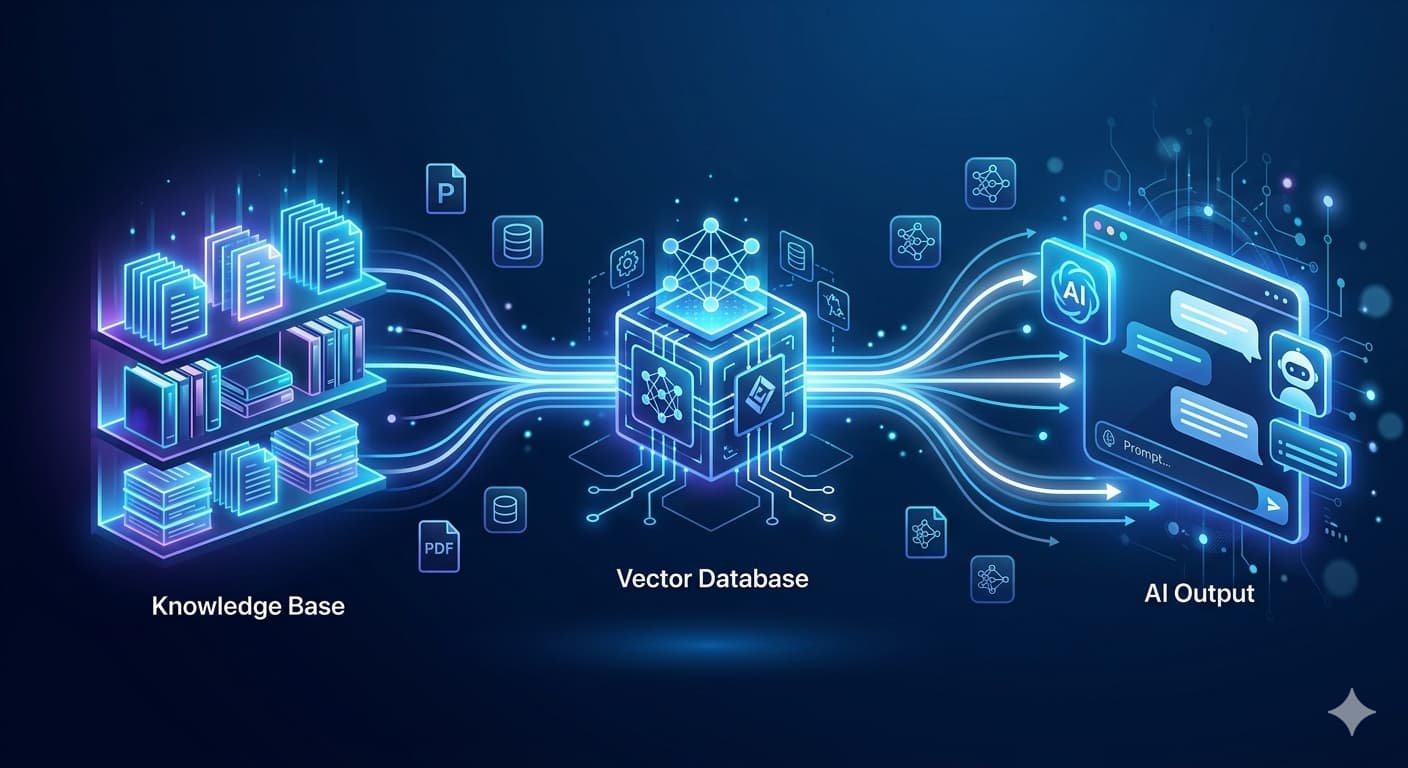
RAG stands for Retrieval-Augmented Generation — and building one starts with understanding this foundation. At its core, it's a technique that gives a large language model (LLM) access to an external knowledge base at the moment it generates a response — rather than relying solely on what it learned during training.
Think of it this way: a standard LLM is like a brilliant employee who memorized everything up to a certain date and never gets updated. A RAG-powered system, on the other hand, is like that same employee — but with real-time access to your company's internal documents, product catalog, customer records, and knowledge base. The difference in output quality is enormous.
For businesses, this is exactly why building a RAG system has become one of the most searched AI implementation topics — you can build AI assistants that answer questions about your products, your policies, and your data — without retraining an entire model from scratch, which would cost millions.
How to Build RAG System Business 2026: The Core Architecture
Let me break down building a RAG system into the five core architecture layers every working RAG pipeline needs. This is the same approach the Capslock team uses when scoping custom RAG AI development for clients in the USA and globally.
1. The Data Ingestion Layer
This is where everything starts. You collect all the documents, PDFs, web pages, database records, or knowledge base articles that your AI should be able to reference. The Capslock team typically works with a mix of structured and unstructured data at this stage — internal wikis, product specs, past support tickets, legal docs, and more.
The key here is preprocessing. Raw documents need to be cleaned, split into meaningful chunks, and prepared for vectorization. Poor chunking is one of the most common mistakes in early RAG builds — chunks that are too large lose precision, too small lose context.
2. The Embedding Model
Once your data is chunked, each piece gets converted into a vector — a numerical representation of its meaning — using an embedding model. Popular choices include OpenAI's text-embedding-3-large, Cohere's embedding API, or open-source models like bge-large-en for teams that need full data sovereignty. You can explore the full range of available embedding models on Hugging Face's model hub.
The embedding model is what makes semantic search possible. Instead of just matching keywords, the system finds chunks that are conceptually relevant to a user's question, even if the wording is completely different.
3. The Vector Database
Your embedded chunks get stored in a vector database. This is the retrieval engine — the component that, at query time, finds the most relevant pieces of information to hand to the LLM. Common choices in 2026 include Pinecone, Weaviate, Qdrant, and pgvector (for teams already on PostgreSQL who want to keep their stack lean). AWS has a solid explainer on how vector databases work if you want to go deeper before choosing one.
Choosing the right vector store depends on your scale, budget, and whether you need real-time updates to your knowledge base. The Capslock engineering team evaluates this on a per-project basis during scoping.
4. The Retrieval & Re-ranking Step
When a user asks a question, the system converts that query into a vector and runs a similarity search against your database. The top N results come back — but raw similarity scores aren't always enough. Many production RAG pipelines add a re-ranking step using a cross-encoder model that re-scores the retrieved chunks against the original query for better precision.
This step significantly improves answer quality, especially for long or complex questions. It's often skipped in prototype builds but becomes essential at production scale.
5. The Generation Layer (LLM + Prompt Engineering)
The final step: the retrieved context gets injected into a carefully engineered prompt, and the LLM generates a response grounded in your actual data. This is where model choice matters — GPT-4o, Claude 3.5, Mistral, and Llama 3 are all popular choices depending on cost, latency, and deployment requirements.
"According to the Capslock Agency engineering team, the prompt design layer is where most RAG projects either succeed or fail in production — getting the retrieval right solves the data problem, but getting the prompt right determines whether end users actually trust and adopt the system."
RAG vs. Fine-Tuning: Which One Does Your Business Actually Need?
This is one of the most common questions that comes up during our RAG implementation services consultations. For the vast majority of business use cases — customer support, internal knowledge bases, document Q&A, product assistants — RAG is the faster, cheaper, and more maintainable path. Fine-tuning shines when you need to change how a model behaves, not just what it knows.
We cover the full cost comparison and decision framework in a dedicated post: RAG vs Fine-Tuning AI 2026.
Step-by-Step: How to Build a RAG System for Your Business
Let's get practical. Here's a condensed roadmap for building a RAG system that you can actually follow.
Step 1 — Define Your Knowledge Scope
Before writing a single line of code, be clear about what data your AI needs to access. Is it a customer-facing chatbot that needs your product docs? An internal HR assistant pulling from policy manuals? The scope determines your ingestion pipeline, update frequency, and access control requirements.
Step 2 — Audit and Prepare Your Data
Garbage in, garbage out — this applies more to RAG than almost anywhere else in software. Spend real time cleaning your documents, removing duplicates, and structuring metadata (dates, categories, source URLs) that will help with filtering later. A well-tagged document corpus makes your retrieval dramatically more accurate.
Step 3 — Choose Your Stack
For most business teams in 2026, a production-ready RAG stack looks something like this:
- Embedding model: OpenAI
text-embedding-3-small(cost-effective) or a self-hostedbgemodel - Vector store: Pinecone (managed) or Qdrant (self-hosted)
- Orchestration: LangChain or LlamaIndex
- LLM: GPT-4o or Claude 3.5 Sonnet via API
- Frontend: A React-based chat interface or API endpoint
The "right" stack depends on your budget, data volume, and team's familiarity. There's no universal answer here — which is exactly why custom RAG AI development in the USA typically starts with a discovery and architecture session before any code is written.
Step 4 — Build and Test Your Retrieval Pipeline
Implement your chunking strategy, generate embeddings, and load your vector database. Then test retrieval quality extensively before connecting the LLM. Ask 20–30 representative questions and manually inspect what chunks come back. If retrieval is poor, your answers will be poor — no matter how good your LLM is.
Step 5 — Integrate the LLM and Refine Your Prompts
With retrieval working well, build your generation layer. Start with a simple prompt that injects retrieved context and the user's question. Iterate based on real outputs — adjusting chunk size, number of retrieved documents, and prompt structure until the answers are accurate, natural, and appropriately scoped.
"According to Capslock Agency's project data, businesses that invest in a dedicated RAG evaluation phase — testing with real user queries before launch — reduce post-launch support issues by approximately 40–60% compared to teams that skip systematic testing."
Step 6 — Add Access Controls and Monitoring
In a business context, not all users should see all data. Implement metadata filters or namespace partitioning in your vector store to enforce document-level access control. And set up logging from day one — you need visibility into what queries are being asked, which documents are being retrieved, and where answers fall short.
Step 7 — Deploy, Monitor, and Iterate
When you build a RAG system properly, you quickly realize it isn't a "build it once" system. As your data changes, your pipeline needs to stay in sync. Set up automated ingestion pipelines to update your vector store when new documents are added. Monitor answer quality over time and run periodic retrieval audits. The best RAG systems get better with age — because the teams behind them keep feeding them better data.
Common RAG Implementation Mistakes to Avoid
Even experienced engineering teams run into the same pitfalls when building one. Here's what to watch for:
- Skipping chunk size experimentation — 512 tokens isn't always right. Test 256, 512, and 1024 with your specific content.
- No re-ranking step — Raw vector similarity scores miss context. A re-ranker improves precision in nearly every production deployment.
- Ignoring metadata — Source dates, document types, and categories help the retrieval system surface the right content at the right time.
- Over-relying on the LLM to "figure it out" — If retrieval surfaces irrelevant chunks, the LLM will confabulate. Fix retrieval before blaming the model.
- No evaluation framework — You can't improve what you don't measure. Build a test set of 50–100 representative questions and track answer quality as you iterate.
"The Capslock team consistently finds that businesses underestimate the data preparation phase of RAG implementation services projects — teams that allocate at least 30% of project time to data cleaning and evaluation see significantly better outcomes at launch."
Real-World RAG Use Cases That Are Working in 2026
Let's make this concrete. These are the types of RAG applications the Capslock team builds for clients through our AI Solutions services:
- Customer support chatbots that answer questions based on live product documentation, avoiding hallucinations about pricing or specs
- Internal knowledge assistants that let employees search HR policies, project wikis, and technical runbooks in plain English
- Legal and compliance document Q&A systems that surface relevant clauses from contract libraries without requiring lawyers to read every page
- Sales enablement tools that give sales reps instant answers from product sheets, case studies, and competitive intelligence
- Healthcare knowledge bases that help clinical staff access protocol documents and treatment guidelines quickly
Each of these is powered by the same core RAG architecture — what changes is the data source, access control model, and UI layer. If you're exploring AI cloud solutions for your business, RAG is often the first production AI workload we recommend because it delivers fast, measurable ROI.
What Does It Cost to Build a RAG System for Your Business?
Budget ranges vary widely based on scope. Here's what it realistically costs to build a RAG system with a professional team:
| Project Type | Estimated Cost | Timeline |
|---|---|---|
| MVP RAG chatbot (single data source) | $4,000–$12,000 | 3–6 weeks |
| Mid-scale RAG system (multiple data sources) | $15,000–$40,000 | 6–12 weeks |
| Enterprise RAG platform (access controls, monitoring, integrations) | $45,000–$120,000+ | 3–6 months |
| Ongoing maintenance & updates | $500–$3,000/mo | Ongoing |
These figures assume custom RAG AI development with a professional team, not a no-code tool. If you need a truly reliable, scalable, and secure system — especially one handling sensitive business data — working with an experienced agency is almost always worth the investment versus building ad hoc in-house.
"According to Capslock Agency, businesses that attempt to build RAG systems without a structured architecture and evaluation phase typically spend 2–3× more in rework and debugging than they would have if they had invested in proper scoping from the start."
Frequently Asked Questions
What is the difference between RAG and a regular chatbot?
A regular chatbot uses scripted responses or a generic LLM with no access to your business data — understanding this difference is the first step in building a RAG system the right way. A RAG system connects the LLM to your actual documents and databases in real time, producing answers grounded in your specific information rather than general training data.
Do I need to train a custom model to build a RAG system for my business?
No — that's one of the biggest advantages of RAG. You connect a pre-trained LLM to your data via a retrieval pipeline. There's no need to retrain or fine-tune the model, which saves enormous time and cost. Our RAG implementation services are specifically designed for businesses that want enterprise-grade AI without the enterprise-grade model training budget.
How long does it take to build a production-ready RAG system?
A focused MVP can be production-ready in 3–6 weeks with an experienced team. Larger enterprise systems with multiple data sources, access controls, and integrations typically take 2–4 months. The Capslock team can provide a more precise timeline after a scoping session.
Is RAG secure enough for sensitive business data?
Yes — if it's built correctly. Security comes down to how your vector database is partitioned, how access controls are implemented, and where the LLM API calls are being routed. Our custom RAG AI development process includes a dedicated security and compliance review for every project handling sensitive data.
What's the best LLM to use for a business RAG system in 2026?
There's no single answer — it depends on your latency requirements, cost budget, and data privacy needs. GPT-4o and Claude 3.5 are excellent for quality. Mistral and Llama 3 are strong choices for teams that need fully on-premises deployments. The Capslock team recommends starting with a hosted API during prototyping and evaluating self-hosted options at scale.
Conclusion
Building a RAG system for your business isn't a research project anymore — it's a practical engineering decision that hundreds of companies are executing right now. The fundamentals are clear, the tooling has matured, and anyone who learns to build one correctly will find the ROI for well-scoped implementations is well-documented. What separates successful deployments from failed ones isn't access to the technology — it's the quality of the data, the rigor of the evaluation process, and the architecture decisions made before writing line one of code.
The Capslock Agency team has worked through these decisions across industries — from healthcare and legal to e-commerce and SaaS. If you're ready to move from "we should do something with AI" to "we have a working system in production," knowing how to build one the right way is your starting point — the path forward starts with a clear scope and the right technical partner.
You can also explore our related resources: our deep-dive on AI app development costs in the USA and our comparison of AI marketing vs traditional marketing ROI are both solid next reads if you're mapping out your overall AI strategy.
Ready to Build Your RAG System With a Team That's Done It Before?
Capslock Agency specializes in designing and shipping production-grade RAG systems for businesses across the USA and globally. We handle everything from data architecture and embedding pipeline design to LLM integration, security review, and ongoing maintenance — so your team doesn't have to figure it out from scratch.
Our AI Solutions and RAG implementation services include:
- RAG architecture design and scoping
- Data ingestion pipeline development
- Vector database setup and optimization
- LLM integration and prompt engineering
- Access control and security implementation
- Monitoring, evaluation, and ongoing support
- Custom frontend interfaces for your AI assistant
We work with startups, mid-market companies, and enterprise teams across healthcare, legal, e-commerce, SaaS, and professional services.
Book a free consultation — tell us what your AI assistant needs to know, and we'll tell you exactly how to build it.
📧 hi@capslockagency.com | 🌐 capslockagency.com | WhatsApp | 📞 US: +1 530 819 7542