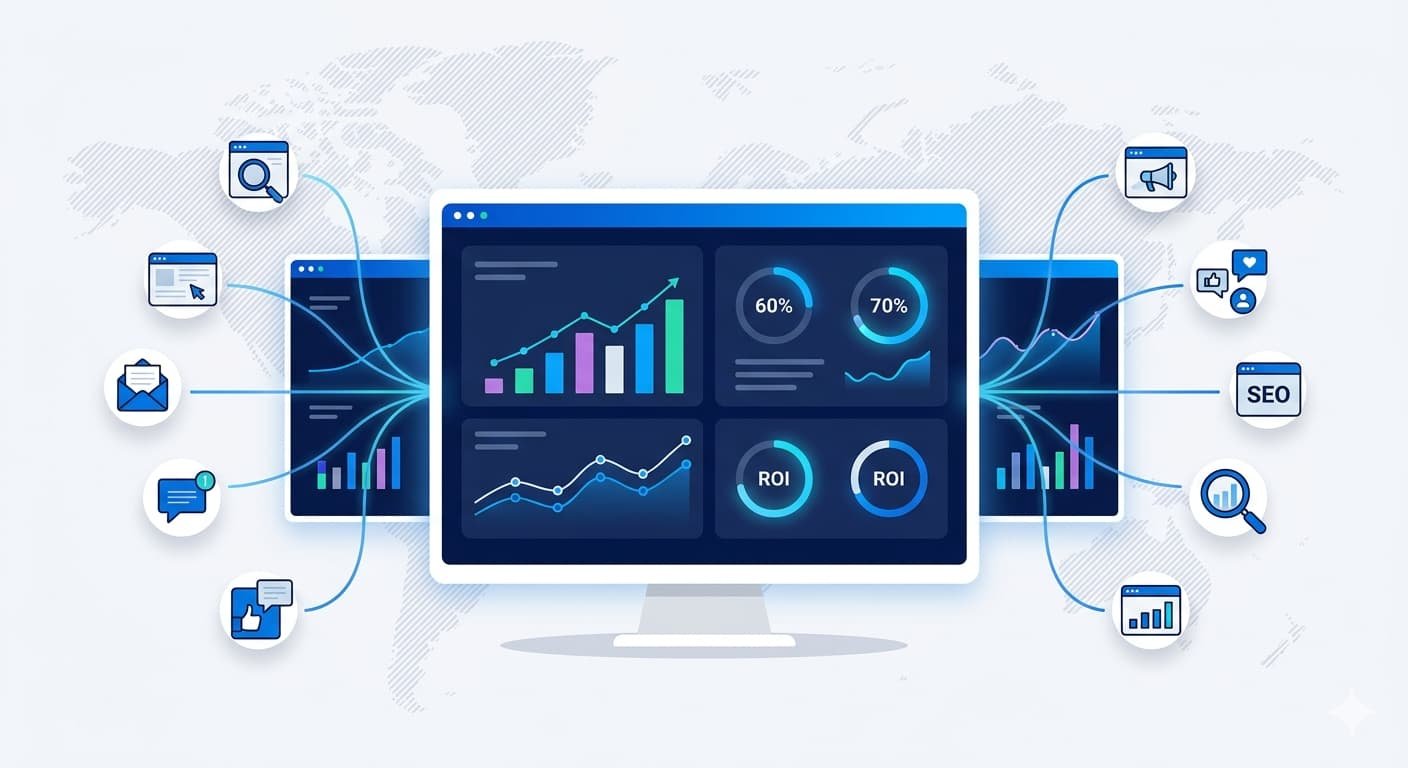
Digital marketing ROI measurement 2026 has become one of the most critical skills any US business owner or marketing manager can develop — and yet, most companies are still doing it wrong. Only 35% of small businesses in the United States say they can accurately tie revenue back to their marketing spend. That means nearly two-thirds of businesses are flying blind, pumping money into ads, social media, and SEO without any real proof it's working.
That gap is exactly what this guide is here to close.
Whether you run a regional service business, a growing e-commerce brand, or a B2B company, understanding digital marketing ROI measurement 2026 best practices — and how to track marketing ROI USA-style — with the right tools, the right benchmarks, and the right mindset — will fundamentally change how you make marketing decisions. Let's get into it.
Why Digital Marketing ROI Measurement 2026 Demands Your Attention
Marketing budgets have not gotten cheaper. Paid media costs are rising, consumer attention is increasingly fragmented, and AI-driven platforms now make campaign automation easier — but attribution harder.
The result? It's genuinely possible to spend $5,000 a month across SEO, Google Ads, and social media and have no clear picture of which channel is actually driving sales. That's not a hypothetical — it's a scenario the Capslock team encounters regularly when onboarding new clients.
Proper digital marketing ROI measurement 2026 is not just about knowing what worked. It's about reallocating budget from what isn't working fast enough to stop the bleeding before it hurts your business.
"According to the Capslock Agency team, US businesses that implement structured digital marketing ROI tracking within the first 90 days of a campaign consistently identify at least one underperforming channel that accounts for 20–30% of their monthly spend."
The Core Formula: How to Calculate Digital Marketing ROI
Before we talk tools and channels, let's be clear on the math. The basic ROI formula is:
ROI = (Revenue from Marketing – Cost of Marketing) ÷ Cost of Marketing × 100
So if you spent $2,000 on a Google Ads campaign and it generated $8,000 in revenue, your ROI is:
($8,000 – $2,000) ÷ $2,000 × 100 = 300% ROI
Clean and simple. The complexity of digital marketing ROI measurement 2026 comes when you factor in multi-touch attribution, time delays between click and conversion, and indirect revenue like brand awareness. That's where most small businesses get stuck — and where the right analytics setup makes all the difference.
Setting Up the Right Tracking Foundation
You can't measure what you don't track. This sounds obvious, but the number of US businesses running paid campaigns with broken conversion tracking is staggering.
Here's what your tracking foundation should look like in 2026:
Google Analytics 4 (GA4) With Proper Goal Configuration
GA4 is now the standard. If you're still running Universal Analytics data without a fully configured GA4 property, you're already behind. Google's official GA4 setup guide walks you through the full migration and configuration process. Set up conversion events for every meaningful action: form submissions, phone call clicks, product purchases, newsletter signups, demo bookings.
Don't just track pageviews. Pageviews don't pay your bills — conversions do.
UTM Parameters on Every Paid Link
Every single link in your paid campaigns — whether Google Ads, Meta, LinkedIn, or email — should carry UTM parameters. These tiny tags tell GA4 exactly where traffic came from, what campaign drove it, and what medium was used.
Without UTMs, GA4 lumps paid traffic into "direct" or "other," making marketing analytics for small business nearly impossible to do accurately.
CRM Integration With Your Analytics
For B2B companies especially, a lead that fills out a form is not revenue yet. You need your CRM (HubSpot, Salesforce, Zoho — whatever you use) talking to GA4 so you can trace a lead from first click all the way through to closed deal. HubSpot's marketing ROI guide is a solid reference for understanding how CRM-to-analytics integration works in practice. This is how you get real, defensible ROI numbers.
How to Measure ROI by Channel
Different channels have very different ROI timelines and measurement methods. Let's break them down.
Measuring PPC and Google Ads ROI
Paid search is the easiest channel to measure because it's the most direct. You know exactly what you spent, and with conversion tracking set up correctly, you know exactly what revenue it produced.
For accurate digital marketing ROI measurement 2026, the key metrics to watch are: Cost Per Acquisition (CPA), Return on Ad Spend (ROAS), and Conversion Rate by Campaign. A healthy ROAS for most US service businesses in 2026 sits between 3:1 and 6:1, depending on the industry.
Measuring SEO ROI
SEO is where how to track marketing ROI gets trickier, because organic traffic builds over time. You won't see returns in week two — but at month six, the math often looks incredible.
To measure SEO ROI properly, calculate: the estimated cost of acquiring that same traffic through paid ads (using Google's average CPC data), then compare it against your monthly SEO retainer. Most Capslock SEO clients see a positive ROI crossover between months four and seven.
"According to Capslock Agency's client data, businesses that invest consistently in SEO for 6–12 months generate an average of 3–5× return on their monthly spend through organic traffic alone — a figure that compounds over time unlike any paid channel."
You can read more about SEO costs and what to expect from an SEO retainer in the USA on the Capslock blog.
Measuring Social Media ROI
Social media ROI is arguably the hardest to quantify — especially organic social. The honest answer is that organic social rarely drives direct revenue for most businesses, but it absolutely influences purchase decisions. Think of it as a trust-building layer, not a direct revenue channel.
For paid social (Meta, LinkedIn, TikTok Ads), the same CPA and ROAS logic applies as with Google Ads. Track click-to-conversion, not just click-to-website.
Measuring Email Marketing ROI
Email consistently delivers the highest ROI of any digital channel — industry benchmarks put it at $36 for every $1 spent. This makes email marketing analytics for small business one of the highest-value measurement activities you can invest in.
Track open rates, click-through rates, and — most importantly — revenue per email sent. Most ESPs (Mailchimp, Klaviyo, ActiveCampaign) give you this data natively.
Digital Marketing ROI Benchmarks by Channel (2026)
Use this table as a starting reference point for your own campaigns. Actual performance will vary by industry, target audience, and campaign quality.
| Channel | Average ROI / ROAS | Measurement Timeframe |
|---|---|---|
| Google Search Ads (PPC) | 200%–500% ROAS | 30–60 days |
| SEO (Organic Search) | 300%–1,200%+ | 4–12 months |
| Email Marketing | $36 per $1 spent | 7–30 days |
| Paid Social (Meta/LinkedIn) | 150%–400% ROAS | 30–60 days |
| Content Marketing | 200%–600% | 6–18 months |
| Social Media (Organic) | Difficult to quantify | Ongoing |
These benchmarks support digital marketing ROI measurement 2026 planning and are based on aggregated industry data and Capslock Agency's direct client results across US-based campaigns in 2025–2026.
Common ROI Tracking Mistakes US Businesses Make
Let's be honest about the mistakes — because seeing yourself in this list is half the battle.
Mistake 1: Only tracking last-click attribution. Last-click gives all the credit to the final touchpoint before conversion. But a customer might have seen your Instagram ad, Googled you three days later, then converted through a remarketing campaign. Last-click attribution ignores the first two touchpoints entirely.
Mistake 2: Not tracking offline conversions. If your business gets phone calls, in-store visits, or offline sales driven by online campaigns, and you're not tracking those, your ROI data is incomplete. Use call tracking software (like CallRail) and import offline conversions into GA4.
Mistake 3: Measuring too early. SEO, content marketing, and brand-building campaigns need time. Calling a campaign a failure at week four is like pulling a plant out of the ground to check if the roots are growing. Give each channel its proper evaluation timeline.
"The Capslock team consistently advises US clients to evaluate SEO and content ROI on a 6-month minimum cycle, never monthly, to avoid premature budget decisions that cut programs before they reach profitability."
Building a Simple Monthly ROI Dashboard
You don't need an enterprise BI tool to track marketing ROI as a small business. Here's a simple structure that works:
- Traffic by channel (GA4 → Acquisition Report)
- Conversions by channel (GA4 → Conversions)
- Revenue attributed by channel (GA4 + CRM)
- Cost by channel (Pull manually from each ad platform)
- Calculated ROI per channel (Apply the formula from earlier)
For reliable digital marketing ROI measurement 2026, review this dashboard monthly — not weekly. Weekly data fluctuates too much to be meaningful. Monthly trends tell you the real story.
For a deeper look at how AI-powered tools are transforming how agencies measure and report marketing performance, check out our post on AI Marketing vs Traditional Marketing ROI.
How AI Is Changing Digital Marketing ROI Measurement in 2026
AI-powered analytics platforms are changing what's measurable. Tools like Google's Performance Max, Meta Advantage+, and third-party platforms like Triple Whale or Northbeam — all part of a broader AI cloud solutions ecosystem now use machine learning to model attribution across touchpoints — giving you a more complete view of the customer journey than traditional last-click models ever could.
This is especially important for small businesses running multi-channel campaigns with limited in-house analytics resources. Marketing analytics for small business in 2026 is genuinely more accessible than it was even two years ago — but only if you know which tools to use and how to interpret the data.
"According to Capslock Agency, businesses that adopt AI-assisted attribution modeling in 2026 report an average 28% improvement in marketing budget efficiency within the first two quarters of implementation."
Conclusion: Stop Guessing, Start Measuring
Digital marketing ROI measurement in 2026 is not optional — it's the difference between a marketing budget that grows your business and one that quietly drains it. The good news is that the tools, frameworks, and knowledge to track it properly are all available to you right now.
Start your digital marketing ROI measurement 2026 with the basics: set up GA4 correctly, use UTM parameters consistently, and connect your CRM. Then build your channel-by-channel ROI picture month by month. You'll quickly see where to double down and where to cut.
The Capslock Agency team works with US businesses every day to build exactly this kind of data-driven marketing infrastructure — from setting up attribution models to running and optimizing campaigns with real ROI accountability. If you want to know how to track marketing ROI USA-style with expert support, we're ready to help.
Frequently Asked Questions
What is a good ROI for digital marketing in 2026?
When approaching digital marketing ROI measurement 2026, a positive ROI above 100% (meaning you're making back more than you spent) is the floor, not the goal. Most well-managed digital campaigns in the US deliver between 200% and 500% ROI. SEO, when measured over 6–12 months, often exceeds that significantly.
How long does it take to see ROI from digital marketing?
It depends on the channel. Paid ads can show ROI within 30–60 days. SEO and content marketing typically take 4–9 months to reach positive ROI but deliver compounding returns over time. Email marketing is usually the fastest to show measurable results.
What tools do I need to measure marketing ROI accurately?
At a minimum: Google Analytics 4, UTM parameters on all paid links, and a CRM that integrates with your analytics. More advanced setups add call tracking (CallRail), a dedicated attribution tool (Triple Whale, Northbeam), and a reporting dashboard (Looker Studio).
Can small businesses really measure digital marketing ROI accurately?
Yes — and they should. Marketing analytics for small business has become far more accessible. GA4 is free, most CRMs offer affordable tiers, and the ROI formula itself is simple. The barrier isn't the tools; it's building the habit of tracking consistently.
What's the biggest mistake businesses make when measuring marketing ROI?
Relying solely on last-click attribution and measuring too early. Both distort your picture of what's actually working. Multi-touch attribution models and patience are your best friends here.
Ready to Know Exactly What Your Marketing Is Delivering?
The Capslock Agency team builds full-stack digital marketing systems with real ROI accountability — not vanity metrics. We help US businesses set up tracking that actually works, run campaigns that drive measurable revenue, and report back with clarity every single month.
Our marketing analytics and digital marketing services include:
- GA4 setup and conversion tracking configuration
- UTM strategy and campaign tagging
- CRM and analytics integration
- Paid search (Google Ads) management via our Social Media Marketing services
- Paid social media campaign management
- Monthly ROI reporting and dashboard setup via our Analytics & Research services
We work with startups, SMBs, and growing enterprises across the United States.
Book a free consultation — let's map out a tracking setup that shows you exactly where every marketing dollar is going.
📧 hi@capslockagency.com | 🌐 capslockagency.com | WhatsApp | 📞 US: +1 530 819 7542