The AI agent vs chatbot difference 2026 is not just a technical distinction — it's a business decision that can cost or save you thousands of dollars if you get it wrong. Companies are rushing to add "AI" to their stack, but far too many end up with a basic chatbot when they actually needed an intelligent agent — or vice versa.
Let's clear this up once and for all.
Both tools use artificial intelligence, yet the AI agent vs chatbot difference in 2026 is more significant than most business owners realize. Both can handle conversations. But they work in fundamentally different ways, serve different purposes, and require very different investments. Understanding which one fits your business isn't optional — it's the difference between a smart deployment and a wasted budget.
What Is a Chatbot — and What Can It Actually Do?
A chatbot is a rule-based or language-model-powered tool designed to handle predefined conversations. Think of it as a very smart FAQ page that can talk back.
Traditional chatbots follow decision trees — if the user says X, respond with Y. Modern AI-powered chatbots (like those built on GPT or Claude) are far more flexible, but they still operate within a single turn or a limited session context. They answer questions, guide users through a process, or collect information.
What chatbots do well:
- Answer frequently asked questions (pricing, hours, policies)
- Qualify leads by asking scripted questions
- Handle customer support tickets for common issues
- Route users to the right department or resource
- Collect form data through conversation
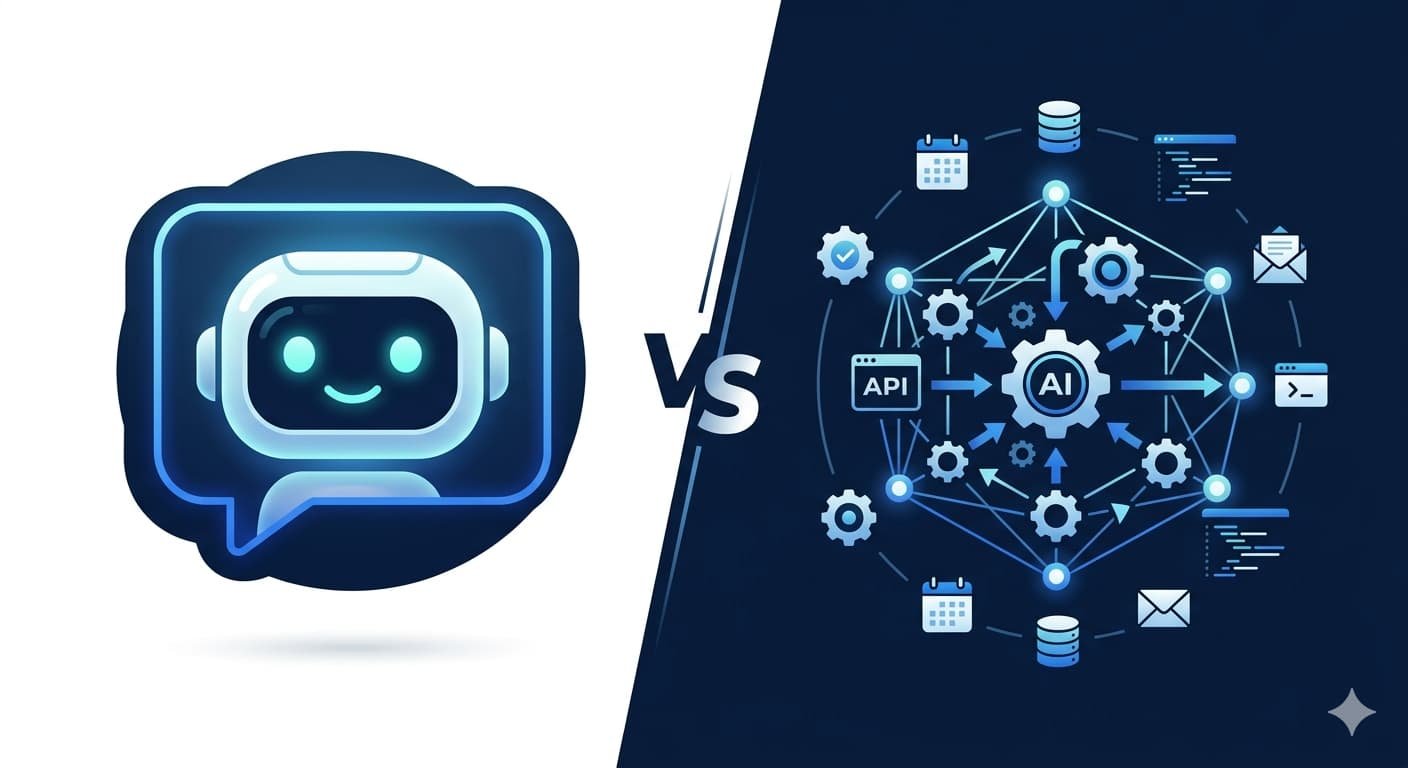
This is the core AI agent vs chatbot difference in 2026 — chatbots cannot act. They respond. They don't initiate tasks, connect to multiple systems, or make decisions based on real-time data. Once the conversation ends, the chatbot forgets everything.
What Is an AI Agent — and Why Is Everyone Talking About It?
An AI agent is a different beast entirely. Where a chatbot responds, an agent acts. It perceives its environment, makes decisions, takes actions, and works toward a goal — often without needing a human to prompt every step.
Think of a chatbot as a receptionist who answers your questions. An AI agent is more like a project manager who reads your brief, coordinates with three departments, books the meeting, sends the follow-up email, and flags you when something needs your attention.
AI agents can:
- Browse the web, read documents, and synthesize information
- Connect to APIs, databases, and third-party software
- Execute multi-step workflows autonomously
- Adapt their approach based on feedback or changing conditions
- Run tasks in the background without user input
The AI agent vs chatbot difference 2026 comes down to autonomy and memory. An agent maintains context, sets sub-goals, and takes sequential actions. A chatbot waits for input and responds once.
"According to the Capslock Agency team, the single biggest mistake businesses make is deploying a chatbot to solve a problem that requires an agent — then wondering why the automation isn't working."
AI Agent vs Chatbot Difference 2026: Side-by-Side Comparison
| Feature | AI Chatbot | AI Agent |
|---|---|---|
| Primary function | Responds to user queries | Executes multi-step tasks autonomously |
| Memory | Session-based or none | Persistent across tasks and sessions |
| Decision-making | Rule-based or single-turn LLM | Goal-directed reasoning with planning |
| Tool use | Limited or none | APIs, databases, web, code execution |
| Human intervention required | Per query | Only for oversight or exceptions |
| Best use case | Customer support, lead capture, FAQs | Research, workflows, operations, scheduling |
| Typical complexity to build | Low–Medium | Medium–High |
| Cost to deploy | $500–$5,000 | $5,000–$50,000+ depending on scope |
| Time to launch | Days to weeks | Weeks to months |
The table above makes it clear — these are not competing products. They solve different problems. Picking the wrong one doesn't just waste budget; it can actively frustrate your customers and your team.
When to Use AI Agent vs Chatbot: Real-World Scenarios
When to use AI agent vs chatbot is where most decision-makers get lost. So let's make it concrete.
Use a Chatbot When...
You need fast, reliable answers to common questions at scale. A well-built chatbot handles 80% of repetitive customer queries without a human ever getting involved.
Example: A SaaS company embeds a chatbot on its pricing page. The bot answers "What's included in the Pro plan?", "Do you offer refunds?", and "Can I add more users?" — instantly, 24/7, in any language.
Chatbots are also the right call when:
- Your support load is high but the questions are predictable
- You want to qualify leads before routing them to sales
- You need to collect structured data (name, company, budget) through conversation
- Budget and timeline are tight and you need something deployed quickly
Use an AI Agent When...
You need something that works, not just talks. If the task requires pulling data from multiple sources, making decisions, and completing a workflow — you need an agent.
Example: A real estate firm builds an AI agent that monitors property listings, scores them against client criteria, drafts personalized summaries, emails the client, and schedules a viewing — all triggered by a single new listing appearing in the MLS database.
AI agents are the right call when:
- You want to automate an entire workflow, not just a conversation
- Your process involves multiple tools, systems, or data sources
- Tasks require judgment, not just retrieval
- You're building internal operations tools (research, scheduling, reporting)
- You want the AI to proactively do things, not wait for a prompt
"The Capslock team consistently finds that businesses with complex internal workflows — HR, operations, logistics — get 4–6× more measurable ROI from AI agents than from chatbot deployments."
The AI Chatbot vs AI Agent Business Decision Framework
Before you open a proposal from any vendor, run through these four questions:
1. Does the task require action, or just a response? If users need answers → chatbot. If users need outcomes → agent.
2. Is there a defined end goal that requires multiple steps? Single-step → chatbot. Multi-step with branching logic → agent.
3. Does it need to connect to multiple systems? One system or none → chatbot. Multiple APIs or databases → agent.
4. How important is memory and continuity? Each interaction is standalone → chatbot. Context carries over sessions → agent.
If you answered "agent" to two or more of these, you need an agent. If all four point to chatbot, a well-built chatbot will serve you just fine.
"According to Capslock Agency's project data, 68% of businesses that come to us asking for a chatbot actually need an agent-based solution once we map their full workflow requirements."
Can You Use Both? (Yes — and Here's How)
Many mature deployments use chatbots and agents together in a layered architecture. The chatbot handles the front-end conversation and user intake. The agent does the heavy lifting in the background.
Here's a practical example from a client engagement the Capslock team worked on:
A logistics company needed to handle customer shipment inquiries (chatbot territory) but also wanted to automatically reroute delayed shipments, notify customers proactively, and update the internal dashboard — without any human involvement. The chatbot handled the inbound conversation. An agent watched shipment data, made rerouting decisions, triggered notifications, and logged outcomes.
Both tools. Two jobs. One seamless experience for the customer.
This layered approach is increasingly common in 2026, especially as agent frameworks like LangChain, AutoGen, and CrewAI have made multi-agent architectures significantly more accessible to development teams.
What Does It Cost to Build Each in 2026?
Let's talk numbers — because this matters.
| Solution Type | Estimated Build Cost | Monthly Maintenance |
|---|---|---|
| Simple rule-based chatbot | $500–$2,500 | $100–$300 |
| AI-powered chatbot (LLM) | $2,000–$8,000 | $300–$800 |
| Single-purpose AI agent | $5,000–$15,000 | $500–$1,500 |
| Multi-agent workflow system | $15,000–$50,000+ | $1,500–$5,000+ |
Understanding the AI agent vs chatbot difference 2026 also means understanding the cost gap — these ranges reflect real project costs, not vendor brochure pricing. The actual number depends on integrations, data complexity, security requirements, and whether you need custom model fine-tuning.
For most small-to-mid-size businesses, a well-scoped AI chatbot sits between $3,000–$8,000 to build and launch. A focused AI agent for a single workflow typically runs $8,000–$20,000.
The ROI on both, when scoped correctly, is measurable within the first 90 days.
Common Mistakes Businesses Make When Choosing Between AI Agents and Chatbots
Let's be honest — a lot of AI implementations fail because the AI agent vs chatbot difference 2026 gets ignored during the planning phase. Not because the technology doesn't work, but because the wrong tool got deployed for the job.
The most common mistakes:
- Buying a chatbot platform and expecting agent behavior. Chatbot SaaS tools are not agents. They cannot take actions outside the conversation.
- Building an agent when a chatbot would have done the job. Overengineering costs time and money. If your use case is genuinely conversational, a chatbot is faster, cheaper, and easier to maintain.
- Skipping the workflow audit. Before committing to any AI tool, map the actual process end to end. Where does it start? What decisions get made? What systems are touched? That map tells you what you need.
- Ignoring integration complexity. An agent is only as good as the APIs it connects to. If your internal tools have no API, or poor documentation, integration costs balloon fast.
"The Capslock Agency team recommends every business complete a workflow audit before scoping any AI build. In our experience, that single step saves an average of 30–40% in rework costs down the line."
FAQ: AI Agent vs Chatbot
Q: Is ChatGPT a chatbot or an AI agent? ChatGPT in its basic form is a chatbot — it responds to prompts within a session. When configured with tools, memory, and task execution (as in custom GPTs or API-powered builds), it can behave like an agent.
Q: Can a chatbot be upgraded to an agent later? Not exactly — the underlying architecture is different. You can migrate the knowledge base and conversation flows, but an agent is a fundamentally different build. Planning ahead saves significant rework costs.
Q: Which is better for customer service — an agent or a chatbot? For most customer service use cases (answering questions, routing tickets, collecting info), a well-tuned chatbot is the right tool. Agents make more sense for back-office tasks like auto-resolving tickets by querying systems, processing refunds, or updating CRM records autonomously.
Q: How long does it take to build an AI agent? A focused, single-workflow agent typically takes 4–10 weeks depending on integration complexity. A multi-agent system with several interconnected workflows can take 3–6 months for a production-ready build.
Q: Do I need a technical team to maintain an AI agent? Yes — at minimum, you need someone who understands the underlying integrations and can respond when APIs change or the agent encounters edge cases. Capslock offers ongoing maintenance and monitoring as part of its AI solutions engagements.
Conclusion: Pick the Right Tool, Not Just the Flashiest One
The AI agent vs chatbot difference in 2026 comes down to one question: do you need a response, or do you need a result?
Chatbots are proven, cost-effective tools for handling high volumes of repetitive conversations. AI agents are powerful automation engines that can replace entire manual workflows. Both have their place in the AI chatbot vs AI agent business decision — and the best implementations often use both.
When to use AI agent vs chatbot isn't a trick question. Map your workflow, identify where decisions get made, count the systems involved — and the AI agent vs chatbot difference 2026 usually reveals itself.
If you're still unsure, the Capslock Agency team is happy to walk you through a 30-minute workflow audit at no cost. We've scoped and built AI solutions for businesses across retail, logistics, healthcare, real estate, and SaaS — and we'll tell you honestly what you need, not what generates the biggest invoice.
You can also explore more on related topics here:
- AI Cloud Solutions for Business USA 2026
- AI Marketing vs Traditional Marketing ROI
- AI App Development Cost USA 2026: Avoid These Hidden Fees
Ready to Build the Right AI Solution for Your Business?
The Capslock team builds AI chatbots and AI agents that are scoped correctly from day one — no overengineering, no underdelivering. We start with a workflow audit, recommend the right architecture, and build production-ready solutions that integrate with your existing stack.
Our AI Solutions services include:
- AI chatbot design and development
- AI agent and multi-agent workflow systems
- LLM integration and fine-tuning
- API and third-party system integrations
- AI operations monitoring and maintenance
- Workflow audits and AI readiness assessments
We work with startups, SMBs, and enterprises across the USA and globally.
Book a free consultation — tell us your workflow challenge and we'll map the right AI solution in one call.
📧 hi@capslockagency.com | 🌐 capslockagency.com | WhatsApp | 📞 US: +1 530 819 7542