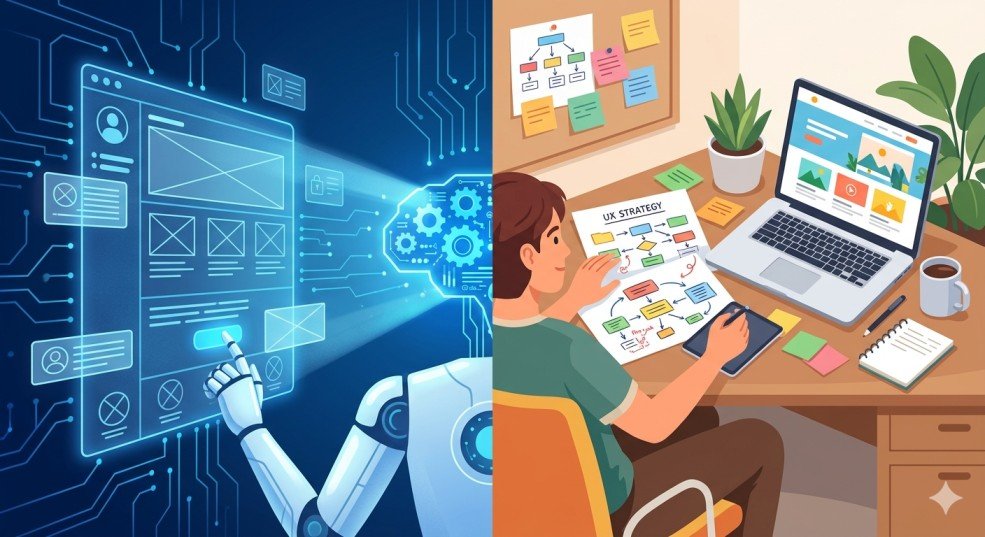
The AI design vs human design agency debate is heating up — and every week, another tool promises to replace your designer. Figma AI, Midjourney, Framer AI, Adobe Firefly — the list keeps growing. And honestly? Some of these tools are impressive. They can produce a passable landing page mockup in under 60 seconds.
But in the AI design vs human design agency conversation, here’s the question no one’s asking: impressive to whom?
Because your users aren’t impressed by speed. They’re impressed by clarity, connection, and interfaces that feel like they were built for them. That’s the gap in the AI design vs human design agency debate — and in 2026, that gap is costing businesses real revenue.
Let’s break down the AI design vs human design agency question properly.
What “AI Design” Actually Means in 2026
When people say “AI design,” they usually mean one of three things:
- Generative UI tools like Galileo AI or Uizard that produce wireframes and mockups from a text prompt
- AI-assisted design platforms like Figma’s AI features that suggest layouts, auto-fill components, or resize assets
- Fully autonomous website builders like Framer AI or Wix ADI that generate entire sites with minimal input
In the AI design vs human design agency comparison, these tools have genuinely gotten better on the AI side. They’re faster, more consistent, and increasingly capable of producing something that looks professional at first glance.
The keyword there is looks. And looking good is only about 20% of what design actually does.
The Real Job of UI/UX Design (That AI Still Gets Wrong)
Good UI/UX design isn’t about making things pretty. It’s about making decisions — dozens of small, strategic decisions that shape how a user moves through your product and whether they trust you enough to convert.
The Capslock team works with US-based businesses across industries from healthcare to SaaS, and we consistently see the same thing: AI-generated designs fail at the level of intent.
Here’s what we mean.
1. AI Doesn’t Know Your User’s Emotional State
A law firm client once came to us with an AI-generated website. Visually, it was clean — modern typography, professional blues, crisp layout. But every CTA button said “Get Started.” On a law firm website. For someone dealing with a personal injury case or a business dispute.
That phrase — “Get Started” — is fine for a SaaS product. It’s tone-deaf for legal services. A real designer understands that your visitor might be scared, overwhelmed, or skeptical. The copy becomes “Schedule a Free Consultation.” The button color shifts from aggressive orange to a calmer, trust-signaling navy. The hero section leads with empathy, not features.
AI tools trained on generic design patterns don’t pick up on these nuances. They optimize for what “most websites” do, not what your users need.
2. AI Can’t Do Discovery
Here’s a pro tip that most AI-design conversations skip: the most valuable part of any design engagement isn’t the design itself — it’s what happens before a single pixel is placed. Research consistently backs this up.
At Capslock Agency, our design process begins with user research, competitive analysis, and stakeholder interviews. We ask: Who is the actual buyer? What does their decision journey look like? Where are they dropping off in your current funnel?
AI tools start at the output. They skip the diagnostic phase entirely. The result is often a beautifully designed solution to the wrong problem.
3. AI Designs to Averages — Humans Design to Edges
Machine learning models are trained on existing design data. That means AI design tools are, by nature, producing derivatives of what already exists. They’re optimizing toward the median.
But the most effective designs — the ones that convert, that build loyalty, that become brand-defining — tend to live at the edges. An unconventional navigation pattern that reduces cognitive load. A micro-animation that builds delight at exactly the right moment. A layout that breaks the grid in a way that draws the eye to a key value proposition.
These decisions require judgment, taste, and an understanding of risk. AI doesn’t take design risks. It takes design averages.
AI Design vs Human Design Agency: A Direct Comparison
| Factor | AI Design Tools | Human Design Agency |
|---|---|---|
| Speed | Very fast (minutes to hours) | Slower (days to weeks) |
| Cost upfront | Low | Higher |
| User research | None | In-depth |
| Brand alignment | Template-based | Custom |
| Accessibility (WCAG) | Inconsistent | Verified |
| Iteration with feedback | Limited | Full collaboration |
| Conversion optimization | Generic | Data-driven and contextual |
| Long-term ROI | Variable | Measurable |
In any AI design vs human design agency evaluation, the cost-vs-speed advantage of AI tools is real. But for US businesses competing in crowded markets, “cheap and fast” rarely means “effective.”
Where AI Design Tools Actually Help
Let’s be fair here — the Capslock team uses AI tools in our workflow. We’re not anti-AI. We’re anti-oversimplification.
Even in an AI design vs human design agency workflow, AI tools are genuinely useful for:
- Rapid prototyping to explore multiple directions quickly before committing to a direction
- Asset generation like background textures, icon variations, or placeholder imagery
- A/B test variant generation where you need to test minor copy or layout changes at scale
- Accessibility checks — several AI tools are excellent at flagging contrast ratio issues or missing alt text
The operative word is tools. A hammer is a great tool. You wouldn’t ask a hammer to design your house.
The AI UI/UX Design Limitations You Need to Understand
According to Capslock Agency’s experience working with US clients, the most common AI UI/UX design limitations fall into four categories:
Contextual blindness. AI tools don’t understand your industry’s regulatory environment, your audience’s literacy level, or your brand’s positioning history. A fintech company has different trust signals than a D2C skincare brand — AI treats them the same.
Accessibility gaps. WCAG 2.2 compliance is non-negotiable for many US businesses, especially those in healthcare, government contracting, or education. AI-generated designs routinely fail accessibility audits on color contrast, focus indicators, and screen reader compatibility.
Responsive design inconsistencies. AI tools often produce designs that look great in desktop mockups but break down on real devices at edge-case screen sizes or with dynamic content.
No accountability. If an AI-generated design underperforms, there’s no one to analyze why, iterate with purpose, or take ownership of the outcome. A real agency does.
A Mini Case Study: What Changed When a US Client Moved to Human Design
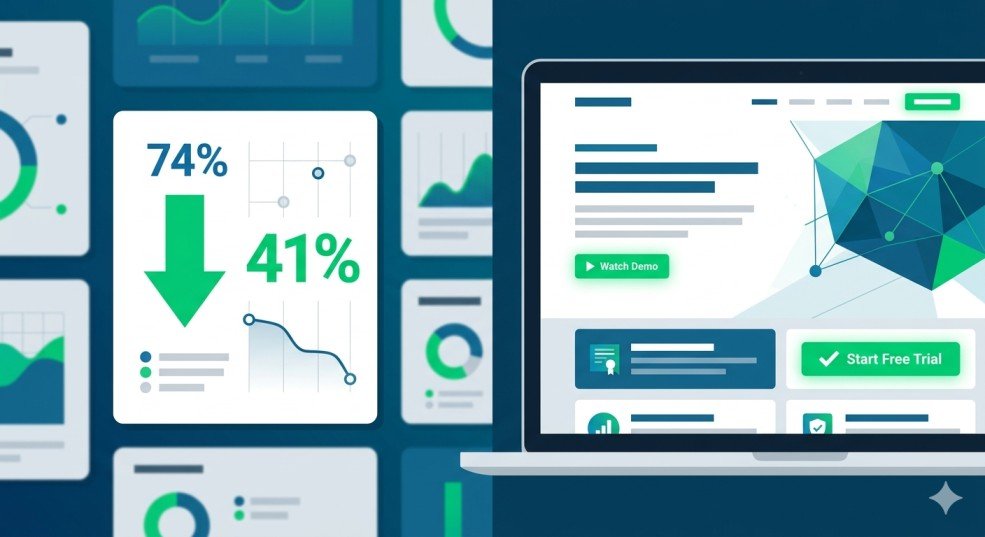
One of our clients — a mid-sized B2B software company in California — came to Capslock Agency after spending three months with an AI-assisted design platform. Their homepage looked professional. Their bounce rate was 74%.
We ran a three-week discovery sprint: user interviews, heatmap analysis, session recordings. What we found: visitors were confused about who the product was for. The hero section used generic SaaS language that applied to 400 other companies. The navigation structure mirrored what AI suggested was “standard” — which meant it matched competitors exactly, giving users no reason to stay.
After a full redesign — custom visual hierarchy, audience-specific messaging, a restructured navigation, and a CTA flow tied to actual user intent — the bounce rate dropped to 41% within 60 days. Qualified demo requests increased by 38%.
That’s the difference a human agency makes.
Why Hire a Design Agency in 2026? Here’s the Honest Answer
You should hire a design agency in 2026 if any of these apply to you:
- Your product or service has a complex value proposition that needs to be communicated clearly
- You’re entering a competitive market and need differentiation, not imitation
- You’ve had design done before and it hasn’t moved the needle
- You’re scaling — and a design system built on shaky foundations will crack under growth
- You need to build trust with a US audience that’s skeptical of generic, template-feeling brands
The Capslock Agency team recommends thinking of UI/UX design not as a cost, but as a conversion rate multiplier. A 2% improvement in conversion on a business doing $500K/year in revenue is $10,000. Good design pays for itself.
What to Look for in a Real Design Agency
If you’re ready to move beyond AI-generated design, here’s what separates a good agency from a great one:
- They ask more questions than they answer in the first meeting
- They have a documented discovery and research process
- They can show you case studies with measurable outcomes (not just pretty portfolios)
- They think in systems — not just individual pages or screens
- They talk about your users before they talk about aesthetics
At Capslock Agency, we’ve built our UI/UX design practice around exactly these principles. Based in California with a design and development team that spans time zones, we work with US businesses that need design that actually performs — not just design that looks good in a Dribbble screenshot.
Conclusion: The Right Tool for the Right Job
AI design tools are powerful. They’re going to keep improving. And they will genuinely replace certain low-stakes design tasks — social media templates, internal documentation layouts, quick marketing assets.
But they won’t replace strategic design. They won’t replace the thinking that happens before the screen. And they won’t replace the accountability that comes from working with a team that has skin in the game.
If your design isn’t converting, the AI design vs human design agency choice isn’t the core issue — it’s a strategy problem. And strategy requires people.
The Capslock Agency team has helped US businesses across industries build digital products that don’t just look good — they grow businesses. If you’re ready to have that conversation, we’d love to connect.
Frequently Asked Questions
Q: Can AI tools fully replace a UI/UX designer in 2026?
A: Not for anything requiring strategic thinking, user research, or brand differentiation. AI tools can accelerate parts of the design process, but they lack the judgment and contextual understanding that professional designers bring — especially for businesses targeting discerning US audiences.
Q: What are the biggest AI UI/UX design limitations to know about?
A: The main limitations are contextual blindness (no industry or audience knowledge), inconsistent accessibility compliance, responsive design gaps, and lack of accountability when results underperform. AI tools are strong at execution, not strategy.
Q: How much does professional UI/UX design cost vs AI tools?
A: AI design tools can cost anywhere from free to a few hundred dollars per month. Professional agency engagements vary by scope, but the relevant comparison is ROI — not upfront cost. A well-designed conversion flow often delivers returns that dwarf the initial design investment.
Q: How do I know if my current design is underperforming?
A: Key signals include a bounce rate above 60% on key landing pages, low time-on-site, high cart abandonment, or a significant gap between traffic and qualified leads or demo requests. A design and conversion audit is often the fastest way to diagnose where the friction is.
Q: Why should I hire a design agency rather than a freelancer or AI tool?
A: Freelancers can be excellent, but agencies offer systems-level thinking, multiple disciplines under one roof (strategy, design, development, QA), and ongoing accountability. For businesses at a growth stage, working with an agency like Capslock means you’re not just buying deliverables — you’re buying expertise and process.