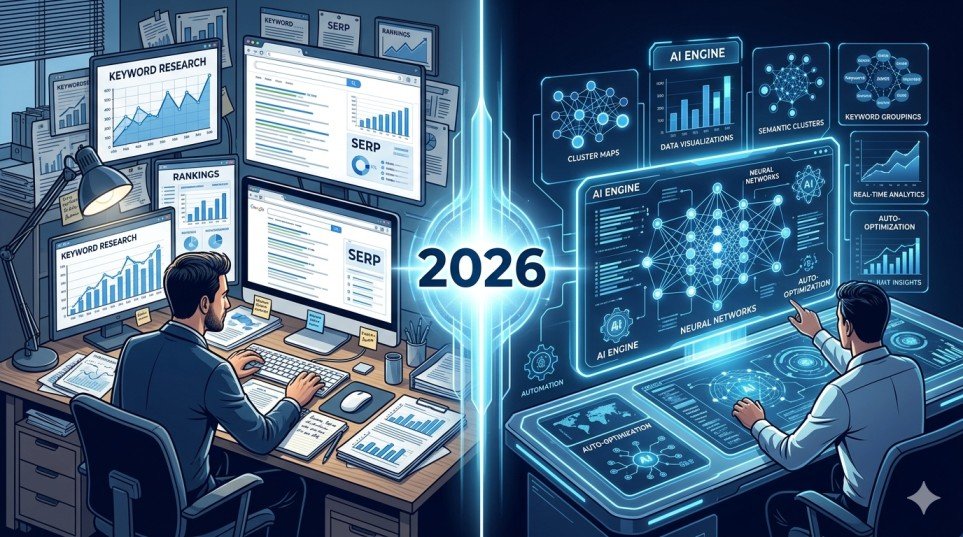
AI SEO tools 2026 are reshaping how businesses approach search — and 2026 feels like a genuine turning point. A year ago, most businesses were still debating whether to try AI SEO tools. Today, the question isn’t whether to use them. It’s how to use them without losing what actually drives rankings: strategy, authority, and relevance.
At Capslock Agency, we use AI SEO tools 2026 with businesses across the USA on SEO campaigns — and the AI vs traditional SEO discussion comes up with almost every new client. And we’ve had front-row seats to watch both traditional SEO techniques and AI-powered approaches play out in real results. This post breaks down what AI SEO tools 2026 and traditional SEO each offer, where one outperforms the other, and what the smartest SEO strategy in 2026 actually looks like.
Let’s dig in.
What We Mean by “Traditional SEO” (And Why It Still Matters)
Before we compare AI SEO tools 2026 with traditional SEO, let’s be precise about what traditional SEO actually includes — because it’s often mischaracterized as outdated.
Traditional SEO refers to the foundational practices that have driven search visibility for over a decade:
- Keyword research using tools like Google Keyword Planner, Ahrefs, or Semrush
- On-page optimization — title tags, meta descriptions, header structure, internal linking
- Technical SEO — site speed, crawlability, Core Web Vitals, canonical tags
- Link building — earning backlinks from authoritative, relevant websites
- Content creation — long-form, expert-driven pieces that match search intent
- Local SEO — Google Business Profile optimization, NAP consistency, local citations
These tactics — and AI SEO tools 2026 — work best when aligned with how Google fundamentally evaluates pages: relevance, authority, and user experience. None of that has changed.
What has changed is the speed and scale at which competitors can execute these tactics — which is exactly where AI SEO tools enter the picture.
What Are AI SEO Tools in 2026?
AI SEO tools are software platforms that use machine learning and large language models to automate, accelerate, or enhance specific parts of the SEO workflow.
In 2026, the most capable AI SEO tools 2026 offers go well beyond basic suggestions. Here’s what they can do:
Content Generation and Optimization
Tools like Surfer SEO, Clearscope, and AI-powered writing platforms can analyze top-ranking pages for a keyword and suggest optimal content structure, semantic keywords, word count, and heading patterns. Some can generate full drafts that are tuned to a target query.
Automated Technical Audits
Platforms like Screaming Frog (now with AI integrations) and Ahrefs AI features can scan thousands of pages in minutes, identify crawl errors, flag thin content, detect duplicate metadata, and prioritize fixes by estimated traffic impact.
Predictive Keyword Clustering
AI tools can group thousands of keywords into topical clusters based on semantic similarity and search intent — a task that used to take days of manual sorting.
SERP Analysis and Competitor Intelligence
Tools can now monitor how competitors’ content evolves, flag when a competitor earns a featured snippet, and predict what content type (video, FAQ, long-form article) is most likely to rank for a given query.
AI Search Optimization (GEO)
This is the newest frontier. As AI-powered search engines like Google’s AI Overviews, ChatGPT Search, and Perplexity grow in use, a new discipline has emerged: Generative Engine Optimization (GEO). AI SEO tools are beginning to help structure content so it gets cited in AI-generated answers — not just ranked on a traditional results page.
AI SEO Tools 2026 vs Traditional SEO: A Direct Comparison
Here’s an honest breakdown of AI SEO tools 2026 vs traditional SEO across the metrics that matter most for US businesses:
| Factor | Traditional SEO | AI SEO Tools |
|---|---|---|
| Speed of execution | Slower (manual research, writing, audits) | Faster (automated workflows, bulk analysis) |
| Content quality | High (human expertise, original insights) | Variable (requires strong human editing) |
| Technical auditing | Reliable but time-consuming | Fast and scalable |
| Link building | Human-driven, relationship-based | Mostly manual still; AI assists with prospecting |
| Strategic thinking | Human advantage | Limited; AI lacks business context |
| Local SEO | Strong with manual effort | Improving but not a strength yet |
| GEO / AI search | Not native to traditional tools | Emerging capability in newer platforms |
| Cost | Lower tool cost; higher labor cost | Higher tool cost; lower labor cost |
| Adaptability to algorithm changes | Slower (manual review) | Faster detection, slower strategic response |
The pattern is clear: AI SEO tools 2026 win on speed and scale. Traditional SEO wins on depth, quality, and strategic nuance.
Where AI SEO Tools Actually Excel
Let’s be specific about where AI SEO tools 2026 genuinely outperform doing things manually.
1. Content Gap Analysis at Scale
One area where AI SEO tools 2026 truly shine is large-scale content auditing. Imagine you’re running SEO for a mid-sized e-commerce business with 500 product categories. Identifying which categories have thin content, which ones are missing FAQ sections, and which ones have title tags that don’t match search intent — doing this manually is a week of work. An AI tool does it in an hour.
The Capslock team uses AI-assisted audits on onboarding new clients specifically for this reason. It surfaces the highest-leverage opportunities fast, so we can prioritize strategy rather than spend the first three weeks in spreadsheets.
2. Semantic Keyword Coverage
Google’s algorithms — especially Helpful Content and the broader EEAT framework — reward content that covers a topic thoroughly, not just content that repeats a keyword. AI content optimization tools analyze top-ranking pages and identify the semantic terms, related concepts, and questions that should appear in a piece. This is genuinely useful.
3. Rapid Content Briefs
Producing a well-researched content brief used to take 1–2 hours per article. AI tools can generate a structured brief with suggested headers, semantic keywords, target word count, and competitor analysis in minutes. Writers can then focus on the actual insight and original thinking — the parts that make content rank and convert.
4. Monitoring at Volume
For agencies or in-house teams managing dozens of clients or large sites, AI-powered rank tracking and anomaly detection can flag a traffic drop or a new competitor feature before a human would catch it in a weekly report.
Where Traditional SEO Still Wins — Clearly
Here’s what AI tools cannot replace in 2026, and likely won’t for years.
Strategic Direction
AI tools optimize for patterns in existing data. They cannot tell you that your client’s real growth opportunity is ranking for bottom-of-funnel service pages, not the high-volume informational terms they’ve been chasing. That requires understanding the business, the customer journey, and the competitive landscape — things that require human judgment.
Link Building
Earning high-authority backlinks still depends almost entirely on human relationships: pitching journalists, building partnerships, creating genuinely shareable content, and following up. AI can help identify prospects and draft outreach emails, but the relationship and the judgment are human.
According to Capslock Agency’s SEO team, link acquisition remains the single highest-effort and highest-impact activity in competitive niches — and no AI tool has meaningfully changed that equation yet.
E-E-A-T Signals
Google’s framework for evaluating content quality — Experience, Expertise, Authoritativeness, and Trustworthiness — increasingly rewards content that demonstrates real human knowledge. Author bios, first-person case studies, original data, and expert citations all signal E-E-A-T. AI-generated content, even when polished, tends to be generic in exactly the places where E-E-A-T signals should be strongest.
Local SEO
If you’re a local business in the USA — a law firm, a dental clinic, a home services company — your SEO depends heavily on Google Business Profile management, local citations, review acquisition, and proximity signals. AI tools add some value here, but the core work is still highly manual and relationship-driven.
Adapting to Algorithm Volatility
When Google releases a major update, the right response depends on understanding what the update rewarded or penalized — and what that means for your specific site. AI tools can flag that a site lost traffic; they can’t tell you whether the fix is content pruning, a technical change, or a complete strategic pivot.
The Best AI SEO Strategy for USA Businesses in 2026
Here’s the best AI SEO strategy USA businesses can follow, according to the Capslock team — and the approach we use internally:
Don’t choose between AI SEO tools 2026 and traditional SEO. Build a workflow that uses both where each is strongest.
A practical breakdown:
Phase 1 — Research and Planning (AI-Assisted)
Use AI tools for keyword clustering, content gap analysis, and competitor SERP analysis. Let the tool do the data processing. You make the strategic decisions about which opportunities to pursue.
Phase 2 — Content Creation (Human-Led, AI-Supported)
Use AI to generate content briefs and identify semantic coverage gaps. Have human writers — ideally with domain expertise — produce the actual content. Use AI editing tools (like Grammarly or Hemingway) for polish, not substance.
Phase 3 — Technical SEO (AI-Automated)
Run monthly automated technical audits. Use AI-powered prioritization to determine what to fix first. This is where AI tools save the most time with the least risk.
Phase 4 — Link Building (Fully Human)
Prospect with AI assist, but pitch, build relationships, and earn links through human outreach. No shortcut exists here.
Phase 5 — GEO / AI Search Optimization (Emerging Priority)
Structure your best content with clear, citable claims, expert attribution, FAQ sections, and factual summaries. This positions your content to appear in AI-generated answers — a channel that’s growing rapidly and still relatively uncontested.
Pro tip: One of the most underrated GEO tactics in 2026 is including direct, factual summary statements in your content — short, declarative sentences that AI systems can pull and attribute. You’re reading examples of this throughout this post.
Real-World Example: How Capslock Combines Both Approaches
A US-based SaaS client came to Capslock Agency asking about the best AI SEO strategy USA agencies recommend for stalled content programs. They had been publishing blog posts consistently for 18 months with minimal organic growth. Their content was well-written but wasn’t ranking.
The audit revealed three problems: content was targeting high-volume terms with no realistic chance of ranking, pages had no semantic keyword coverage (single-keyword focus), and internal linking was almost nonexistent.
Using AI-assisted tools, we rebuilt their keyword strategy in two days — clustering over 800 keywords into 40 topical pillars. Then the human strategy work started: selecting the 12 pillars with the best balance of search volume, competition level, and conversion relevance for their business.
We rewrote 20 existing posts with semantic keyword coverage improvements and rebuilt internal linking. Within four months, organic sessions had grown by 68% and three posts ranked in featured snippets.
AI tools saved us roughly 60% of the research time. Human strategy and writing drove the results.
Common Mistakes to Avoid in 2026
Whether you’re still weighing AI vs traditional SEO or already running a hybrid program, watch out for these common mistakes in 2026:
- Using AI-generated content without expert editing. Google’s Helpful Content system is getting better at detecting generic, low-value AI content. Human expertise is not optional.
- Over-automating link building. Automated link schemes are a fast path to a manual penalty. Don’t confuse AI-assisted outreach with automated link building.
- Ignoring GEO signals. If your content strategy doesn’t account for how AI systems surface information, you’re already behind.
- Treating AI tools as strategy. They’re execution tools, not strategy tools. The plan still requires human thinking.
- Neglecting technical fundamentals. No amount of great content fixes a slow site, broken crawl paths, or duplicate content issues.
Conclusion: The Future Belongs to Integrated SEO
The debate around AI vs traditional SEO misses the point. In 2026, the real AI vs traditional SEO question isn’t which one wins — it’s how well you integrate both.
AI tools make SEO teams faster, more data-informed, and better at scaling execution. Traditional SEO principles — authority, relevance, user experience, and genuine expertise — remain the foundation of what actually ranks.
When it comes to AI vs traditional SEO, the agencies and in-house teams that will lead in search over the next two to three years are the ones who treat AI as a powerful tool in the hands of skilled strategists, not a replacement for strategy itself.
The Capslock Agency team works with businesses across the United States to build SEO programs using AI SEO tools 2026 combined with human expertise and strategic direction. According to the Capslock team, the most consistent predictor of SEO success in 2026 is not the sophistication of the tools used — it’s the quality of the thinking behind them.
Our SEO Services at Capslock Agency
If you’re a business in the USA looking to grow organic traffic in 2026, Capslock Agency offers full-service SEO programs that combine the best of AI-assisted tooling and expert strategy.
What we offer:
- SEO Audits — technical, content, and competitive analysis
- Content Strategy — keyword research, topical authority planning, content calendars
- On-Page Optimization — title tags, metadata, internal linking, semantic keyword coverage
- Link Building — white-hat, relationship-driven authority building
- Local SEO — Google Business Profile, citations, review management
- GEO / AI Search Optimization — structuring content for AI-powered search visibility
Whether you’re exploring AI SEO tools 2026 for the first time or need to unlock growth from an existing program, our team will build a strategy tailored to your industry, your audience, and your goals.
Explore Capslock’s SEO Services →
Frequently Asked Questions
1. Are AI SEO tools worth the investment for small businesses in the USA?
For most small businesses, AI SEO tools offer strong ROI — particularly for technical audits and content optimization. However, the highest-tier platforms can cost $100–$400/month. If budget is a constraint, prioritize a tool that combines keyword research and on-page optimization in one platform, and supplement with strong human strategy. The tool is only as valuable as the strategy behind it.
2. Will Google penalize AI-generated content in 2026?
Google has been consistent on this: the issue isn’t whether content was AI-generated, it’s whether the content is helpful, original, and trustworthy. Low-quality, generic AI content that provides no real value will be penalized under Google’s Helpful Content system. AI content that is edited by experts, grounded in real knowledge, and genuinely useful to readers is treated the same as human-written content.
3. What is the best AI SEO strategy USA businesses should follow in 2026?
The best AI SEO strategy combines AI-assisted research (keyword clustering, content gap analysis, technical audits) with human-led strategy and content creation. For US-market SEO specifically, local relevance signals, E-E-A-T optimization, and GEO signals for AI-powered search are increasingly important layers to add.
4. How is GEO (Generative Engine Optimization) different from traditional SEO?
Traditional SEO aims to rank in the ten blue links of a standard search results page. GEO aims to ensure your content gets cited and surfaced in AI-generated answers from tools like Google AI Overviews, ChatGPT Search, and Perplexity. GEO best practices include writing clear, citable factual claims, using structured data, including expert attribution, and covering topics with depth and specificity.
5. How long does it take to see results from an AI-optimized SEO strategy?
Timeline varies by competition level, domain authority, and how significant the changes are. In most cases, meaningful movement in rankings is visible within 3–6 months for on-page and content improvements, and 6–12 months for authority-building efforts. The Capslock team sets realistic timeline expectations during onboarding based on a site’s current standing and target keywords.