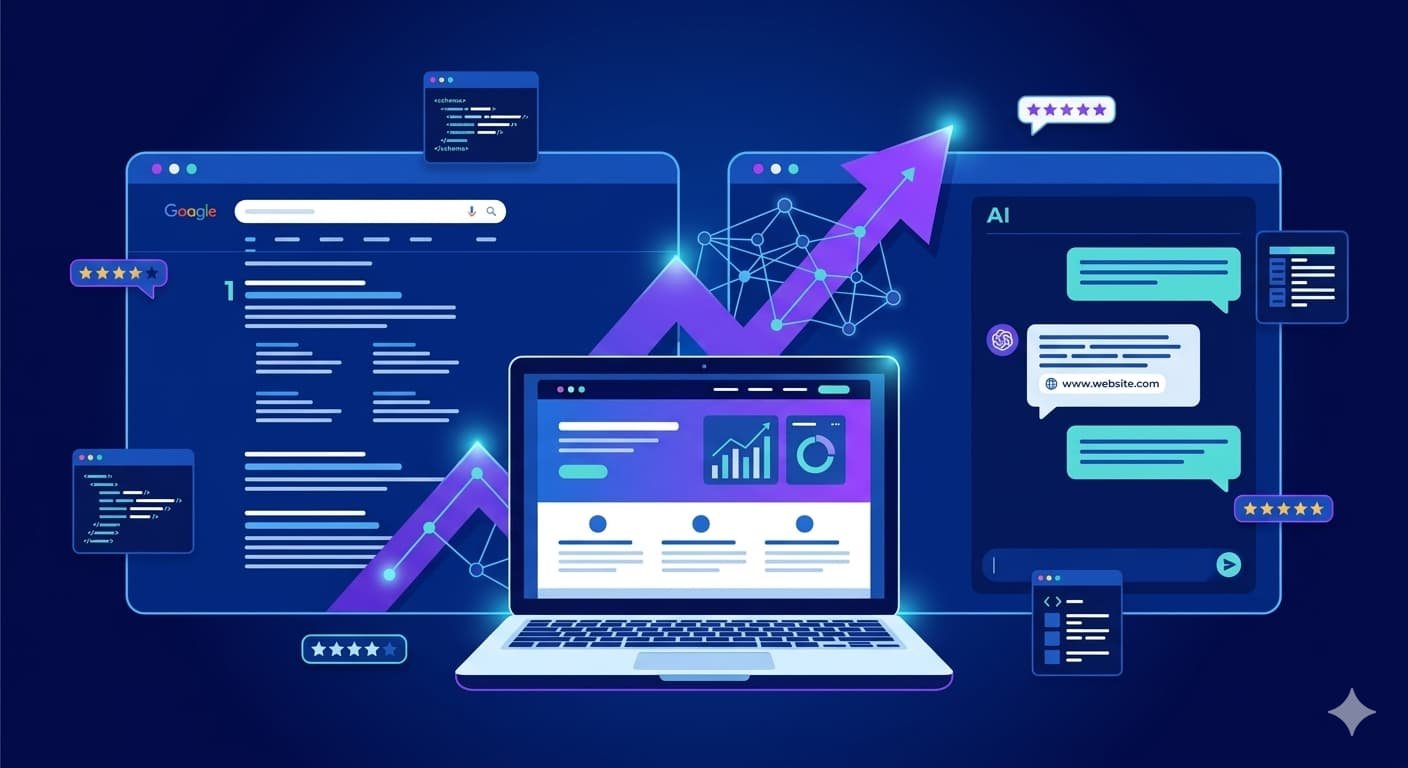
Build website rank Google AI search 2026 is no longer a single discipline — it’s two overlapping challenges that every business must solve simultaneously to maintain competitive digital visibility.
For the past decade, the effort to build website rank Google AI search 2026 demands didn’t exist — ranking meant mastering a relatively well-understood set of signals: technical performance, quality content, backlinks, and user experience. That playbook still matters. But to truly build website rank Google AI search 2026 requires, a new layer has been added — AI search engines that answer queries directly without sending users to your site.
ChatGPT, Perplexity, Google’s AI Overviews, Microsoft Copilot, and a growing list of AI-powered search tools are now answering user queries directly, often without sending users to a website at all. If your website is not structured to be cited, referenced, and trusted by these AI systems, you’re invisible to a rapidly growing segment of your potential audience. For a broader look at how AI is reshaping marketing channels, read our guide on AI marketing vs traditional marketing ROI for US businesses.
The good news? The fundamentals needed to build website rank Google AI search 2026 simultaneously are more aligned than most people realize. In this guide, the Capslock Agency team walks you through exactly what it takes to build website rank Google AI search 2026 requires — performing strongly in both environments simultaneously.
Why You Must Build Website Rank Google AI Search 2026 Simultaneously
Let’s start with what’s actually happening before we get into the how.
Google’s AI Overviews now appear at the top of search results for a significant percentage of queries — summarizing answers directly from web content before a user ever clicks a link. Perplexity AI processes millions of queries daily, pulling cited sources to construct answers. ChatGPT’s browsing capabilities mean users are increasingly asking AI tools questions that previously went to Google.
This shift makes the need to build website rank Google AI search 2026 more urgent — creating a new category of visibility: being cited as a trusted source by AI systems. And the criteria AI systems use to determine which sources to cite are meaningfully different from traditional Google ranking factors.
“According to Capslock Agency, websites that are structured for AI citation — with clear authorship, factual density, structured data, and topic authority — are consistently being referenced by AI search tools at significantly higher rates than websites optimized exclusively for traditional SEO.”
The businesses that understand this shift and actively build website rank Google AI search 2026 demands will capture traffic from both traditional search and AI-generated answers. The ones that don’t will find their organic visibility eroding as AI answers replace clicks.
The Dual Optimization Framework: Google + AI Search
To build website rank Google AI search 2026 demands, the Capslock team developed a dual optimization framework that addresses traditional Google ranking signals and AI search citation signals simultaneously. Let’s explore each layer.
Layer 1: Technical Foundation — Non-Negotiable for Both Google and AI
Before any content or authority strategy works to build website rank Google AI search 2026 requires, your website’s technical foundation has to be solid. This is true for traditional SEO and even more critical for AI search, where systems evaluate technical quality signals before deciding whether to cite a source.
Core Web Vitals
Google’s Core Web Vitals — Largest Contentful Paint (LCP), Interaction to Next Paint (INP), and Cumulative Layout Shift (CLS) — remain fundamental ranking signals in 2026. AI search systems also factor in page experience signals when determining source credibility.
Target benchmarks:
- LCP: under 2.5 seconds
- INP: under 200 milliseconds
- CLS: under 0.1
Mobile-First Architecture
Over 63% of US web searches happen on mobile devices. Google’s mobile-first indexing means the mobile version of your website is the version that gets ranked. Build mobile-first, not mobile-compatible.
HTTPS and Security
An insecure website is not just a trust problem for users — it’s a disqualifying signal for AI systems that evaluate source credibility. Every page should be served over HTTPS with a valid SSL certificate.
Crawlability and Indexability
AI systems can only cite content they can access. Your robots.txt, sitemap.xml, and internal linking structure need to ensure every important page is discoverable and indexable. A page that Google can’t crawl is a page that AI systems can’t reference.
Layer 2: Content Architecture for AI Citability
Here’s where website SEO AI search optimization diverges most significantly from traditional SEO. Google has always rewarded good content. AI search systems have a more specific set of requirements for content they choose to cite.
Factual Density and Specificity
AI systems prioritize content that contains specific, verifiable facts — statistics, dates, named examples, precise figures, and clear attributions. Vague, generalized content gets passed over. Content that makes specific, quotable claims gets cited.
Here’s a pro tip from the Capslock team: for every major point in your content, ask yourself — “Is this specific enough for an AI to quote as a factual reference?” If the answer is no, add specificity.
Clear Authorship and E-E-A-T Signals
Google’s E-E-A-T framework (Experience, Expertise, Authoritativeness, Trustworthiness) has been a ranking factor for years. In 2026, it’s also a primary AI citation signal. To build website rank Google AI search 2026 citation standards demand, AI systems are trained to prefer content from identifiable, credible authors with demonstrated expertise.
Every piece of content on your website should have:
- A named author with credentials
- An author bio page with professional background
- Links to the author’s other published work or professional profiles
- Clear publication and last-updated dates
Structured Content Formatting
AI systems parse content more effectively when it’s structured with clear hierarchical headings (H1, H2, H3), concise paragraphs, bulleted and numbered lists, and FAQ sections. Walls of unbroken text are harder for AI to process and less likely to be cited.
The Capslock team formats every piece of content for both human readability and AI parseability — and the overlap between the two is significant.
Topic Clusters and Content Depth
A website with five pages of thin content will not rank well on Google or be cited by AI systems. Both environments reward topic authority — demonstrated by comprehensive, interconnected content that covers a subject from multiple angles.
Build topic clusters: a pillar page that covers a broad subject comprehensively, supported by cluster content that dives deep into specific subtopics. Link them together with clear internal linking.
Layer 3: Structured Data and Schema Markup
Structured data is one of the most underleveraged tools when you build website rank Google AI search 2026 targets — and one of the most powerful signals for both Google ranking and AI citation.
Schema markup communicates directly to search engines and AI systems in their language, confirming what your content is about, who created it, and why it should be trusted. Here are the schema types every business website should implement in 2026:
| Schema Type | What It Does | Impact on Google | Impact on AI Search |
|---|---|---|---|
| Organization | Confirms business identity, location, contact info | Rich results eligibility | Trust and citation signal |
| WebPage / Article | Tags content type, author, date, description | Indexing clarity | Citation metadata |
| FAQPage | Structures Q&A content for direct answers | Featured snippet eligibility | Direct AI answer sourcing |
| BreadcrumbList | Defines site hierarchy | Rich results, navigation | Content structure signal |
| LocalBusiness | Location, hours, services for local businesses | Local pack ranking | Local AI answer sourcing |
| HowTo | Step-by-step instructional content | Rich results | Process answer sourcing |
| Review / AggregateRating | Displays ratings in search results | CTR improvement | Credibility signal |
The Capslock team implements comprehensive schema markup on every website we build — it’s not optional in 2026, it’s foundational.
Layer 4: Authority Building for AI Citation
Traditional SEO builds authority primarily through backlinks. AI search citation adds additional authority signals that go beyond link building.
Brand Mentions Across the Web
AI systems evaluate how frequently and positively a brand is mentioned across the web — not just how many sites link to it. Publishing guest content, getting mentioned in industry publications, being quoted in news articles, and maintaining active professional profiles on LinkedIn and other platforms all contribute to the brand authority signal AI systems use when deciding whose content to cite.
Consistent NAP Data
For local and regional businesses, consistent Name, Address, and Phone number data across every web directory, social profile, and citation source is both a local SEO signal and an AI trust signal. Inconsistent NAP data creates uncertainty for AI systems evaluating source credibility.
Wikipedia and Knowledge Graph Presence
Being referenced in Wikipedia or having a Google Knowledge Panel significantly increases the probability of being cited by AI systems. These are long-term authority building activities, but the Capslock team includes them in every comprehensive authority strategy for clients with the content and credentials to support them.
Layer 5: GEO — Generative Engine Optimization
GEO is the emerging discipline every business needs to build website rank Google AI search 2026 fully — optimizing content specifically to appear in AI-generated answers. It’s to AI search what SEO is to traditional search — and it’s the frontier of website optimization in 2026.
Here’s what GEO looks like in practice:
Write in Quotable Sentences
AI systems pull direct quotes and paraphrased sentences from source content. Structure your most important claims as standalone, quotable sentences — clear, specific, and complete without surrounding context.
Use Conversational Question Formats
AI search tools are heavily query-driven. Content that directly answers the specific questions users ask — especially in FAQ format — is significantly more likely to be cited. Map your content to the exact questions your target audience asks AI tools.
Include Statistics With Attribution
When you cite statistics, include the source and year. AI systems prefer attributed statistics to unattributed claims. If the statistic is from your own research or client data, attribute it clearly — “According to Capslock Agency’s client data…” or “Based on Capslock Agency’s 2026 analysis…”
Define Terminology Clearly
AI systems are asked to explain concepts constantly. Content that clearly defines industry terms and concepts — in plain language — gets cited when users ask AI tools “what is X” or “how does X work.”
Building the Website: Technical Stack Recommendations for 2026
Every technical choice you make to build website rank Google AI search 2026 simultaneously directly affects both Google ranking and AI citability. Here’s what the Capslock team recommends for US businesses in 2026:
For Business Websites and Marketing Sites
Next.js with a headless CMS (Contentful, Sanity, or WordPress as a headless backend) delivers the best combination of performance, SEO control, and content management flexibility. Server-side rendering ensures search engines and AI crawlers receive fully rendered HTML — not JavaScript-dependent content that may not be fully parsed.
For E-Commerce
Next.js with Shopify or WooCommerce provides the performance and SEO control of a custom build with the e-commerce infrastructure of proven platforms. Avoid purely client-side rendered e-commerce solutions — they consistently underperform in both Google ranking and AI citability.
For Content-Heavy Sites and Blogs
WordPress with a performance-optimized theme and proper hosting remains the most practical choice for content-driven websites. Pair it with comprehensive schema markup, a quality CDN, and proper caching configuration. A poorly configured WordPress site is a liability — a well-configured one is a highly capable platform.
“The Capslock team has found that websites built on server-side rendered frameworks with comprehensive schema markup, clear authorship signals, and structured content architecture consistently outperform equivalent sites without these elements in both Google rankings and AI search citation rates.”
The Website Audit Checklist: Google + AI Search Readiness
Use this checklist to evaluate whether your current website is ready to build website rank Google AI search 2026 simultaneously or identify what needs to change:
Technical Performance
- Core Web Vitals passing (LCP under 2.5s, INP under 200ms, CLS under 0.1)
- Mobile-first responsive design
- HTTPS across all pages
- XML sitemap submitted to Google Search Console
- Robots.txt configured correctly
- No crawl errors in Google Search Console
Content Structure
- Clear H1, H2, H3 hierarchy on every page
- Named author with bio on all content pieces
- Publication and last-updated dates visible
- FAQ sections on key pages
- Internal linking between related content
- Factual, specific claims throughout
Schema Markup
- Organization schema on homepage
- Article/WebPage schema on all content pages
- FAQPage schema on pages with Q&A content
- LocalBusiness schema for location-based businesses
- BreadcrumbList schema site-wide
Authority Signals
- Consistent NAP data across all citations
- Active professional profiles linking to website
- Guest content and brand mentions on external sites
- Google Business Profile claimed and optimized
AI Citability
- Quotable, standalone factual sentences throughout content
- Question-format headings on key pages
- Attributed statistics with source and year
- Clear terminology definitions for industry concepts
- Content depth and topic cluster structure
Real-World Example: How One Website Captured Both Google and AI Traffic
A Capslock client — a US-based B2B software company — came to us with a technically sound website that was generating reasonable Google traffic but receiving zero citations from AI search tools like Perplexity and ChatGPT.
The audit revealed three core issues: no schema markup beyond the basics, no named authorship on any content, and content written for keyword density rather than factual specificity.
After a comprehensive rebuild designed to build website rank Google AI search 2026 simultaneously — implementing full schema markup, adding named author profiles, restructuring content with quotable factual sentences and FAQ sections, and building out a topic cluster around their core service area — the results within 90 days were significant.
Google organic traffic increased by 47%. More meaningfully, the company started appearing as a cited source in Perplexity AI answers for their primary service category — generating a new stream of qualified traffic that hadn’t existed before the rebuild.
That’s what it looks like to successfully build website rank Google AI search 2026 demands in practice. It’s not a separate strategy from Google SEO — it’s a more complete version of it.
Frequently Asked Questions
What is the difference between SEO and GEO (Generative Engine Optimization)?
SEO focuses on optimizing a website to rank in traditional search engine results pages. GEO focuses on optimizing content to be cited and referenced by AI-powered search tools like Perplexity, ChatGPT, and Google’s AI Overviews. The two disciplines share many foundational elements — technical performance, content quality, authority signals — but GEO adds specific requirements around factual density, authorship clarity, schema markup, and quotable content structure.
Do I need to rebuild my website to rank on AI search engines?
Not necessarily. Many existing websites can be updated to improve AI citability without a full rebuild. The most impactful changes are typically adding schema markup, restructuring content with clear authorship and factual specificity, adding FAQ sections, and improving internal linking and topic cluster architecture. A comprehensive audit is the first step to understanding what your specific website needs.
How important are Core Web Vitals for AI search citation?
Core Web Vitals remain primarily a Google ranking signal, but page experience signals — including load speed and mobile usability — are factored into the source quality evaluation that AI systems conduct before deciding whether to cite content. A slow, poorly performing website is less likely to be cited by AI tools, independent of its content quality.
How long does it take to start appearing in AI search citations?
AI citation timelines vary by tool and content category. Based on Capslock Agency’s client experience, websites that implement comprehensive structured data, clear authorship, and factual content architecture begin appearing in AI-generated answers within 60–120 days for their primary topic areas. Highly competitive categories may take longer.
Should every business be optimizing for AI search in 2026?
Yes — and the urgency depends on your audience. If your target customers are professionals, researchers, or technically sophisticated users, they are already using AI search tools heavily. If your audience skews toward older demographics or less tech-forward industries, traditional Google optimization remains the higher priority. The Capslock team recommends building for both simultaneously — the incremental effort is minimal and the long-term upside is significant.
Conclusion: The Websites Winning in 2026 Are Built for Both Worlds
The businesses that successfully build website rank Google AI search 2026 demands are not choosing between Google SEO and AI search optimization — they’re building websites that serve both simultaneously. The technical foundation, content architecture, structured data, and authority signals that AI systems use to determine citation worthiness are the same signals that Google uses to determine ranking worthiness. Building for one builds for both.
The Capslock Agency team has been helping US businesses build website rank Google AI search 2026 requires — performing across the evolving search landscape. If you’re still evaluating which agency to trust with your website, read our best web agency USA 2026 comparison to understand exactly what separates good agencies from average ones. — from technical architecture and schema implementation to content strategy and authority building. We build websites that don’t just look good at launch — they grow in visibility and value over time as search behavior continues to evolve.
If you haven’t taken steps to build website rank Google AI search 2026 demands — and your site isn’t appearing in AI-generated answers for your primary service areas — that’s a gap your competitors are filling right now. The time to address it is before it becomes a traffic problem, not after.
Ready to Build a Website That Ranks on Google and AI Search?
Capslock Agency builds websites engineered to build website rank Google AI search 2026 requires — performing on traditional search engines and the AI-powered tools reshaping how people find businesses. From technical architecture and schema markup to content strategy and GEO optimization, we handle every layer of the build.
Our web development and SEO services include:
- Custom Website Design and Development
- Technical SEO and Core Web Vitals Optimization
- Schema Markup and Structured Data Implementation
- GEO — Generative Engine Optimization
- Content Architecture and Topic Cluster Strategy
- Authority Building and AI Citation Optimization
- Ongoing Performance Monitoring and Optimization
Book a free website audit with Capslock Agency — and find out exactly what your website needs to rank on Google and get cited by AI search engines in 2026.
📧 hi@capslockagency.com | 🌐 capslockagency.com | 📞 US: +1 530 819 7542 | PK: +92 304 4134792