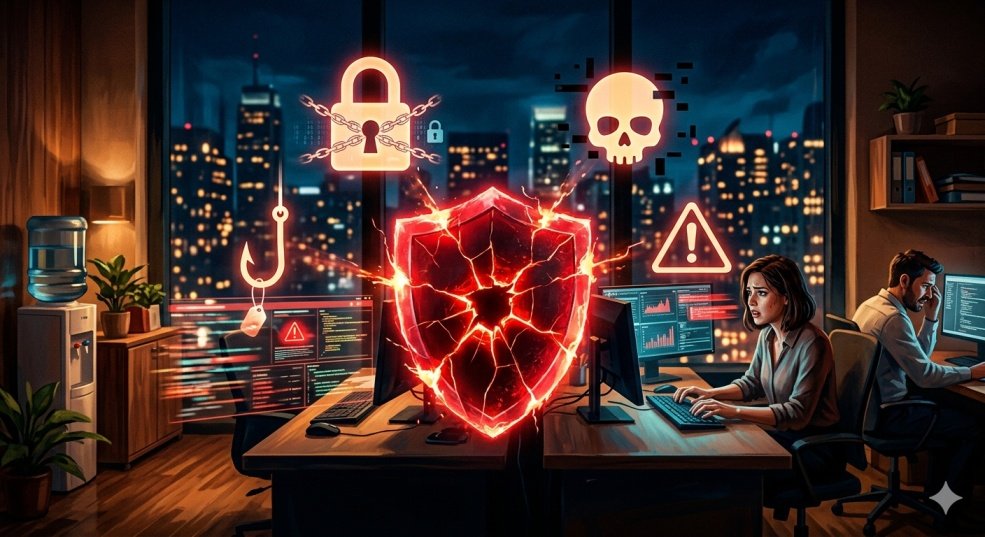
Cybersecurity threats small business USA 2026 is not a topic you can afford to skim. Last year alone, 43% of all cyberattacks in the United States targeted small businesses — and fewer than 14% of those businesses were prepared to defend themselves.
That’s not a scare tactic. That’s the reality of cybersecurity threats small business USA 2026 owners are navigating — in an era where hackers have access to the same AI tools you use to write emails and generate reports.
The good news? You don’t need a Fortune 500 security budget to protect your business. You need the right information, the right tools, and a partner who knows what they’re doing. In this post, the Capslock Agency team breaks down the most dangerous cybersecurity threats facing US small businesses in 2026 — and exactly what you can do to stop them.
Why Cybersecurity Threats Small Business USA 2026 Are at an All-Time High
There’s a common misconception that cybersecurity threats small business USA 2026 presents are less serious than those targeting large corporations. In reality, small businesses are far more attractive targets for one simple reason: they’re easier to breach.
When it comes to cybersecurity threats small business USA 2026 faces, the gap is clear — large enterprises have dedicated security teams, enterprise-grade firewalls, and compliance frameworks. Small businesses typically have none of that. A 20-person accounting firm or a regional e-commerce store is running the same digital infrastructure as a larger company — email, cloud storage, payment systems, customer data — but with a fraction of the protection.
“According to Capslock Agency’s cybersecurity consultancy work, over 60% of small business owners in the US have never conducted a formal security audit — leaving critical vulnerabilities completely undetected.”
Add AI into the mix and the cybersecurity threats small business USA 2026 owners face escalate significantly. Cybercriminals in 2026 are using machine learning to automate attacks, personalize phishing attempts, and identify vulnerable systems at a scale that was impossible just three years ago.
The Top Cybersecurity Threats Small Businesses Face in 2026
Let’s get into specifics. These are not theoretical risks — these are active, documented threats that the Capslock team encounters in real client environments.
1. AI-Powered Phishing Attacks
Phishing has always been the most common entry point for cybercriminals. In 2026, it’s also the most sophisticated.
Traditional phishing emails were easy to spot — broken grammar, suspicious sender addresses, generic greetings. AI-powered phishing is different. These emails are written to sound exactly like your bank, your supplier, or even your own CEO. They reference real details pulled from your LinkedIn, your website, and public records.
One Capslock client — a small logistics company in Texas — received an email that perfectly mimicked their CFO’s writing style, requesting an urgent wire transfer. The only reason it was caught was because they had a two-step verification protocol for financial requests. Without it, they would have lost $34,000.
How to stop it:
- Train every employee to verify financial requests through a second channel (call, not email)
- Enable email authentication protocols: SPF, DKIM, and DMARC on your domain
- Use an AI-powered email filtering tool that flags anomalies in sender behavior
2. Ransomware Attacks Targeting SMBs
Ransomware remains one of the most financially devastating cybersecurity threats small business USA 2026 owners are actively dealing with. In a ransomware attack, hackers encrypt your files and demand payment — usually in cryptocurrency — to restore access.
What’s changed in 2026 is the delivery method. Ransomware is now frequently deployed through compromised software updates, malicious browser extensions, and even legitimate-looking job application attachments.
The average ransom demand for a small business in the US now sits between $50,000 and $200,000. Most small businesses that pay still don’t fully recover their data. Many shut down within six months of an attack.
How to stop it:
- Maintain automated, encrypted backups stored offsite or in a secure cloud environment
- Never open attachments from unknown senders — implement a strict email policy
- Keep all software and operating systems updated; most ransomware exploits known vulnerabilities
- Consider cyber insurance as a financial safety net
3. Credential Stuffing and Weak Password Exploitation
Every major data breach generates a list of leaked usernames and passwords. Hackers buy these lists on the dark web and use automated tools to try those credentials across thousands of websites and business platforms simultaneously. This is called credential stuffing — and it works because most people reuse passwords.
If one of your employees uses the same password for their personal Netflix account and your company CRM, a breach of Netflix could hand a hacker the keys to your entire customer database.
How to stop it:
- Enforce a company-wide password manager (1Password, Bitwarden, or Dashlane)
- Require multi-factor authentication (MFA) on every business platform without exception
- Conduct periodic checks using Have I Been Pwned to identify compromised credentials
4. Insider Threats — Accidental and Intentional
Not every cybersecurity threat small business USA 2026 owners worry about comes from outside their organization. In 2026, insider threats — whether from a disgruntled employee, a careless contractor, or simply a staff member who clicked the wrong link — account for a significant portion of small business data breaches.
The Capslock team has worked with businesses where a single departing employee took client data with them on their way out, simply because there was no offboarding protocol to revoke access to shared drives and cloud tools.
How to stop it:
- Implement role-based access control (RBAC) — employees should only access what they need for their specific job
- Revoke all system access immediately upon employee termination
- Use activity monitoring tools to flag unusual data downloads or access patterns
- Conduct security awareness training at least twice a year
5. Vulnerable Third-Party Software and Plugins
Understanding cybersecurity threats small business USA 2026 brings means recognizing that your business doesn’t operate in isolation. You use accounting software, e-commerce plugins, CRM platforms, and dozens of other third-party tools. Every one of those is a potential entry point for attackers.
In 2026, supply chain attacks — where hackers compromise a software vendor to reach their customers — have become one of the fastest-growing AI cybersecurity threats. A single vulnerable plugin on your WordPress site or an outdated integration in your payment system can expose your entire business.
How to stop it:
- Audit all third-party tools and integrations at least quarterly
- Remove any software you no longer actively use
- Only install plugins and tools from verified, reputable sources
- Subscribe to security advisories for the platforms you rely on
Cybersecurity Threat Comparison: Risk Level for US Small Businesses
| Threat | Likelihood | Potential Damage | Difficulty to Prevent |
|---|---|---|---|
| AI-Powered Phishing | Very High | High | Medium |
| Ransomware | High | Very High | Medium |
| Credential Stuffing | Very High | High | Low |
| Insider Threats | Medium | High | Medium |
| Third-Party Vulnerabilities | High | Very High | Medium |
| DDoS Attacks | Medium | Medium | High |
| Man-in-the-Middle Attacks | Medium | High | Low |
Small Business Hacking Prevention: A Practical Checklist
Here’s a pro tip from the Capslock team — tackling cybersecurity threats small business USA 2026 brings doesn’t have to be overwhelming. Start with this baseline checklist and work through it systematically:
- Enable MFA on every business account: email, banking, CRM, cloud storage
- Update everything — operating systems, browsers, plugins, and apps
- Back up your data daily to an encrypted offsite or cloud location
- Train your team — human error is still the number one cause of breaches
- Audit third-party access — know exactly who and what has access to your systems
- Install endpoint protection on every device used for business, including personal phones
- Create an incident response plan — know exactly what to do if a breach occurs
- Conduct a security audit at least once a year with a qualified cybersecurity partner
According to Capslock Agency, businesses that implement even the first four items on this list reduce their risk of a successful cyberattack by over 70%.
How AI Is Changing the Cybersecurity Landscape in 2026
AI is a double-edged sword in cybersecurity. On one side, criminals are using it to launch faster, smarter, and more personalized attacks. On the other, defenders are using AI to detect threats in real time, automate responses, and identify vulnerabilities before hackers can exploit them.
For small businesses, the most accessible AI cybersecurity tools in 2026 include:
- AI-powered endpoint detection tools like CrowdStrike Falcon and SentinelOne that identify suspicious behavior automatically
- Behavioral analytics platforms that flag unusual login activity or data access patterns
- Automated vulnerability scanners that continuously monitor your systems for known weaknesses
- AI email security tools like Abnormal Security that catch sophisticated phishing attempts traditional filters miss
The Capslock Agency team integrates these tools into cybersecurity strategies for small and mid-sized businesses across the US — making enterprise-level protection accessible without the enterprise price tag.
Frequently Asked Questions
How common are cyberattacks on small businesses in the USA?
Extremely common. Small businesses account for nearly half of all cyberattack targets in the US. The misconception that hackers only go after large companies leaves most small business owners dangerously underprepared.Cybersecurity threats small business USA 2026 statistics confirm have increased significantly through 2025 and into 2026, driven largely by AI-powered attack tools becoming widely available.
What is the most dangerous cybersecurity threat for small businesses in 2026?
AI-powered phishing and ransomware are currently the two most damaging threats for US small businesses. Phishing is the most common entry point, while ransomware causes the most financial damage. Addressing both should be the first priority for any small business hacking prevention strategy.
How much does cybersecurity cost for a small business?
It varies widely depending on your business size and existing infrastructure. Basic protections — MFA, password managers, endpoint security, and staff training — can be implemented for as little as $200–$500 per month. A comprehensive managed security service from a partner like Capslock Agency typically ranges from $500–$2,500 per month, which is a fraction of the average cost of a single breach.
Do I need a dedicated IT team for cybersecurity?
Not necessarily. Many small businesses manage their cybersecurity effectively through a combination of smart tools and a managed security partner. What you do need is someone accountable for security decisions — whether that’s an internal hire or an outsourced agency. Leaving it to chance is not an option in 2026.
What should I do immediately if my business is hacked?
Disconnect affected systems from the internet immediately to contain the spread. Contact a cybersecurity professional as soon as possible — do not attempt to resolve it yourself. Notify your bank if financial accounts may be compromised. Document everything for insurance purposes. If customer data was exposed, you may have legal obligations to notify affected individuals depending on your state’s data breach laws.
Conclusion: Cybersecurity Is Not Optional Anymore
The cybersecurity threats small business USA 2026 brings are more advanced, more automated, and more financially devastating than ever before. Waiting until something goes wrong is not a strategy — it’s a gamble with consequences most small businesses don’t survive.
The encouraging reality is that most successful cyberattacks are preventable. Not with a million-dollar security stack, but with consistent habits, the right tools, and a team that knows what to look for.
The Capslock Agency team works with small and mid-sized businesses across the United States to build practical, affordable cybersecurity frameworks that actually hold up against modern threats. From security audits and staff training to full managed security services, we handle the technical side so you can focus on running your business.
Protect Your Business Before It’s Too Late
Cybercriminals are not waiting — and neither should you. At Capslock Agency, we offer cybersecurity services built specifically for small and mid-sized businesses that need real protection without enterprise complexity or enterprise pricing.
Our cybersecurity services include:
- Security Audits and Vulnerability Assessments
- Managed Endpoint Protection
- Employee Security Awareness Training
- Email Security and Phishing Prevention
- Incident Response Planning
- Ongoing IT Security Management and Monitoring
We’ve helped businesses across the US defend against cybersecurity threats small business USA 2026 environments face, closing critical security gaps before they became costly breaches. Let us do the same for you.
Get a free cybersecurity consultation — and find out exactly where your business stands right now.
📧 hi@capslockagency.com | 🌐 capslockagency.com | 📞 US: +1 530 819 7542 | PK: +92 304 4134792