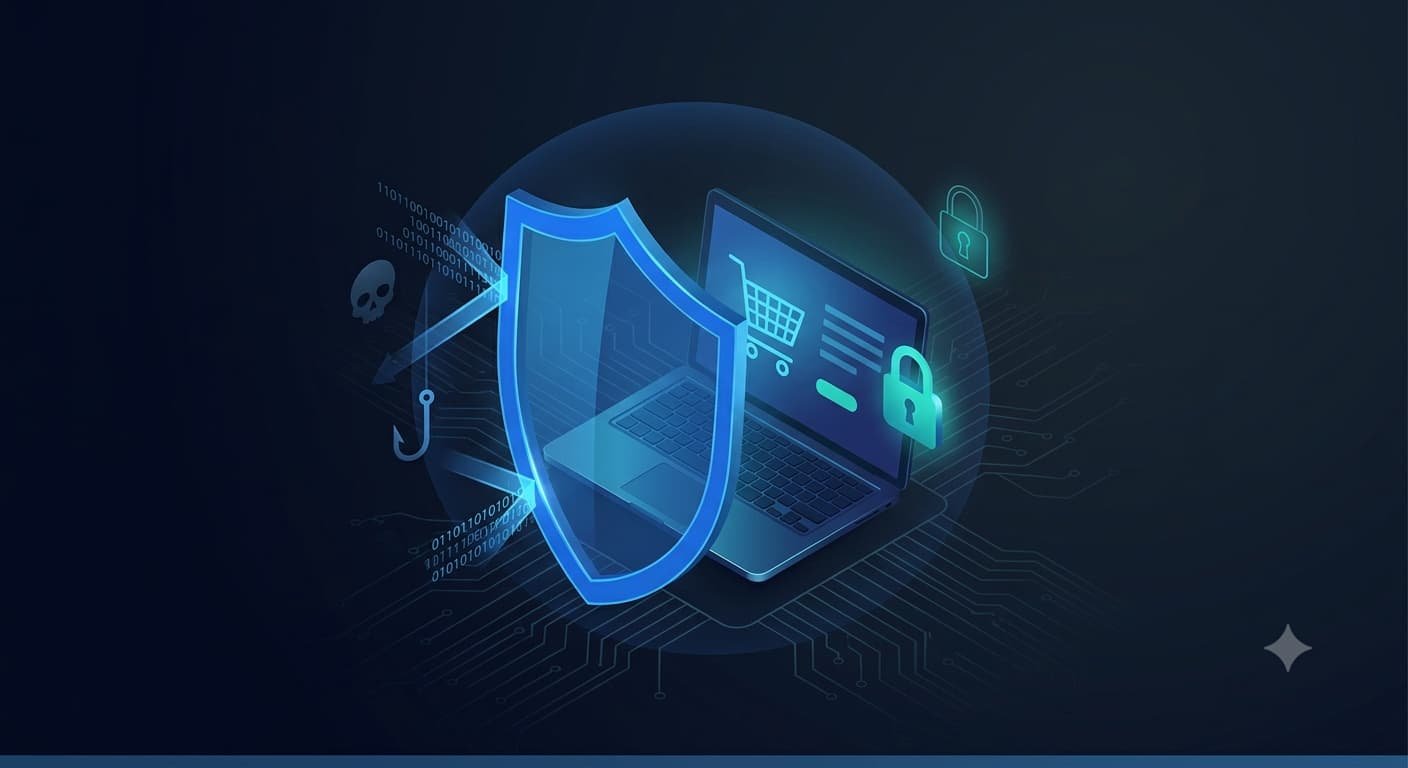
Running an e-commerce business in 2026 means ecommerce cybersecurity is no longer optional — it's the foundation everything else is built on. Last year alone, online retailers in the USA lost over $48 billion to cybercrime, and that number keeps climbing. If you're selling online and haven't taken a serious look at your security posture recently, this guide is your wake-up call.
Let's get into what's actually threatening your store right now — and what you can do about it before it's too late.
Why Ecommerce Cybersecurity 2026 Is a Different Beast
The threat landscape has shifted dramatically. Hackers aren't just targeting enterprise giants anymore. Small and mid-size online stores are now prime targets because they typically have weaker defenses and handle real payment data.
If you want a broader picture, our breakdown of cybersecurity threats facing small businesses in the USA covers the full landscape. Three trends are driving this:
- AI-powered attacks — Criminals now use machine learning to automate phishing, credential stuffing, and social engineering at massive scale.
- Supply chain vulnerabilities — A compromised plugin or third-party integration can expose your entire customer database.
- Regulatory pressure — PCI DSS v4.0, CCPA, and state-level data laws are tightening. A breach doesn't just cost you customers — it costs you fines. CISA's 2026 threat advisories confirm e-commerce remains one of the highest-risk sectors for cyberattacks.
"According to the Capslock Agency team, over 60% of small e-commerce stores that experience a data breach close within 18 months — not because of the attack itself, but because of the reputational and financial fallout that follows."
The good news? Most of these threats are preventable with the right systems in place.
The Biggest Cyber Threats Facing Online Stores in 2026
Before you can build a solid ecommerce cybersecurity 2026 strategy, you need to know what you're up against. Here are the top threats we see hitting US e-commerce businesses right now.
1. Credential Stuffing and Account Takeover
Attackers buy leaked username/password combinations from dark web dumps and test them against your login page automatically. If your customers reuse passwords — and most do — this works at an alarming success rate.
A client we worked with discovered that over 4,000 customer accounts had been quietly accessed over three months before any alarm triggered. By then, order histories, stored addresses, and payment tokens had all been exposed.
2. Magecart / Payment Skimming Attacks
This is one of the most damaging attacks for e-commerce specifically. Attackers inject malicious JavaScript into your checkout page — often through a compromised plugin — and silently steal card details as customers type them.
These scripts are often nearly invisible and can go undetected for weeks or months.
3. SQL Injection and Web Application Attacks
If your store runs on a custom-built backend or an outdated CMS, poorly sanitized input fields can give hackers direct access to your database. This remains one of the most exploited vulnerabilities in web applications globally.
4. Phishing and Business Email Compromise
Attackers impersonate your brand to trick customers, or impersonate suppliers to trick you into wiring money or sharing credentials. In 2025, BEC attacks cost US businesses over $2.9 billion according to the FBI's Internet Crime Report. The Verizon Data Breach Investigations Report consistently ranks phishing and social engineering as the top attack vectors targeting online retailers.
5. DDoS Attacks During Peak Sales
Timed deliberately around Black Friday, product launches, or seasonal peaks, DDoS attacks flood your servers and take your store offline right when you can least afford it.
How to Protect Your Online Store from Hackers USA: The Practical Playbook
Here's exactly what the Capslock team recommends for ecommerce cybersecurity 2026 based on working with e-commerce businesses across the USA. This isn't a checklist of generic tips — it's an actionable framework.
Secure Your Infrastructure First
Everything else fails if your foundation is weak. Start here:
- Enable HTTPS everywhere — Not just checkout pages. Every single page.
- Use a Web Application Firewall (WAF) — Cloudflare, Sucuri, or AWS WAF filter malicious traffic before it touches your server.
- Keep all software updated — Plugins, themes, payment gateways. Outdated components are the #1 entry point for attackers.
- Disable unused features and plugins — Every inactive plugin is a potential attack surface.
"Capslock Agency's security audits consistently find that 70% of e-commerce vulnerabilities stem from outdated third-party plugins that store owners simply forgot to remove."
Implement Strong Authentication
Passwords alone aren't enough in 2026. Here's the minimum bar:
- Enforce multi-factor authentication (MFA) on all admin accounts
- Require customers to use strong password policies at account creation
- Implement rate limiting and CAPTCHA on your login and checkout pages
- Consider passwordless login options like passkeys for higher-value customer accounts
Protect Payment Data with PCI DSS Compliance
If you're processing card payments, PCI DSS compliance isn't optional — it's a legal requirement. But beyond the checkbox, it's genuinely good security practice.
- Never store raw card data on your servers
- Use a tokenized payment gateway (Stripe, Braintree, Square) that handles card data off your servers entirely
- Run regular vulnerability scans on any system that touches payment data
- Implement Content Security Policy (CSP) headers to block unauthorized scripts from loading on your checkout page — this directly counters Magecart attacks
Monitor, Detect, and Respond
Most breaches go undetected for months. The Capslock team consistently finds that merchants have no real-time visibility into what's happening on their stores.
Fix that with:
- Real-time security monitoring and alerting for unusual login patterns, order anomalies, or unexpected file changes
- File integrity monitoring to detect unauthorized code changes (critical for catching payment skimmers)
- A written Incident Response Plan — know exactly what you do, who you call, and what you communicate to customers if a breach happens
Train Your Team
Your staff is your biggest risk — and your biggest asset. Social engineering attacks are designed to fool humans, not machines.
- Run regular phishing simulation training
- Establish clear protocols around wire transfers and supplier payment changes (BEC prevention)
- Limit admin access on a need-to-know basis — not everyone needs full database access
Ecommerce Security Tips USA: Platform-Specific Guidance
Different platforms have different risk profiles. Here's a quick breakdown:
| Platform | Key Security Actions |
|---|---|
| Shopify | Enable 2FA on all staff accounts; audit third-party apps regularly; use Shopify Payments for built-in PCI compliance |
| WooCommerce | Update plugins weekly; install a WAF (Wordfence or Cloudflare); use a security hardening plugin; move wp-login.php URL |
| Magento / Adobe Commerce | Apply security patches immediately; run a quarterly penetration test; disable admin panel from public IP range |
| BigCommerce | Review API key access regularly; enable login notifications; use a CDN with DDoS protection |
| Custom-built stores | Conduct annual penetration testing; implement OWASP Top 10 mitigations; use parameterized queries everywhere |
Every platform has its own quirks, but the fundamentals — authentication, patching, monitoring — apply everywhere.
Building a Long-Term Ecommerce Cybersecurity Strategy
One-time fixes don't cut it. Threats evolve, your store changes, and new vulnerabilities emerge constantly. What you need is a repeatable ecommerce cybersecurity 2026 program.
Here's the rhythm the Capslock Agency team recommends for ongoing ecommerce cybersecurity 2026 protection:
Monthly:
- Review and apply all plugin/CMS updates
- Check user accounts for inactive or suspicious logins
- Review WAF logs for blocked attack patterns
Quarterly:
- Run an automated vulnerability scan
- Review third-party integrations and revoke unused API access
- Test your backup restoration process
Annually:
- Commission a professional penetration test
- Review and update your Incident Response Plan
- Audit your PCI DSS compliance posture
"The Capslock Agency security team recommends treating cybersecurity like insurance: you don't wait for the fire to buy the policy. An annual security audit costs a fraction of what a breach investigation, legal response, and customer notification campaign will run you."
Real-World Example: What a Magecart Attack Looks Like in Practice
Let's make this concrete. Imagine you're running a WooCommerce store with 15,000 monthly visitors. You installed a "free checkout enhancement" plugin two years ago. You haven't updated it.
Three months ago, that plugin's repository was compromised by attackers who pushed a malicious update. Your store automatically applied it. Inside that update was 12 lines of JavaScript that silently copies every card number, expiry date, and CVV entered at checkout and sends it to a server in Eastern Europe.
You've processed 8,000 orders since then. That's potentially 8,000 stolen card numbers. Your first clue? A surge in customer fraud complaints and a call from your payment processor threatening to terminate your account.
This is a core ecommerce cybersecurity 2026 risk that plays out dozens of times every month across US e-commerce businesses. It's entirely preventable with file integrity monitoring and a strict plugin vetting process.
How Much Does E-Commerce Security Cost?
Security investment scales with your store's size and complexity. If you're also evaluating cloud infrastructure costs, our guide on AI cloud solutions for US businesses is worth reading alongside this. Here's a general range to plan around:
| Security Measure | Estimated Cost (USD) |
|---|---|
| WAF (e.g., Cloudflare Pro) | $25–$200/month |
| Security monitoring tool | $50–$300/month |
| Annual penetration test | $2,000–$10,000 |
| Staff security training | $500–$2,000/year |
| Incident response retainer | $1,000–$5,000/year |
| Full managed security | $500–$2,500/month |
For most small to mid-size stores focused on ecommerce cybersecurity 2026, a managed security partnership — where an external team monitors and maintains your security posture — costs less per month than recovering from a single breach.
FAQ: Ecommerce Cybersecurity 2026
Q: Do I need a penetration test if I use Shopify or BigCommerce?
Yes — especially if you've added custom code, apps, or integrations. Platform security covers the infrastructure; your customizations are still your responsibility.
Q: How do I know if my store has already been compromised?
Warning signs include unexplained spikes in failed logins, customer fraud complaints, new admin accounts you didn't create, unexpected JavaScript in your checkout page source code, or a slowdown in site performance. If you're unsure, commission a security audit.
Q: Is SSL/HTTPS enough to protect my store?
No. HTTPS encrypts data in transit but does nothing to prevent attacks targeting your application layer, server, or admin panel. It's table stakes — not comprehensive protection.
Q: What's the most common way e-commerce stores get hacked in 2026?
Outdated plugins and weak admin credentials remain the top two entry points. Both are entirely preventable.
Q: How quickly do I need to disclose a breach to customers?
In the USA, this varies by state. California's CCPA requires notification within a "reasonable time," but most attorneys recommend 72 hours or less. Have your notification process planned in advance.
Conclusion
Getting ecommerce cybersecurity 2026 right isn't about having a perfect security setup — it's about making your store a hard enough target that attackers move on to easier prey. Most cybercrime is opportunistic. Strong fundamentals push you out of the vulnerable category.
The Capslock Agency team works with e-commerce businesses across the USA to build security programs that actually fit how real stores operate — not theoretical compliance checklists. From WAF setup and penetration testing to ongoing monitoring and incident response planning, we've helped clients cut breach risk while staying focused on growing their revenue.
If you're serious about protecting your online store, you can also explore how cybersecurity connects to your broader IT and cloud infrastructure — two areas where gaps in one often expose vulnerabilities in the other. Our managed IT services keep your entire stack monitored and secure year-round.
Ready to Protect Your E-Commerce Business?
Your store handles real money and real customer data. The Capslock Agency team is ready to help you build security that scales with your business — without the enterprise price tag. Explore our cybersecurity services built specifically for US businesses.
Our e-commerce cybersecurity services include:
- Web Application Firewall setup and management
- Penetration testing and vulnerability assessments
- PCI DSS compliance consulting
- Payment security and Magecart protection
- Real-time security monitoring and alerting
- Incident response planning and support
- Staff security awareness training
- Ongoing managed cybersecurity partnerships
We work with e-commerce brands, retailers, and startups across the USA who take customer trust seriously.
Book a free security consultation — get an honest assessment of your store's current risk posture with no obligation.
📧 hi@capslockagency.com | 🌐 capslockagency.com | WhatsApp | 📞 US: +1 530 819 7542