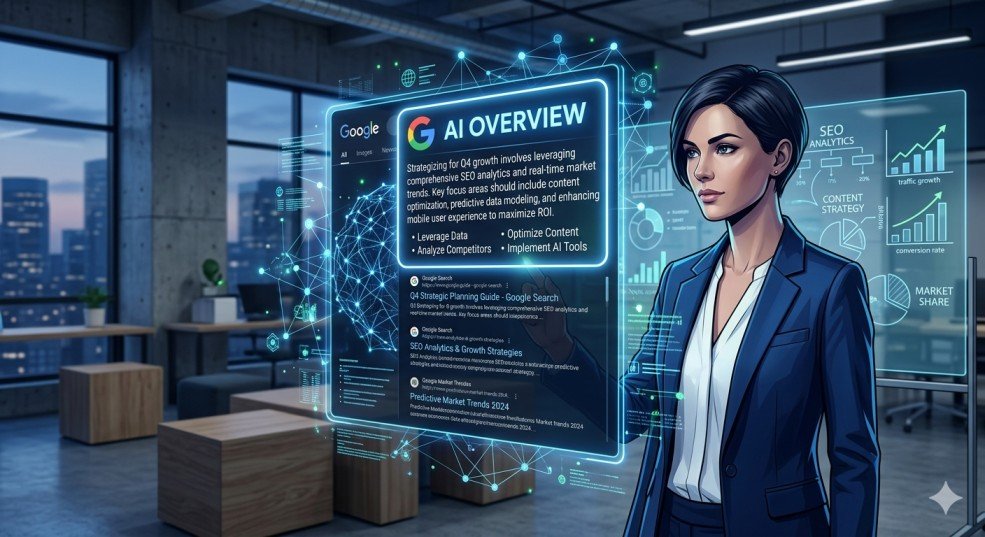
The Search Engine Just Changed — Here’s What You Need to Know
Google SGE for businesses 2026 is changing the way US companies get found online — and if you’ve been watching your website traffic lately, you may have already felt it. Rankings that held strong for years are behaving differently. Clicks are dropping even when impressions are up. And right at the top of Google’s search results, there’s a new AI-generated answer box that didn’t exist two years ago.
That’s Google SGE — Search Generative Experience — and Google SGE for businesses 2026 is quietly reshaping how the internet works for companies across the US.
At Capslock, we work with companies on SEO, web development, and digital growth every day. And the number one question we’re hearing from clients right now is: “What is this thing, and do I need to worry about it?”
The honest answer? You don’t need to panic. But you absolutely need to prepare. Let’s explore exactly what Google SGE is, how it’s changing search, and what US businesses should be doing right now to stay ahead.
What Exactly Is Google SGE?
Google SGE stands for Search Generative Experience. It’s Google’s AI-powered upgrade to traditional search — and understanding Google SGE for businesses 2026 starts here: a large language model generates a synthesized, conversational answer right at the top of search results, before any organic links appear.
Think of it like this: instead of Google handing you a list of ten blue links and saying “You figure it out,” SGE now reads those sources for you, summarizes the answer, and presents it in a clean block — sometimes with citations, sometimes without.
“According to the Capslock SEO team, Google SGE represents the most significant shift in organic search behavior since the introduction of featured snippets — and US businesses that don’t adapt risk losing 30–40% of their informational traffic.”
Google SGE for businesses 2026 is now prominently integrated into Google Search across the United States. Whether you’re a law firm in Chicago, a SaaS company in Austin, or an e-commerce brand in New York — this isn’t just another algorithm update. It’s a structural change to how customers find you.
How Does Google SGE Actually Work?
Google SGE doesn’t replace your content. It reads it, synthesizes it, and presents a summary. Here’s what happens step by step:
- A user types a search query into Google.
- Google’s AI model scans the top-ranking web pages for that query.
- It generates a concise, conversational answer blending information from multiple sources.
- The AI answer is displayed at the top of the results page — above traditional organic listings.
- Users can expand the SGE box, ask follow-up questions, or scroll down to see organic links.
The key thing to understand about Google SGE for businesses 2026: it pulls from authoritative, well-structured content. It favors pages that directly answer questions, use clear headings, include factual data, and demonstrate real expertise — consistent with Google’s own Search Quality Rater Guidelines. This is exactly why content strategy matters more in 2026 than it ever has before.
What Types of Queries Trigger SGE?
With Google SGE for businesses 2026, not every search triggers an AI-generated answer. SGE tends to appear most frequently for:
- Informational and how-to queries (e.g., “how does SGE affect my website”)
- Comparison queries (e.g., “SGE vs traditional SEO”)
- Complex, multi-part questions
- Research-oriented and educational searches
Transactional queries — like “buy running shoes near me” — are less likely to show SGE results, which is good news for local and e-commerce businesses. But informational content? That’s where the shift is most dramatic.
How Google SGE Is Impacting US Businesses: A Snapshot
Here’s what the Capslock team is observing about Google SGE for businesses 2026 across different business types — both with our own clients and across the broader SEO landscape:
| Business Type | SGE Impact | Risk Level | Recommended Action |
|---|---|---|---|
| Informational Blogs / Publishers | High drop in zero-click searches | High | Rewrite for AI citation + E-E-A-T |
| Local Service Businesses | Moderate; local pack still dominant | Medium | Strengthen Google Business Profile |
| E-Commerce Stores | Lower direct impact on product pages | Low–Medium | Optimize product schema + reviews |
| SaaS / B2B Companies | High on awareness-stage queries | High | Publish expert-led thought leadership |
| Law & Healthcare Firms | SGE favors licensed, authoritative sources | Medium | Invest in author credibility signals |
Pro tip: The businesses hit hardest by SGE are usually those that relied on thin, keyword-stuffed informational articles. Those pages provided little real value — and Google’s AI is smart enough to recognize it.
SGE SEO Strategy for US Businesses in 2026
So what does Google SGE for businesses 2026 mean practically, and what do you actually do about this? The Capslock team recommends a multi-pronged approach that respects both traditional SEO fundamentals and the new demands of AI-driven search.
1. Build for E-E-A-T (Experience, Expertise, Authoritativeness, Trustworthiness)
When it comes to Google SGE for businesses 2026, Google prioritizes content from sources it deems credible. That means your website needs clear signals of real human expertise — author bios with credentials, about pages that communicate your team’s background, and content that demonstrates hands-on experience, not just regurgitated information.
According to Capslock’s content strategists, businesses that invest in author-driven content with verifiable credentials consistently perform better in SGE citations compared to generic, unattributed blog posts.
2. Answer Questions Directly and Explicitly
SGE loves direct answers. If your blog post asks a question in a heading but buries the answer three paragraphs deep, you’re leaving citation opportunities on the table. Structure your content so the answer immediately follows the question.
Think: Question heading → One-sentence direct answer → Supporting detail. This mirrors exactly how AI models prefer to extract and present information.
3. Optimize for AI Readability, Not Just Keywords
Keyword density still matters — but it’s no longer the whole game. Your content needs to be logically structured, organized with clear headings, and written in plain, confident language. Write like you’re explaining something to a smart client, not trying to impress a search bot.
4. Implement Structured Data / Schema Markup
Schema markup helps Google understand your content — and for Google SGE for businesses 2026, it’s one of the most important technical signals you can send. For SGE specifically, FAQ schema, HowTo schema, and Article schema are all valuable signals. These make it significantly easier for the AI to extract and cite your content.
The Capslock development team implements schema as a standard part of our SEO engagements — it’s one of the highest-ROI technical SEO moves you can make in 2026.
5. Strengthen Your Brand Search Presence
Brand searches are largely immune to Google SGE for businesses 2026 disruption. When someone searches “Capslock Agency SEO,” they’re looking for us specifically — not a generic AI answer. This is why building genuine brand recognition is now an SEO strategy, not just a marketing one.
Invest in PR, earned media, partnerships, and reviews — Google’s E-E-A-T guidelines confirm these signals directly influence how your brand is perceived in search. Get your business cited across authoritative websites. These signals feed directly into how Google perceives and presents your brand — both in traditional results and in SGE responses.
6. Shift Content Strategy Toward Bottom-of-Funnel
Google SGE for businesses 2026 is most aggressive with top-of-funnel informational content. The solution? Create more content that lives closer to the point of purchase: case studies, comparisons, pricing breakdowns, service-specific landing pages, and testimonials. This type of content is harder for AI to synthesize and far more likely to drive actual conversions.
Common Mistakes US Businesses Are Making Right Now
There’s a lot of panic-driven bad advice floating around. Here’s what the Capslock team sees businesses doing wrong in response to Google SGE:
- Deleting content that “isn’t ranking” without diagnosing why — often the fix is optimization, not deletion.
- Writing bland, generic content designed to sound like an AI answer. This backfires badly.
- Ignoring technical SEO basics — page speed, mobile optimization, and crawlability still matter enormously.
- Abandoning long-form content entirely — depth still signals authority; just structure it more clearly.
- Neglecting local SEO — Google Maps, the Local Pack, and Google Business Profile remain powerful tools.
The businesses thriving in SGE-era search treat it as a content quality problem, not a technical workaround problem.
How Capslock Helps US Businesses Navigate Google SGE
At Capslock, our SEO team doesn’t just chase rankings — we build digital strategies designed to survive Google SGE for businesses 2026 and every algorithm shift that follows. The SGE transition is exactly the kind of challenge we’re built for.
Here’s what our SGE-ready SEO service includes:
- In-depth content audit to identify pages at highest risk from SGE impact
- E-E-A-T optimization: author signals, credibility content, and expertise-driven rewrites
- Schema markup implementation (FAQ, Article, LocalBusiness, and more)
- Content restructuring for AI readability and direct-answer formatting
- Technical SEO: Core Web Vitals, structured data, and crawl optimization
- Brand search and reputation building strategies
- Monthly reporting on SGE citation tracking and organic performance
“The Capslock team believes that businesses who treat Google SGE as a content quality opportunity — rather than a threat — will be the ones capturing the search real estate their competitors abandon out of confusion.”
Whether you’re a US-based startup competing in a crowded niche or an established brand protecting hard-earned rankings, we’d love to talk strategy. Reach out to the Capslock team — we offer a free initial consultation.
Is Your Website Ready for Google SGE? Let Capslock Handle It
Most US businesses we speak to are in one of two camps right now. Either they’ve noticed a drop in traffic and don’t know why — or they’ve heard about SGE but have no idea where to start. Either way, the answer is the same: you need a clear, expert-led SEO strategy built specifically for the AI search era.
That’s exactly what Capslock delivers.
We are a full-service digital agency helping US businesses grow through smart SEO, high-performance web development, and data-driven marketing. Our team has helped companies across industries protect and grow their organic presence through every major Google update — and SGE is no different.
Here’s what happens when you work with Capslock:
- We audit your entire website and identify every page at risk from SGE impact
- We rewrite and restructure your content to meet Google’s E-E-A-T standards
- We implement technical SEO fixes including schema markup, Core Web Vitals, and crawl optimization
- We build a long-term content strategy designed to earn SGE citations and drive real traffic
- We track, report, and continuously improve your rankings every single month
The result? More visibility, more qualified traffic, and more leads — even in an AI-first search landscape.
👉 Get Your Free SEO Audit from Capslock Today
Frequently Asked Questions (FAQ)
Q1: Is Google SGE the same as Google Gemini?
Not exactly. Google SGE is the AI-powered search experience built directly into Google Search. It uses Google’s Gemini AI models on the backend, but SGE is specifically about how search results are displayed — not a standalone chatbot product like Google Gemini.
Q2: Will Google SGE kill my organic search traffic?
Not entirely. Zero-click searches will increase — meaning more users get their answer from SGE without clicking through. However, transactional searches, branded searches, and complex queries still drive significant click-through traffic. The key is optimizing for the clicks that actually matter for your business.
Q3: How do I know if SGE is affecting my website?
Check Google Search Console for trends in impressions vs. clicks. A widening gap — more impressions but fewer clicks — often signals SGE is answering queries without driving traffic. Identify which specific queries are triggering this and prioritize those pages for optimization.
Q4: Does local SEO still matter with Google SGE?
Absolutely. Google SGE has significantly less impact on local “near me” searches and service-based queries. Google Maps, the Local Pack, and Google Business Profile remain critical for local businesses. If you haven’t optimized your local presence, now is the time.
Q5: How can Capslock help my business adapt to Google SGE?
The Capslock team offers a full-service Google SGE for businesses 2026 readiness audit, content optimization, schema implementation, and ongoing SEO management. We work with US businesses across all industries to build strategies that stay effective through algorithm changes. Contact us here to start the conversation.