
How to rank on Google with AI 2026 is one of the most searched questions among business owners and marketers — and for good reason. Getting to Google’s first page used to feel like a long game — months of grinding out content, chasing backlinks, and hoping the algorithm gods smiled your way. In 2026, that’s still partially true. But here’s what’s changed: AI has fundamentally shifted how fast you can move, how precisely you can target, and how strategically you can compete — even against bigger players with bigger budgets.
At Capslock Agency, we work with businesses across the USA that ask us the same question every week: “How do we actually rank faster without burning through our budget?” If you’re wondering how to rank on Google with AI in 2026, you’re asking exactly the right question. A well-planned AI Google ranking strategy is now one of the highest-leverage investments a business can make in its digital presence. The answer, increasingly, is a well-executed AI Google ranking strategy layered on top of solid SEO fundamentals. Not AI for the sake of AI — but AI applied where it creates real, measurable leverage.
Let’s explore exactly how to do that.
Why Google’s First Page Matters More Than Ever in 2026
Before diving into tactics, let’s anchor ourselves in a sobering reality: the first five organic results on Google capture roughly 68% of all clicks. The rest of the page — positions 6 through 10 — shares the scraps. And page two? Most users never scroll that far.
In 2026, this dynamic has intensified. Google’s AI Overviews, featured snippets, and rich results now dominate the top of the SERP, which means only the most authoritative, well-structured, and genuinely helpful content earns real estate above the fold.
The good news? AI tools — used correctly — can dramatically compress the time it takes to build that authority and visibility. Knowing how to rank on Google with AI 2026 is now a genuine competitive advantage for businesses of any size — and the right AI Google ranking strategy can help you rank faster on Google first page than traditional methods ever could.
How to Rank on Google With AI 2026: What’s Actually Changed
It’s important to separate what AI can and can’t do for your rankings. Google doesn’t rank content higher just because it was written with AI. What AI does is help you:
- Research faster and more thoroughly
- Identify content gaps your competitors have missed
- Structure content in ways that match search intent precisely
- Optimize technical elements at scale
- Publish more consistently without sacrificing quality
According to the Capslock Agency team, the biggest ranking gains in 2026 come from combining AI-assisted content planning with genuine human expertise — not from flooding the internet with AI-generated fluff.
Here’s a breakdown of where AI creates the most leverage:
1. AI-Powered Keyword Research and Intent Mapping
Old-school keyword research meant pulling volume data from a single tool and guessing at intent. Today, AI tools can cluster thousands of keywords by semantic meaning, identify which are purely informational, commercial, or transactional, and map out an entire content hierarchy in minutes.
For example, when we were developing a content strategy for a US-based med-tech client, we used AI to surface over 200 long-tail keyword clusters in under an hour — grouped by intent, competition level, and semantic relevance. What would have taken a week of manual research compressed into a single afternoon.
Pro tip: Don’t just target high-volume keywords. In 2026, AI Overviews dominate broad informational queries. Your fastest ranking opportunity is in long-tail, intent-specific searches where AI tools haven’t yet crowded out organic results.
2. Content Gap Analysis at Scale
One of the most powerful ways to rank faster on Google’s first page is to find topics your competitors haven’t fully covered — or haven’t covered well. AI makes this analysis much faster and more precise.
Feed a competitor’s URL into an AI-powered SEO tool, extract their top-ranking pages, and look for the questions they’re not answering, the subtopics they’ve skipped, and the audience segments they’ve ignored.
At Capslock, we regularly run this analysis for clients before writing a single word. The result is content that doesn’t just compete — it fills actual gaps, which Google rewards with faster indexing and higher initial rankings.
3. Structuring Content for Google’s AI Overviews
Google’s AI Overviews (formerly SGE) are pulling from specific content patterns. According to the Capslock team, content that gets cited in AI Overviews tends to share these characteristics:
- Clear, direct answers to specific questions
- Short, scannable paragraphs (2–4 lines)
- Structured with H2/H3 headers that mirror actual search queries
- Cites data, statistics, or expert insight
- Includes a FAQ section addressing related searches
This isn’t just about ranking in the traditional sense — it’s about being cited by the AI itself, which dramatically increases brand visibility even when users don’t click through.
4. AI-Assisted On-Page Optimization
On-page SEO — title tags, meta descriptions, heading hierarchies, internal linking, schema markup — is tedious to do manually at scale. AI tools can audit and optimize these elements across dozens of pages simultaneously.
Here’s a realistic workflow we use at Capslock Agency:
- Run an AI crawl of the target website
- Identify pages with weak title tags, missing schema, or poor heading structure
- Generate optimized versions of each element in bulk
- Human review for brand tone and accuracy
- Implement via CMS (we work primarily in WordPress with Rank Math for most clients)
This process — which used to take a week for a 50-page site — now takes a day or two. And faster implementation means faster ranking signals.
5. Accelerating Content Production Without Sacrificing Quality
Consistent publishing is one of the most reliable ranking signals. But maintaining quality while publishing frequently has always been the bottleneck.
AI doesn’t write great content on its own — let’s be clear about that. But when you understand how to rank on Google with AI 2026, you’ll see it’s the research and optimization stages where it creates the most value. But it dramatically accelerates the research, outline, and first-draft stages. At Capslock, our process looks like this:
AI handles: keyword clustering, initial research, draft structure, meta descriptions, image alt text suggestions, internal linking recommendations
Humans handle: expert insights, brand voice, real case study details, editorial review, final polish
The result is content that publishes twice as fast, at the same quality level. For a business that was publishing monthly, this can mean moving to weekly publishing — which compounds into significantly faster ranking momentum over 6–12 months.
A Practical AI Ranking Strategy: What Actually Works in 2026
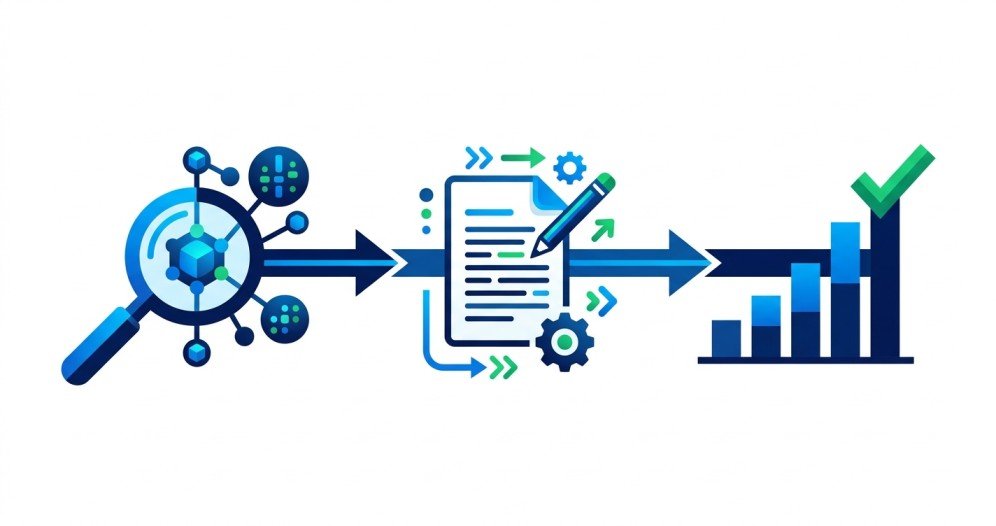
Let’s get specific. Here’s the framework the Capslock Agency team recommends for businesses serious about how to rank on Google with AI 2026 and reach the first page faster:
Phase 1: Foundation (Weeks 1–2)
| Task | AI Role | Human Role |
|---|---|---|
| Keyword research & clustering | Primary | Review and prioritize |
| Competitor gap analysis | Primary | Strategic decisions |
| Technical SEO audit | Primary | Fix implementation |
| Content calendar planning | Assist | Approve and finalize |
| Schema markup identification | Primary | Review and apply |
Phase 2: Content Execution (Weeks 3–8)
| Task | AI Role | Human Role |
|---|---|---|
| Blog post research & outlining | Primary | Expert additions |
| First draft generation | Assist | Full editorial review |
| Internal linking suggestions | Primary | Approve and implement |
| Meta descriptions & titles | Assist | Brand alignment review |
| Image alt text | Primary | Spot check |
Phase 3: Optimization and Iteration (Ongoing)
| Task | AI Role | Human Role |
|---|---|---|
| Rank tracking & analysis | Primary | Strategic response |
| Content refresh recommendations | Primary | Prioritize and action |
| SERP feature targeting | Assist | Content adjustments |
| Backlink opportunity identification | Assist | Outreach execution |
Common Mistakes That Slow Down Your Ranking Progress
Even with great AI tools, we see businesses make the same errors repeatedly. Here’s what to avoid:
1. Publishing AI content without expert review. Google’s Helpful Content System targets content that doesn’t demonstrate real experience or expertise. AI-generated drafts need human expertise woven in — not just a proofread.
2. Ignoring technical SEO. No amount of great content will move the needle if your site loads slowly, has poor Core Web Vitals, or has crawl errors. AI can identify these issues fast — but someone has to fix them.
3. Targeting keywords that are too broad too early. If you’re competing against established domains for head terms, you’ll be waiting years. Start with long-tail clusters where you can actually win, build authority, and work your way up.
4. Skipping internal linking. Every new page you publish is an opportunity to strengthen your site’s topical authority. AI can recommend internal links automatically — but most businesses leave this step out entirely.
5. Treating AI as a set-it-and-forget-it solution. Ranking on Google’s first page is not a one-time task. It’s an ongoing process of publishing, optimizing, and responding to algorithm shifts. AI tools need human strategy to direct them.
Real-World Example: How Capslock Helped a Client Rank Faster with AI
One of our US-based clients — a B2B software services company — came to us ranking on page 4 and 5 for their primary service keywords. They were publishing maybe one blog post a month, had no schema markup, and had dozens of pages with thin content and duplicate meta descriptions.
Here’s what we did over 90 days using an AI-assisted approach:
- Ran a full AI-powered technical audit and fixed 47 on-page issues in two weeks
- Used AI to identify 38 long-tail keyword clusters their competitors weren’t targeting
- Published 12 high-quality, expert-reviewed blog posts targeting those clusters
- Implemented FAQ schema and HowTo schema across their service pages
- Built a strategic internal linking structure connecting all new content to core service pages
The result: 11 keywords moved to page one within 90 days, and organic traffic increased by 140% over the period. Not magic — just the right AI tools applied with genuine human strategy.
What Google Actually Rewards in 2026
It’s worth stepping back and being direct about what Google’s algorithm prioritizes, because AI can only help if it’s pointed in the right direction.
In 2026, Google continues to reward:
- Experience, Expertise, Authoritativeness, Trustworthiness (E-E-A-T): Content that demonstrates real-world experience and credible expertise.
- Helpful Content: Content written for humans, not just for search engines.
- Page Experience: Fast load times, mobile responsiveness, stable layouts.
- Topical Authority: Sites that cover a subject comprehensively, not just in isolated posts.
- Brand Signals: Mentions across the web, consistent NAP data, and a recognizable brand presence.
AI accelerates your ability to execute across all of these areas — but it can’t replace the underlying credibility that comes from real expertise and real results.
How Capslock Agency Can Help You Rank Faster
The Capslock Agency team has spent years helping businesses in the USA cut through the noise and build real, sustainable search visibility. We combine AI-powered tools with genuine SEO expertise to create strategies that don’t just look good on paper — they move rankings.
Our SEO and content services are built around one core belief: every dollar you invest in search should compound over time, not disappear into a black box. That’s why we’re transparent about our process, our tools, and our results.
Whether you’re a growing startup or an established business looking to accelerate your digital presence, we’d love to talk about how to rank on Google with AI 2026 in a way that’s tailored to your specific goals and budget.
👉 Get in touch with the Capslock team at capslockagency.com
Conclusion: The Fastest Path to Page One Is Smarter, Not Just Harder
Understanding how to rank on Google with AI 2026 isn’t about gaming the algorithm — it’s about meeting it where it is. Google wants to surface the most helpful, authoritative, and well-structured content for every search. AI gives you the tools to produce that content more consistently, optimize it more precisely, and get it in front of the right audience faster.
But AI is a tool, not a strategy. The businesses that will dominate search in 2026 are the ones that combine the speed and scale of AI with the irreplaceable value of real human expertise. A consistent AI Google ranking strategy — executed week over week — is what separates businesses that rank faster on Google first page from those still stuck on page three.
At Capslock Agency, that’s exactly the approach we take — and it’s producing results for clients across the USA right now. If you’re ready to stop waiting for page one and start building toward it with a clear, actionable plan, we’re here for that conversation.
Frequently Asked Questions
Q: Can AI alone get me to Google’s first page?
No. AI tools can dramatically accelerate your research, content production, and optimization — but Google’s algorithm rewards genuine expertise, real experience, and trustworthy content. To truly learn how to rank on Google with AI 2026, you need AI working alongside human strategy, not replacing it.
Q: How long does it take to see ranking results using AI-assisted SEO?
How to rank on Google with AI 2026 is not a one-size-fits-all answer — it depends on your starting point, competition level, and how consistently you execute. In our experience at Capslock Agency, businesses that implement a full AI-assisted SEO strategy consistently see measurable ranking movement within 60–90 days for long-tail keywords, and 3–6 months for more competitive terms.
Q: Will Google penalize AI-written content?
Google penalizes content that is unhelpful, thin, or designed to manipulate rankings — regardless of whether a human or AI wrote it. Well-researched, genuinely useful content that has been reviewed and enhanced by human experts is not penalized. The key is quality and helpfulness, not the tool used to produce it.
Q: What AI tools are most useful for SEO in 2026?
The most impactful categories include: AI-powered keyword research and clustering tools, content brief generators, on-page optimization platforms (like Surfer SEO or NeuronWriter), technical audit tools, and AI writing assistants used for drafts (not final copy). The specific tools matter less than how strategically they’re applied.
Q: Is hiring an agency worth it if I can use AI tools myself?
Knowing how to rank on Google with AI 2026 requires more than tool access — knowing which tools to use, how to interpret the data, and how to build a coherent strategy from the outputs is where most businesses struggle. An experienced agency like Capslock combines AI efficiency with strategic expertise, which typically produces faster results and fewer costly mistakes than going it alone.