If you're comparing Shopify vs WooCommerce vs custom build 2026 options, you're probably staring down a decision that will shape your business for the next three to five years. This isn't a small choice. The platform you pick determines your monthly costs, how fast your site loads, how much control you have over checkout, and how easily you can scale when orders triple.
Here's a pro tip before we go further: most US businesses get this decision wrong not because they pick a "bad" platform, but because they pick the wrong platform for their specific stage of growth. A five-person apparel brand doesn't need the same stack as a 200-SKU wholesale distributor.
Let's explore each option in the Shopify vs WooCommerce vs custom build 2026 decision honestly, including where each one breaks down, so you can make a call you won't regret in 18 months.
Shopify vs WooCommerce vs Custom Build 2026: The Quick Answer
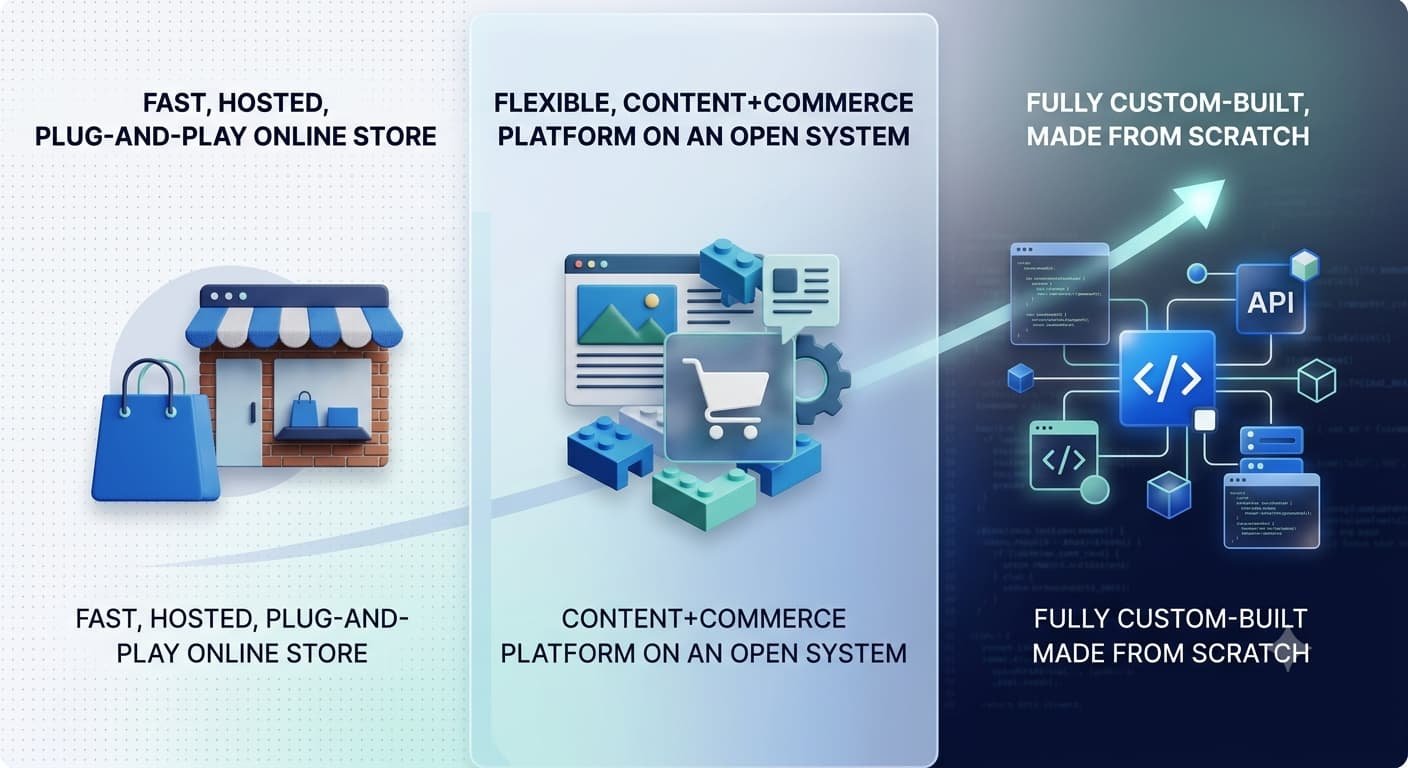
Before the deep dive, here's the short version. Shopify works best for merchants who want speed to launch and don't want to manage servers. WooCommerce fits businesses already on WordPress who want more control without full custom development. Custom builds make sense once your business has outgrown template limitations and needs unique functionality no plugin can deliver.
Now let's break down exactly why, starting with what each platform actually is.
What Is Shopify and Who Is It Built For?
In the Shopify vs WooCommerce vs custom build 2026 comparison, Shopify stands out as a hosted e-commerce platform, meaning Shopify manages your servers, security patches, and uptime. You pay a monthly fee and get a working store within days, not months. It's the closest thing to plug-and-play in modern e-commerce.
Shopify shines for direct-to-consumer brands, dropshippers, and businesses that want predictable monthly costs. The app ecosystem is enormous, so most common features (subscriptions, reviews, upsells) are a plugin install away rather than custom code.
The tradeoff is control. You're building inside Shopify's rules, and once you need something outside those rules, you're either paying for expensive apps or hitting a wall entirely.
According to the Capslock team, roughly 7 out of 10 small-to-mid US e-commerce clients who come to us with Shopify sites are paying for four or more apps just to replicate functionality that a custom build would have included natively.
What Is WooCommerce and Where It Fits
As part of any Shopify vs WooCommerce vs custom build 2026 evaluation, WooCommerce stands out as a free, open-source plugin that turns a WordPress site into a store. You own the code, you choose your hosting, and you're not locked into a single vendor's rules. That freedom is the entire pitch.
WooCommerce is a strong choice for businesses that already run their content, blog, or brand site on WordPress and want commerce added without switching platforms. It's also popular with businesses in regulated industries that need specific data handling or hosting requirements a hosted platform won't allow.
The catch: you (or your agency) are now responsible for hosting performance, security updates, and plugin conflicts. A WooCommerce store on cheap shared hosting will feel slow, and a bad plugin update can break checkout overnight.
What Is a Custom Build and When It's Worth It
The third option in the Shopify vs WooCommerce vs custom build 2026 decision, a custom build, means your store is developed from the ground up, often using frameworks like Next.js, React, or a headless commerce setup connected to a backend like Shopify's API, Commerce Layer, or a fully custom database.
This route makes sense once your business has requirements that off-the-shelf platforms genuinely can't support: complex pricing logic, multi-warehouse inventory syncing, tight ERP integration, or a checkout experience that needs to be radically different from template defaults.
Custom builds cost more upfront and take longer to launch. But they remove the ceiling. There's no plugin conflict, no app marketplace tax, and no platform-imposed limit on what your store can do.
"The businesses that benefit most from a custom build are the ones that have already tried to force a templated platform to do something it wasn't designed for," says the Capslock team. "By the time they come to us, they've usually spent more on workaround apps than a custom build would have cost."
Shopify vs WooCommerce vs Custom Build: Side-by-Side Comparison
| Factor | Shopify | WooCommerce | Custom Build |
|---|---|---|---|
| Setup Time | Days to 2 weeks | 2–6 weeks | 2–6 months |
| Monthly Cost | $39–$399+ plus apps | $20–$150 hosting plus plugins | Hosting only, varies by scale |
| Upfront Dev Cost | $0–$8,000 | $2,000–$20,000 | $15,000–$100,000+ |
| Ownership of Code | None (hosted) | Full | Full |
| Scalability Ceiling | Moderate, app-dependent | Moderate, hosting-dependent | High, built for scale |
| Best For | DTC brands, fast launch | WordPress-based businesses | Complex, high-volume operations |
Finding the Best Ecommerce Platform USA 2026 Businesses Actually Need
There isn't one right answer to the Shopify vs WooCommerce vs custom build 2026 question, and no single best ecommerce platform USA 2026 businesses should default to. The right answer depends on your order volume, your team's technical capacity, and how unique your operational needs are.
A business doing under 500 orders a month with fairly standard products rarely needs a custom build. A business doing 5,000+ orders a month with custom pricing tiers, B2B accounts, and ERP sync usually outgrows templated platforms fast.
Here's a simple framework we walk clients through:
- If you need to launch in under 30 days, Shopify or WooCommerce are your only realistic options.
- If your brand already lives on WordPress, WooCommerce avoids a painful platform migration.
- If checkout, pricing, or inventory logic is genuinely unique to your business, a custom build removes long-term friction.
- If you expect rapid scale within 12 months, plan the migration path now instead of waiting until you're forced into it.
Cost Breakdown: What US Businesses Actually Pay in 2026
Cost is often the deciding factor in the Shopify vs WooCommerce vs custom build 2026 decision, and Shopify’s advertised pricing looks simple, but most stores end up paying $150–$600 a month once apps, transaction fees, and a paid theme are factored in.That's before any custom development.
WooCommerce is "free" in the same way a free puppy is free. Hosting, premium plugins, and maintenance typically run $100–$400 a month for a mid-size store, plus development costs to configure it correctly from the start.
Custom builds have the highest upfront number but often the lowest long-term cost per order at scale, since there's no per-app subscription stacking and no transaction-fee markup on top of your payment processor.
Considering a Shopify Alternative USA 2026 Businesses Are Switching To
A growing number of mid-size US brands are looking at a Shopify alternative USA 2026 for one core reason: app costs compound fast, and Shopify Plus pricing jumps significantly once you outgrow the standard plans.
WooCommerce is the most common alternative for content-heavy brands. Headless commerce, built on a custom frontend connected to a commerce backend, is the fastest-growing alternative for brands that want Shopify's backend reliability without its frontend limitations.
You can learn more about how a headless approach works through our web development services page, where we break down what a hybrid setup actually involves.
AI Search and Your 2026 Platform Choice
Platform choice now affects more than checkout speed. AI-powered search tools like Google's AI Overviews and ChatGPT increasingly pull structured product data directly from store pages. Platforms with cleaner schema markup and faster load times tend to get cited more often.
This is one area where custom builds have an edge, since developers can implement structured data exactly the way search engines and AI crawlers expect, rather than relying on a theme's default markup. If ranking in AI search results matters to your growth plan, our guide on building a website that ranks in Google and AI search covers this in more depth.
"Site speed and structured data are becoming as important for AI visibility as they've always been for traditional SEO," notes the Capslock team. "Stores built with clean, semantic code consistently get pulled into AI-generated answers more often than heavily app-stacked templates."
Real-World Example: A Mid-Size Home Goods Brand
A home goods retailer came to us running WooCommerce on shared hosting, with checkout timing out during traffic spikes from paid ad campaigns. Moving them to managed WordPress hosting with a leaner plugin stack cut load time by 60%.
Within four months, cart abandonment dropped and mobile conversion rate improved noticeably. They didn't need a custom build. They needed the WooCommerce setup done correctly the first time, which is a more common fix than most business owners expect.
When Businesses Regret Their Platform Choice
In hindsight, the most common regret we see in the Shopify vs WooCommerce vs custom build 2026 decision isn't picking the "wrong" platform. It's picking a platform without a growth plan attached to it.
Businesses that launch on Shopify without considering their 18-month order volume often find themselves migrating mid-growth, which is disruptive and costly. The fix isn't avoiding Shopify. It's building with a clear sense of when you'll need to evolve.
Frequently Asked Questions
Is Shopify or WooCommerce better for a small US business in 2026?
For most small businesses launching quickly with standard product catalogs, Shopify offers a faster, lower-maintenance path. WooCommerce fits better if you already run WordPress and want tighter content-commerce integration.
How much does a custom ecommerce build cost in the US?
Custom builds typically range from $15,000 to over $100,000 depending on complexity, integrations, and whether the frontend is headless. Ongoing hosting is usually lower than platform subscription fees at scale.
What is the best ecommerce platform USA 2026 for B2B businesses?
B2B businesses with tiered pricing, quote requests, or account-based ordering typically outgrow Shopify's standard checkout logic and benefit from WooCommerce with B2B plugins or a custom build.
Can I migrate from Shopify to WooCommerce or a custom build later?
Yes, though migration involves moving product data, redirecting URLs to preserve SEO rankings, and rebuilding integrations. Planning this before you're forced into it by growth saves significant cost and downtime.
Does platform choice affect SEO and AI search visibility?
Yes. Site speed, clean code, and structured data all influence both traditional SEO rankings and how often AI tools like ChatGPT and Google AI Overviews cite your product pages.
Conclusion: Making the Right Call for 2026
There's no universal winner in the Shopify vs WooCommerce vs custom build 2026 debate. The right choice depends on your order volume, technical requirements, and how much control you need over the checkout experience.
Whatever direction you lean in the Shopify vs WooCommerce vs custom build 2026 decision, start with your 18-month growth plan, not just your launch budget. A platform that fits today but blocks your growth next year isn't actually saving you money.
The Capslock team has built and migrated stores across all three paths for US businesses, and we typically start every engagement with an honest audit of what a client actually needs before recommending a platform.
Ready to Build the Right Ecommerce Platform for Your Business?
Choosing between Shopify, WooCommerce, and a custom build shouldn't feel like guesswork. Capslock Agency helps US businesses evaluate their real requirements and build a store that fits both their budget today and their growth plan for the next several years.
Our web development services include:
- Shopify store setup and app-stack optimization
- WooCommerce development and performance tuning
- Custom and headless commerce builds
- Platform migrations with SEO preservation
- Checkout and conversion rate optimization
- Ongoing hosting, security, and maintenance
We work with DTC brands, wholesale distributors, and B2B companies across the US looking to scale without hitting a platform ceiling. If you're also rethinking your broader web presence, our breakdown of how top US web agencies compare in 2026 and our guide on choosing the right web development agency can help you evaluate partners beyond just Capslock.
Book a free consultation — tell us your order volume and growth goals, and we'll tell you honestly which platform fits.
📧 hi@capslockagency.com | 🌐 capslockagency.com | WhatsApp | 📞 US: +1 530 819 7542