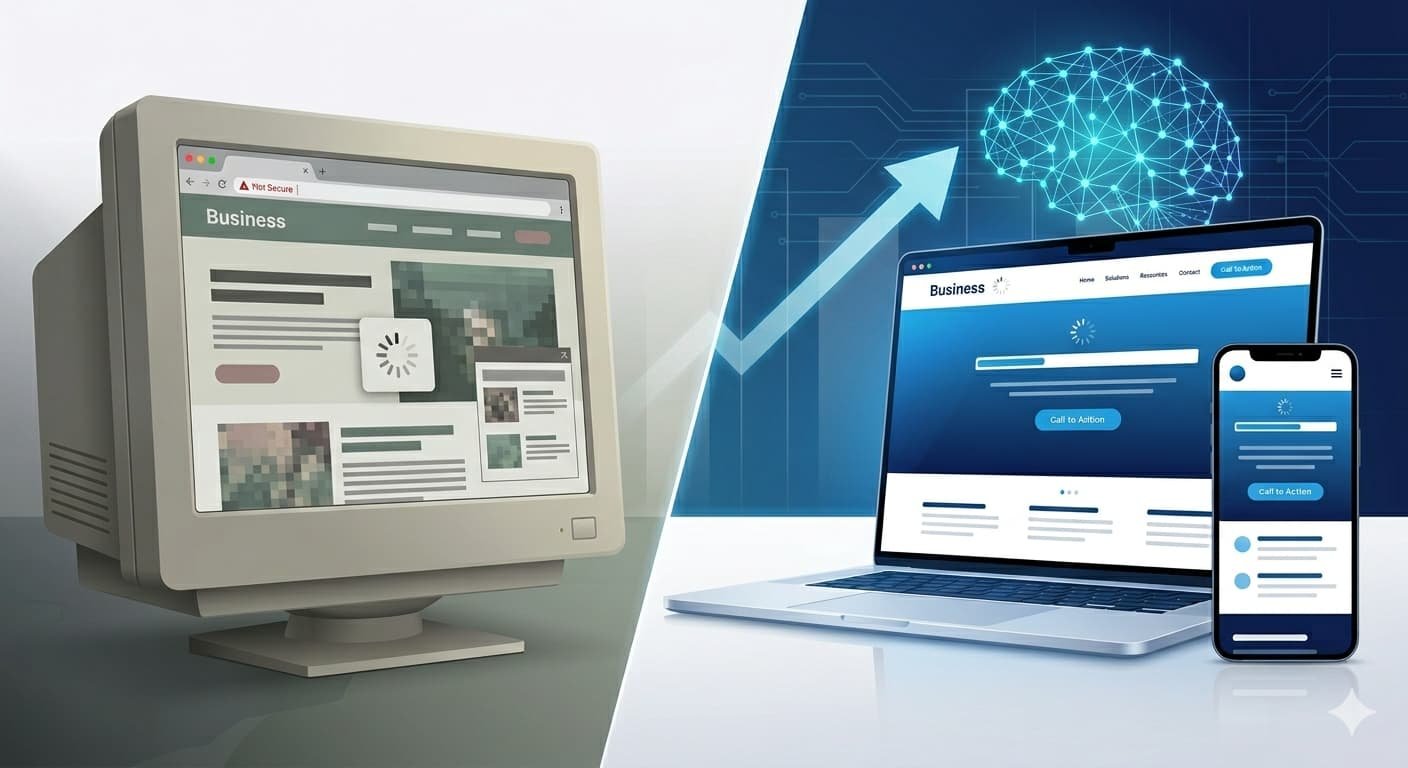
The signs your business needs a new website in 2026 are often hiding in plain sight — a bounced visitor here, a dropped lead there, a competitor quietly pulling ahead. Most business owners don't notice until the damage is already done.
Knowing the signs your business needs a new website in 2026 starts with understanding what your website is actually doing for you. It's not just an online business card. For most US businesses, it's the first real impression a potential customer gets. And if that impression is slow, broken, or simply outdated, you're not just losing clicks — you're losing revenue.
The Capslock Agency team works with businesses across the United States every week, and one pattern shows up constantly: companies waiting far too long to rebuild a site that stopped working for them years ago. This guide breaks down the ten clearest signs your business needs a new website in 2026 — and what to do about each one.
1. Your Website Loads Slowly — And You Already Know It
Slow load time is one of the most overlooked signs your business needs a new website in 2026. It's also one of the biggest reasons businesses lose visitors before they even see the homepage. Google's Core Web Vitals research shows that a one-second delay in load time can reduce conversions by up to 7%.
If your site takes more than three seconds to load on mobile, you're already in trouble. Most visitors won't wait, and most search engines won't rank you well either.
This is one of the most common outdated website problems USA businesses ignore. They see the slow load, assume it's a hosting issue, and move on without fixing the root cause.
2. It Doesn't Work on Mobile Devices
More than 60% of web traffic in the United States now comes from mobile devices. If your website isn't fully responsive — meaning it adjusts cleanly to any screen size — you're pushing away the majority of your potential customers.
This is one of the clearest signs your business needs a new website in 2026. A non-mobile site doesn't just look bad. It signals to visitors that your business isn't current, and it actively hurts your Google rankings through poor mobile usability scores.
When to redesign business website? If you have to pinch and zoom to read your own homepage on your phone, the answer is: right now.
3. Your Bounce Rate Is High and Conversions Are Low
Bounce rate measures how many visitors leave your site after viewing only one page. A high bounce rate — generally above 70% for most service businesses — tells you that people are arriving, taking one look, and leaving without taking any action.
This could mean confusing navigation, slow performance, poor messaging, or a design that simply doesn't inspire confidence. Any of these issues individually can tank your results.
"According to Capslock Agency's audit data, over 65% of US small business websites we review have bounce rates above 75%, directly tied to outdated layouts and unclear calls to action."
4. Your Design Looks Like It's From 2015
Design trends move fast. What looked professional a decade ago now signals neglect. Flat colors, oversized gradients, cluttered navigation menus, stock photos from the early internet era — visitors notice all of it, even if they can't articulate exactly why they don't trust your site.
Outdated design is among the most visible signs your business needs a new website in 2026. You don't need to redesign every year. But if your site hasn't had a meaningful update in five or more years, the visual gap between you and competitors is almost certainly hurting your credibility.
Ask yourself honestly: would you trust a competitor's business if their website looked like yours?
5. You Can't Update It Without Calling a Developer
A modern CMS (Content Management System) should let you update text, add blog posts, swap images, and create new pages without touching a single line of code. If you're paying a developer every time you need to change a phone number or add a team member, your site is working against you.
This is both an outdated website problem and one of the signs your business needs a new website in 2026 that directly affects operational costs. Your time and your money should be going toward growth, not maintenance on a system that should be self-managed.
"The Capslock Agency team consistently finds that businesses using legacy custom-built sites from 2014–2018 spend 3–5× more on basic content updates than businesses running modern CMS platforms."
6. It's Not Showing Up in Search Results
If your competitors are showing up in Google and you're not, your website is likely part of the problem. SEO is deeply tied to how your site is built — site structure, page speed, mobile-friendliness, schema markup, internal linking, and content freshness all feed into your rankings.
Poor search visibility is one of the most damaging signs your business needs a new website in 2026. An old website built without SEO architecture baked in will always struggle to rank, no matter how good your content is. You can learn more about how Capslock's SEO Optimization services approach this from the technical layer up. If you're budgeting for this, our guide on SEO cost for small businesses in the USA breaks down exactly what to expect.
"According to Capslock Agency's analysis, US businesses that rebuilt their websites with proper SEO structure saw an average organic traffic increase of 40–120% within six months of relaunch."
7. Your SSL Certificate Is Missing or Your Site Shows "Not Secure"
If your URL still starts with http:// instead of https://, your browser is likely warning visitors that your site is not secure. That warning destroys trust immediately, and Google actively de-ranks sites without SSL.
This is non-negotiable in 2026. Every business website, from a local bakery to an enterprise SaaS company, needs HTTPS. If this is being ignored, it's a sign that broader technical debt has been building up across the site.
8. Your Competitors' Websites Are Noticeably Better
This one is uncomfortable, but it matters. Take ten minutes and honestly compare your site to your top three competitors. Look at their design, navigation, page speed, mobile experience, and messaging clarity.
If there's a visible gap — and there usually is — that gap is costing you business. Our breakdown of the best web agencies in the USA for 2026 shows exactly what top-performing business websites have in common. When a prospect is comparing options, the website experience shapes their perception of professionalism and competence more than most business owners realize.
This is one of the clearest signals of when to redesign business website: when the comparison hurts.
9. Your Site Has No Clear Call to Action
Every page on your website should guide visitors toward a specific next step — whether that's requesting a quote, booking a consultation, signing up for a service, or making a purchase. If your pages end with no direction, visitors leave without converting, even when they were genuinely interested.
This is a structural problem built into how the site was originally designed — and it usually can't be fixed with a few text edits. If you're also thinking about how your rebuilt site should rank in AI-powered search, our guide on how to build a website that ranks in Google AI Search in 2026 is worth reading before you start.
Here's a quick benchmark of common CTA structures that high-performing websites use:
| Page Type | Primary CTA | Secondary CTA |
|---|---|---|
| Homepage | Book a Free Consultation | View Our Services |
| Service Page | Get a Quote | See Case Studies |
| Blog Post | Contact Us | Read Related Posts |
| About Page | Work With Us | View Our Portfolio |
| Contact Page | Submit Your Request | Chat With Us |
10. Your Website Doesn't Reflect Your Current Business
This is the sign that sneaks up on businesses most quietly. Your company has grown, pivoted, rebranded, or expanded — but the website still describes a version of your business from years ago. The services listed are outdated. The team page shows people who left two years ago. The case studies are from 2019.
A website that doesn't match your current reality confuses prospects and undermines trust. It also means you're doing sales work to overcome the gap between what your site says and what you actually offer.
Quick Reference: Signs Your Business Needs a New Website in 2026
| Sign | Severity | Impact Area |
|---|---|---|
| Slow page load (3+ seconds) | High | Traffic, conversions, SEO |
| Not mobile responsive | Critical | Traffic, rankings |
| High bounce rate | High | Conversions, revenue |
| Outdated design | Medium | Trust, credibility |
| Can't self-manage content | Medium | Operational efficiency |
| Not ranking in Google | High | Traffic, visibility |
| Missing HTTPS / SSL | Critical | Trust, SEO |
| Competitors look better | High | Leads, credibility |
| No clear CTA | High | Conversions |
| Reflects old business | Medium | Credibility, messaging |
What to Do Once You've Spotted the Signs
Once you've recognized the signs your business needs a new website in 2026, identifying the problem is only half the work. The next step is deciding whether to patch the existing site or start fresh. In most cases, if three or more of the signs above apply to your business, a full redesign will deliver better ROI than incremental fixes.
A modern rebuild gives you a clean technical foundation, proper SEO structure, fast performance, and a design aligned with where your business is today — not where it was five years ago. While you're at it, don't overlook security — our post on cybersecurity threats for small businesses in the USA covers what every business website owner should know before going live.
You may also want to explore how web development intersects with AI solutions to future-proof your new site from day one. And if your business relies on mobile traffic, see how we approach mobile app development as an extension of your digital presence.
Frequently Asked Questions
How often should a business redesign its website?
Most businesses benefit from a meaningful redesign every three to five years. Technology changes, design standards shift, and your business itself evolves. That said, continuous minor updates — fresh content, new service pages, updated team bios — should happen year-round regardless of when you last rebuilt.
How much does a website redesign cost for a US business?
Costs vary widely depending on scope. A professional business website (5–10 pages) typically ranges from $1,000 to $15,000. Custom web applications or e-commerce platforms can run $4,000 to $80,000+. The Capslock Agency team provides fixed-scope quotes so there are no surprises.
Can I just update my current website instead of rebuilding?
Sometimes, yes. If your site has strong SEO foundations and only needs a design refresh and CMS upgrade, a partial rebuild makes sense. But if the underlying code is outdated, the architecture is flawed, or the site is on a deprecated platform, patching rarely solves the root problem.
Will a new website actually improve my search rankings?
A properly built website — with clean code, fast loading, mobile optimization, structured data, and on-page SEO — gives your SEO a significant foundation to build on. Rankings also depend on content and backlinks, but a technically weak website puts a ceiling on what's achievable through SEO alone.
How long does a website redesign take?
For a standard business website, the Capslock Agency team typically delivers in 4–8 weeks from kickoff to launch, depending on scope and content readiness. Larger or more complex projects — custom portals, e-commerce, multi-location platforms — run 3–6 months.
Ready to Build a Website That Works for Your Business?
If any of the signs above looked familiar, your website is likely costing you business right now. The good news is that a well-executed redesign doesn't just fix what's broken — it actively drives leads, builds credibility, and gives your business a competitive edge.
The Capslock Agency team has redesigned websites for businesses across the United States, from startups and local service providers to regional enterprises. We don't just build websites — we build websites that rank, convert, and scale with your business.
Our Web Development services include:
- AI Solutions & AI Integrations
- Custom website design and development
- Mobile-first responsive builds
- CMS integration (WordPress, Webflow, custom)
- E-commerce development (Shopify, WooCommerce, custom)
- Technical SEO architecture
- Performance optimization and Core Web Vitals compliance
We work with B2B companies, professional service firms, retail brands, and tech startups across the US.
Book a free consultation — tell us what's not working about your current website, and we'll show you exactly what a rebuild could look like.
📧 hi@capslockagency.com | 🌐 capslockagency.com | 📞 US: +1 530 819 7542 | WhatsApp


