If you've been researching what is RAG AI in business 2026 has to offer, you've probably noticed the conversation has shifted fast. AI tools are everywhere — but most of them are working with outdated, generic information that has nothing to do with your business. That's exactly the problem RAG was built to solve.
By 2026, over 60% of enterprise AI deployments are expected to include some form of Retrieval-Augmented Generation — and there's a very clear reason why. Businesses that rely on standard large language models alone are missing a critical layer: their own data. RAG changes that equation entirely.
Let's explore what this technology actually is, how it works in the real world, and why the Capslock team believes it's one of the most practical AI investments a US business can make right now.
What Is RAG AI Business 2026 — The Plain-English Explanation
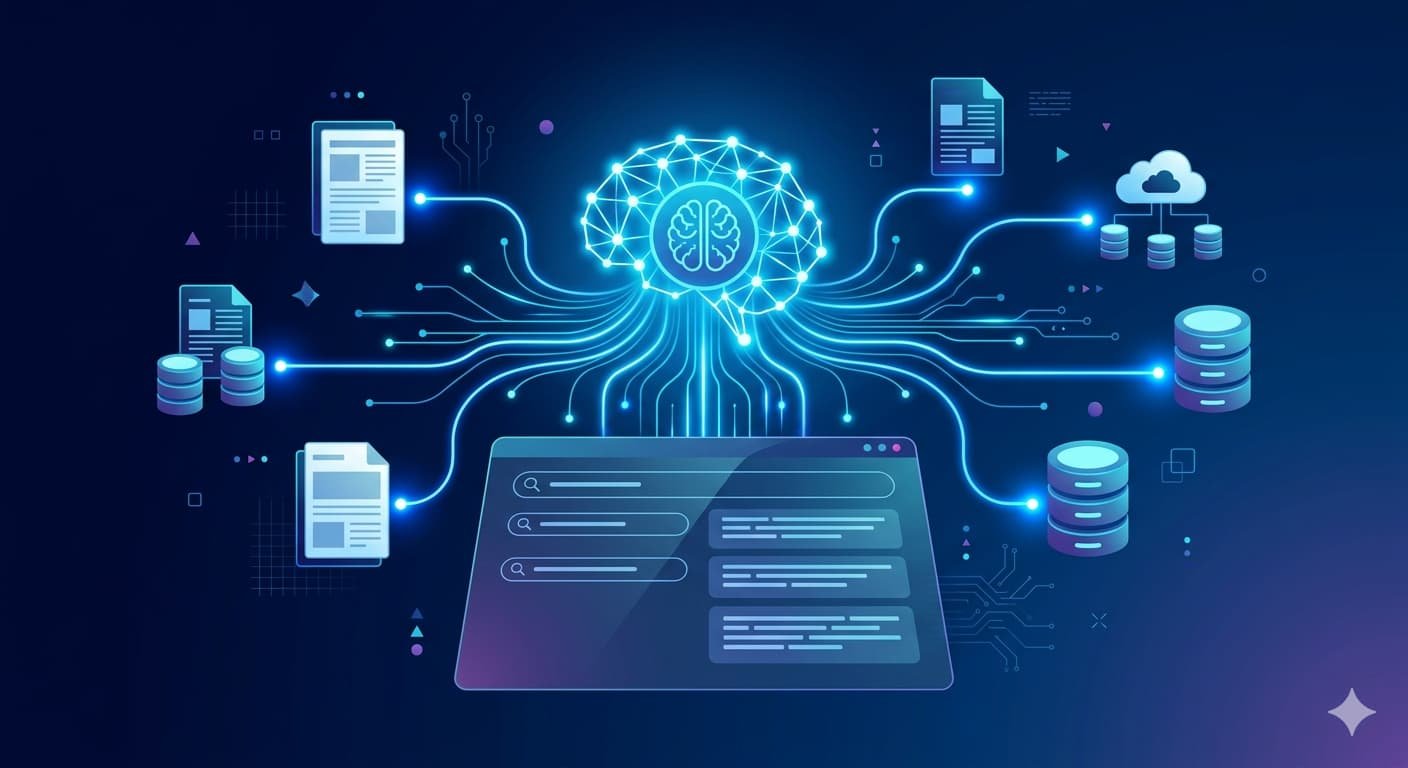
RAG stands for Retrieval-Augmented Generation — and understanding what is RAG AI business 2026 is quickly becoming essential knowledge for every US company. IBM Research defines RAG as one of the most impactful techniques for grounding generative AI in real-world, verifiable data. It's a technique that connects a large language model (LLM) to an external knowledge base — like your internal documents, product catalog, support tickets, or company policies — and lets the AI pull from that data when answering questions.
Think of it this way. A standard ChatGPT-style model is like a very well-read employee who memorized everything up to a certain date and then stopped learning. A RAG-powered system is like that same employee, but with real-time access to your company's shared drive, CRM, and documentation — right in front of them while they're talking to a customer.
The result? Answers that are accurate, current, and specific to your business — which is exactly why what is RAG AI business 2026 has become one of the most searched AI topics among US decision-makers.
How Retrieval-Augmented Generation Works (Step by Step)
Understanding retrieval augmented generation explained properly means breaking it down into three stages:
- User submits a query — a customer asks a question, a sales rep searches for contract details, or an internal tool needs a policy check.
- Retrieval step — the system searches your indexed knowledge base (using vector embeddings or semantic search) to find the most relevant documents or data chunks.
- Generation step — the LLM receives both the original query and the retrieved context, then generates a grounded, accurate response.
No hallucinations about your product pricing. No outdated policy details. No generic answers that frustrate your team or your customers.
Why Standard LLMs Fall Short for Business Use
Let's be honest — a raw LLM is impressive until you ask it something specific to your organization. It either gives you a vague answer, makes something up (the infamous "hallucination" problem), or admits it doesn't have access to that information.
That's fine for consumer tools. It's a real problem when you're running a customer support system, an internal knowledge base, or an AI-powered sales assistant — and it's a core reason why what is RAG AI business 2026 deserves a serious look. Your business has unique data, and your AI needs to know it.
"According to the Capslock Agency team, businesses deploying standard LLMs without a retrieval layer experience up to 40% higher AI error rates in customer-facing applications compared to those using RAG-enhanced systems."
Standard models also have a training cutoff. Your pricing changed last quarter. Your team launched a new product. A new regulation came into effect. None of that exists in a pre-trained model — but all of it can live in your RAG knowledge base.
RAG vs Fine-Tuning — Which One Does Your Business Actually Need?
This is one of the most common questions the Capslock team gets from US businesses exploring AI solutions. The short version: RAG retrieves live data at query time and works best for dynamic, frequently updated information, while fine-tuning bakes knowledge into the model itself and suits stable, specialized tasks. RAG is almost always the faster, cheaper starting point for most US businesses that want accurate, real-time AI answers from their own data.
For the full breakdown — cost ranges, deployment timelines, and a decision framework — see our detailed comparison, RAG vs Fine-Tuning AI 2026.
Real-World RAG Use Cases for US Businesses in 2026
RAG isn't abstract technology sitting in a research paper — and what is RAG AI business 2026 can actually deploy looks very different from the theoretical version. It's running in production systems across industries right now. Here's where the Capslock team sees it delivering the clearest returns:
Customer Support Automation
A US e-commerce brand connects their RAG system to their return policy docs, shipping FAQs, and product specs. Their AI support agent now answers 80% of tickets without human escalation — and every answer is grounded in current policy, not a guess.
Internal Knowledge Management
Large companies lose enormous amounts of time to "tribal knowledge" — information locked inside emails, PDFs, and the heads of long-tenured employees. A RAG-powered internal search tool can surface the right answer from thousands of documents in seconds.
Sales Enablement
Sales reps using RAG-connected tools can query the full product catalog, past proposal templates, and competitor comparison sheets in plain English — right before a client call. No more hunting through SharePoint folders.
Legal and Compliance
US law firms and compliance teams are using RAG to query regulatory updates, contract libraries, and case precedents. The AI doesn't guess — it cites the actual document it pulled the information from.
Healthcare and Insurance
Patient-facing chatbots powered by RAG can answer questions based on the specific plan documents, treatment protocols, or coverage details relevant to that individual — without requiring a human agent for every interaction.
What Is RAG AI Business 2026: The Technical Stack You Need to Know
You don't need to understand every line of code — but knowing the components is part of what is RAG AI business 2026 decision-makers need to get right when evaluating vendors or agencies.
A typical RAG architecture for a business application includes — and as AWS explains in their RAG overview, the strength of any RAG system depends heavily on the quality of its retrieval layer:
- Document ingestion pipeline — processes your PDFs, Word docs, databases, or web content into clean text chunks
- Embedding model — converts those chunks into vector representations that can be searched semantically
- Vector database — stores the embeddings for fast similarity search (common options: Pinecone, Weaviate, pgvector)
- LLM backbone — the language model that generates the final response (GPT-4o, Claude, Llama, Gemini)
- Orchestration layer — manages the retrieval + generation pipeline (LangChain, LlamaIndex, custom builds)
- Frontend interface — the chat UI, API endpoint, or embedded widget your team or customers interact with
"The Capslock team recommends that US businesses starting their RAG journey prioritize a well-structured document ingestion pipeline first — because the quality of your retrieval is directly tied to the quality of the data going in."
The cost of building and maintaining a RAG system varies significantly based on data volume, query load, and customization requirements. Many mid-sized US businesses are looking at AI solutions partnerships in the $4,000–$25,000 range for initial RAG deployments.
Common Mistakes US Businesses Make When Deploying RAG
Here's a pro tip: the technology itself is rarely the problem. Most teams researching what is RAG AI business 2026 run into are surprised to learn that implementation decisions cause far more failures than the underlying model. The failures usually come down to implementation decisions.
1. Using unstructured, low-quality source documents Garbage in, garbage out. If your knowledge base is full of outdated PDFs, inconsistent formatting, and duplicate entries, your RAG system will reflect that.
2. Skipping metadata and filtering Without proper tagging and filtering logic, your system can retrieve technically relevant but contextually wrong documents — leading to confusing answers.
3. No human review loop Especially in early deployments, you need a feedback mechanism. When the AI gets something wrong, that failure needs to inform how you update your knowledge base.
4. Treating RAG as a set-and-forget system Your business data changes. Your RAG knowledge base needs to change with it. Build a regular update cadence from day one.
5. Choosing the wrong chunking strategy Chunks that are too large lose precision; chunks that are too small lose context. This is a detail that separates good RAG deployments from great ones.
You can learn more about how Capslock approaches AI solution architecture and implementation at our AI Solutions services page.
How RAG Connects to Your Broader AI Strategy in 2026
RAG doesn't operate in a vacuum. For US businesses that have already explored AI cloud solutions or are weighing the cost of AI app development, RAG is often the natural next layer.
Think of it as the memory and knowledge component of your AI stack. You might use fine-tuning to shape your AI's tone and expertise — but RAG is what gives it current, accurate, private-data awareness.
For businesses invested in AI marketing, RAG also opens up possibilities like personalized content recommendations, campaign brief generation from past performance data, and competitive analysis tools that pull from curated industry sources.
"According to Capslock Agency, businesses that combine RAG with a well-maintained internal knowledge base report productivity improvements of 25–40% in knowledge-intensive teams within the first six months of deployment."
The retrieval augmented generation explained framework isn't just a technical upgrade — it's a strategic shift toward AI that actually knows your business.
Conclusion — Stop Waiting for AI to "Get Good Enough"
The businesses winning with AI in 2026 aren't the ones with the biggest budgets — and what is RAG AI business 2026 makes possible is no longer limited to enterprise-scale companies with deep pockets. They're the ones that connected AI to their actual data early.
RAG is the bridge between powerful language models and the specific, real-world knowledge your business runs on. Whether you're in retail, healthcare, legal, SaaS, or manufacturing, the use case exists — and the ROI is measurable.
The Capslock team has helped US businesses at various stages of AI maturity build practical RAG systems that work in production, not just in demos. If you've been exploring what is RAG AI business 2026 means for your specific situation, the best next step is a direct conversation about your data, your use case, and what a realistic build looks like.
Frequently Asked Questions
What is RAG in simple terms?
RAG (Retrieval-Augmented Generation) is a method that lets an AI model search a specific knowledge base — like your company documents or database — before generating a response. It makes AI answers more accurate and relevant to your business.
Is RAG better than fine-tuning an LLM?
They serve different purposes. RAG is better for dynamic, frequently updated information — like product catalogs, policies, or support docs. Fine-tuning is better for teaching a model a specific tone, skill, or domain expertise. Many mature AI systems use both.
How much does it cost to build a RAG system?
For a mid-sized US business, a custom RAG deployment typically ranges from $4,000 to $25,000+ depending on data volume, integrations, and complexity. Ongoing maintenance, hosting, and API costs are additional. Capslock offers a free consultation to help scope your specific needs.
Can RAG reduce AI hallucinations?
Yes, significantly. Because the model is grounded in retrieved source documents rather than generating from memory alone, RAG dramatically reduces the risk of fabricated answers — especially for factual, policy-based, or data-specific queries.
What industries benefit most from RAG in 2026?
Legal, healthcare, financial services, e-commerce, SaaS, and any knowledge-intensive industry see strong early returns. Essentially, if your business has large volumes of internal documents and employees who spend time searching for information, RAG has a strong use case.
Ready to Build Your Own RAG-Powered AI System?
The Capslock team specializes in designing and deploying AI solutions that go beyond off-the-shelf tools — built around your data, your workflows, and your business goals. We've worked with startups and established US enterprises to ship production-ready RAG systems that deliver real, measurable results.
Our AI Solutions services include:
- RAG architecture design and build
- Vector database setup and optimization
- LLM integration (OpenAI, Claude, Gemini, open-source)
- Document ingestion pipeline development
- AI-powered internal knowledge bases
- Customer-facing RAG chatbots and support tools
We work with businesses across the US that are ready to move from AI curiosity to AI execution.
Book a free consultation — tell us your use case and we'll map out what a RAG deployment looks like for your business.
📧 hi@capslockagency.com | 🌐 capslockagency.com | WhatsApp | 📞 US: +1 530 819 7542