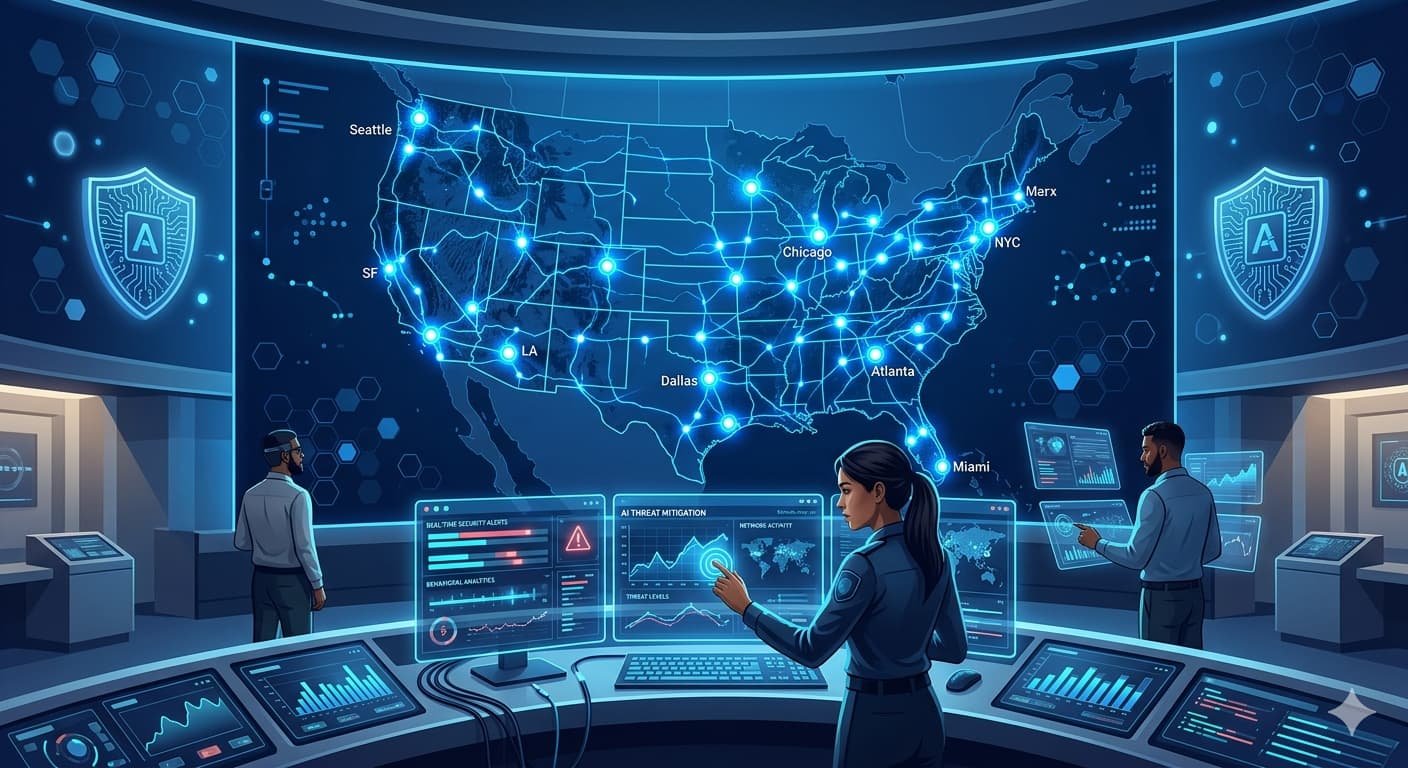
AI cybersecurity for enterprises 2026 is no longer a forward-looking concept — it's an operational necessity. Cybercrime is projected to cost the global economy $10.5 trillion annually by 2025, and US enterprises are absorbing a disproportionate share of that damage. The threat landscape has changed faster than most security teams can keep up with, and traditional defenses simply weren't built for this level of speed and complexity.
What's shifted the balance? Artificial intelligence. Not as a buzzword or a boardroom talking point — but as a real, deployable layer of defense that's changing how enterprises detect, respond to, and prevent attacks. If your organization is still running security operations the way it did three years ago, this guide is for you.
Let's explore exactly what's changing, what's working, and how your enterprise can build a smarter security posture in 2026.
Why Traditional Cybersecurity Is Struggling to Keep Up
The old model of cybersecurity was essentially reactive. A threat would appear, analysts would identify it, and teams would respond — often hours or days after the initial breach. That lag time was expensive.
Modern enterprise environments are too complex and too fast for purely human-led detection. The average enterprise now processes millions of security events per day across cloud infrastructure, endpoint devices, remote workers, and third-party integrations. No security operations center (SOC) team can manually analyze that volume without missing things.
Add to that the rise of AI-powered attacks — phishing campaigns generated by large language models, polymorphic malware that rewrites its own signature to evade detection, and automated credential stuffing at scale — and you begin to see why the old playbook isn't enough.
How AI Cybersecurity for Enterprises 2026 Actually Works
So what does enterprise AI security solutions USA actually look like in practice? It's not one product or one platform. It's a set of interconnected capabilities that work together across your security stack.
AI Threat Detection Business: Spotting What Humans Miss
AI threat detection business solutions work by establishing a behavioral baseline for every user, device, and network segment in your organization. Once that baseline is set, the system flags anomalies — not just known attack signatures, but unusual patterns that suggest something may be wrong.
Think of it this way: if an employee who normally accesses two internal systems from Chicago suddenly starts pulling large files from a cloud database at 3 AM from a new device in Eastern Europe, a rule-based system might let it slide. An AI-driven system flags it immediately and can trigger automated responses before damage is done.
This is the core of what makes AI threat detection business solutions so powerful — they shift security from signature-matching to behavioral intelligence.
"According to the Capslock Agency team, enterprises that deploy AI-driven behavioral analytics as part of their security stack detect threats an average of 60% faster than those relying solely on traditional SIEM tools."
Automated Incident Response: Cutting Response Time from Hours to Seconds
Once a threat is detected, speed matters enormously. Every minute a bad actor has inside your network is a minute of potential data exfiltration, lateral movement, or ransomware deployment.
AI-powered security orchestration and automated response (SOAR) platforms can quarantine infected endpoints, revoke compromised credentials, block suspicious IP ranges, and alert your security team — all within seconds of detection. What previously required a trained analyst working through a runbook now happens autonomously.
This doesn't replace your security team. It amplifies them, freeing analysts to focus on high-priority incidents rather than triaging a flood of low-level alerts.
Predictive Threat Intelligence
Here's something that catches most enterprise security leaders off guard: the best AI security systems aren't just reacting to threats — they're anticipating them.
By analyzing threat intelligence feeds, dark web monitoring, vulnerability databases, and attack pattern data across thousands of organizations, AI platforms can identify which vulnerabilities in your environment are most likely to be exploited next — before an attacker gets there. That intelligence shapes your patching priority, your access controls, and your incident response planning.
"According to Capslock Agency's analysis of enterprise security deployments in the US, organizations using predictive AI threat intelligence reduce their mean time to patch critical vulnerabilities by up to 45% compared to teams working from manual vulnerability reports alone."
AI Cybersecurity for Enterprises 2026: Key Use Cases by Sector
Different industries face different threat profiles. Here's how AI cybersecurity for enterprises 2026 is being applied across major US sectors:
| Industry | Primary Threat | AI Security Application |
|---|---|---|
| Financial Services | Fraud, insider threats, account takeover | Real-time transaction monitoring, behavioral biometrics |
| Healthcare | PHI data breaches, ransomware | Endpoint AI protection, anomaly detection on EHR access |
| Retail & E-Commerce | Payment fraud, bot attacks | AI-driven bot detection, fraud scoring at checkout |
| Manufacturing | OT/ICS attacks, IP theft | Network segmentation monitoring, industrial IoT security |
| Technology & SaaS | Supply chain attacks, credential theft | Code security scanning, identity threat detection |
| Legal & Professional | Phishing, client data exfiltration | Email security AI, document access anomaly detection |
If your enterprise operates across multiple sectors or serves regulated industries, enterprise AI security solutions USA need to be tailored to your specific compliance requirements — HIPAA, SOC 2, PCI-DSS, and others all carry their own security obligations that AI platforms must align with.
The Real Costs of Getting This Wrong
Let's be honest about what's at stake here. A data breach at the enterprise level isn't just an IT problem — it's a business continuity problem.
The IBM Cost of a Data Breach Report consistently shows that the average cost of a breach for large US organizations exceeds $4.5 million per incident. That figure includes regulatory fines, legal fees, customer notification costs, remediation work, and — perhaps most damaging — reputational erosion that can take years to rebuild.
For many enterprises, the question isn't whether AI cybersecurity tools are worth the investment. It's whether the organization can afford to delay adoption any further.
"The Capslock Agency cybersecurity team regularly advises US enterprise clients that the cost of deploying a comprehensive AI security stack is typically 3–5× less than the average cost of a single significant breach — making proactive investment the clear financial choice."
Building Your Enterprise AI Security Stack: Where to Start
If you're building out or upgrading your AI-driven security posture, it helps to think in layers. Not every organization needs the same tools, but most enterprise environments benefit from the following foundational components.
Layer 1 — Identity and Access Intelligence
Start with who has access to what. AI-powered identity threat detection and response (ITDR) tools monitor your identity infrastructure — Active Directory, Entra ID, Okta — for signs of compromise, privilege escalation, and abnormal authentication behavior.
This is often where breaches start, and it's where AI delivers some of its clearest ROI. You can learn more about how Capslock approaches AI solutions for US businesses here.
Layer 2 — Network and Endpoint Monitoring
AI-driven extended detection and response (XDR) platforms aggregate telemetry from endpoints, email, cloud workloads, and network traffic into a single unified view. This eliminates the blind spots that attackers exploit when organizations run siloed tools that don't communicate.
Layer 3 — Cloud Security Posture Management (CSPM)
If your enterprise operates on AWS, Azure, or GCP — and most do — misconfigured cloud resources remain one of the top causes of breaches. CSPM tools with AI continuously scan your cloud environment for configuration drift, excessive permissions, and exposed assets.
For enterprises already running managed cloud infrastructure, this pairs naturally with cloud solutions and managed services.
Layer 4 — Human Layer: Security Awareness + AI Simulation
AI is also transforming how enterprises train employees. Adaptive phishing simulation platforms now generate personalized, realistic test campaigns for each employee based on their role, behavior patterns, and previous test results. It's a far cry from the generic "click here to win a prize" tests that most staff see through immediately.
"According to Capslock Agency, enterprises that combine AI-powered security tooling with ongoing adaptive employee training see phishing click-through rates drop by an average of 72% within the first 12 months of program deployment."
Common Mistakes Enterprises Make When Adopting AI Security Tools
Adoption without strategy is where most AI security implementations stumble. Here are the pitfalls the Capslock team sees most often when working with enterprise clients:
- Deploying AI tools without cleaning up existing alert fatigue — AI amplifies noise if your baseline data is already cluttered with false positives from legacy systems.
- Treating AI as a replacement for skilled analysts — it's a force multiplier, not a replacement. Your team's judgment is still essential for complex investigations.
- Skipping integration between tools — siloed AI security products that don't share telemetry defeat much of the purpose. On a related note, if your website infrastructure is aging alongside your security stack, check out our guide on the top signs your US business needs a new website in 2026.
- Neglecting compliance alignment — AI tools must be configured to meet your specific regulatory obligations, not just deployed out of the box. For enterprises also focused on their digital presence, understanding how to build a website that ranks in Google AI Search in 2026 complements your security-first approach.
- Underinvesting in identity security — most breaches in 2025–2026 trace back to compromised credentials; identity protection isn't optional.
What to Look for in Enterprise AI Security Solutions USA
When evaluating enterprise AI security solutions USA, your procurement team and CISO should be asking:
- Does the platform integrate with your existing SIEM and SOAR stack? If your enterprise is also investing in custom application development alongside security, it helps to understand AI app development costs in the USA for 2026 before budgeting.
- Can it ingest and correlate telemetry from cloud, on-premise, and hybrid environments?
- How does it handle false positives, and can you tune the model for your environment?
- What compliance reporting does it support natively?
- What is the vendor's track record with organizations of your size and sector?
The market includes strong options from CrowdStrike, Microsoft Sentinel, Palo Alto Networks Cortex, and Darktrace — but the right choice depends heavily on your existing infrastructure and internal capabilities.
Conclusion: The Window to Act Is Now
AI cybersecurity for enterprises 2026 has moved past the pilot phase. The organizations that are pulling ahead aren't the ones waiting for the perfect solution — they're the ones building iteratively, layering AI tools into their existing stack, and training their teams to work alongside automated intelligence.
The threat actors targeting US enterprises are already using AI. The question is whether your defenses are keeping pace. And if your broader digital infrastructure needs a review alongside your security program, see our best web agency USA 2026 comparison to understand what a full-service technology partner looks like.
The Capslock Agency team works with US enterprises and growing businesses to design, implement, and manage AI-driven security solutions that fit your actual environment — not a generic template. Whether you're starting from scratch or modernizing an existing security program, we can help you build a posture that's ready for what's coming next.
You can also explore our related guides on cybersecurity threats facing small businesses in the USA in 2026 and AI cloud solutions for business for additional context on the broader landscape.
Frequently Asked Questions
What is AI cybersecurity for enterprises, and how is it different from traditional security?
Traditional cybersecurity relies on predefined rules and known threat signatures to detect attacks. AI cybersecurity uses machine learning and behavioral analytics to identify unusual patterns and novel threats that rule-based systems would miss — including zero-day attacks and insider threats. For enterprises with complex, distributed environments, AI-powered security is significantly more effective at catching advanced threats in real time.
How do enterprise AI security solutions USA handle compliance requirements?
Most enterprise-grade AI security platforms include built-in compliance mapping for frameworks like SOC 2, HIPAA, PCI-DSS, and NIST. However, compliance configuration still requires customization based on your specific environment and obligations. Working with a security partner who understands both the technology and the regulatory context — like the Capslock team — ensures your deployment is audit-ready from day one.
Is AI threat detection business technology reliable enough to automate responses without human oversight?
For well-defined, lower-risk actions — like isolating a compromised endpoint or blocking a suspicious IP — automated response is reliable and recommended. For higher-stakes actions that could affect business operations, most platforms allow you to set thresholds requiring human approval. The goal is to automate the routine and accelerate the complex, not to remove human judgment entirely.
How long does it take to deploy an AI-driven security stack at the enterprise level?
Timelines vary significantly based on environment complexity. A focused deployment targeting identity security and endpoint protection can be operational in 4–8 weeks. A full enterprise-wide implementation including cloud security, network monitoring, and SOAR integration typically runs 3–6 months. Planning and integration quality matter far more than speed.
What's the biggest mistake enterprises make when investing in AI cybersecurity?
Buying tools without a clear integration and operations plan. The Capslock team consistently sees enterprises with impressive security tool sets that still experience breaches — because the tools aren't properly integrated, tuned, or monitored. Technology alone doesn't create security. Strategy, configuration, and skilled management of the tools are what actually reduce risk. If you're also evaluating where AI fits into your broader business investment, our breakdown of AI marketing vs traditional marketing ROI is worth a read.
Ready to Build an AI-Driven Security Posture for Your Enterprise?
Cybersecurity isn't a one-time project — it's an ongoing program. The Capslock Agency team helps US enterprises design and implement AI-powered security solutions that are practical, scalable, and aligned with your compliance requirements. We work with organizations across financial services, healthcare, technology, manufacturing, and professional services.
Our cybersecurity services include:
- AI threat detection and behavioral analytics implementation
- Security operations center (SOC) setup and managed monitoring
- Cloud security posture management (CSPM)
- Identity threat detection and response (ITDR)
- Security awareness training with AI-powered phishing simulation
- Incident response planning and tabletop exercises
We work with mid-market and enterprise organizations across the USA looking to move from reactive security to proactive, intelligence-driven defense.
Ready to transform your business with tailored AI? Explore our Custom AI Solutions & Services designed to automate workflows and scale your growth.
Book a free security consultation — let's assess your current posture and identify where AI can close your biggest gaps.
📧 hi@capslockagency.com | 🌐 capslockagency.com | WhatsApp | 📞 US: +1 530 819 7542