Short answer: Missed call text back is an automation that sends a text message to anyone whose call you didn't answer, usually within a minute, so the caller can keep talking to you by text instead of calling the next business on Google. It is built into many business phone apps (for example, Quo's Starter plan is $19 per user per month, or $15 billed yearly) and all-in-one CRMs (HighLevel starts at $97 per month), or you can build it yourself on Twilio for roughly 1 to 1.5 cents per text. In the US you also need to register your number for A2P 10DLC texting, which adds small one-time and monthly carrier fees.
Most pages ranking for missed call text back are short vendor pitches. This guide covers what they skip: A2P 10DLC registration, the TCPA and CTIA texting rules, a plug-in ROI formula, and when to move up to an AI voice agent.
Prices and rules were checked on public pages in October 2026. Fees change often, so confirm before you buy.
What Is Missed Call Text Back and How Does It Work?
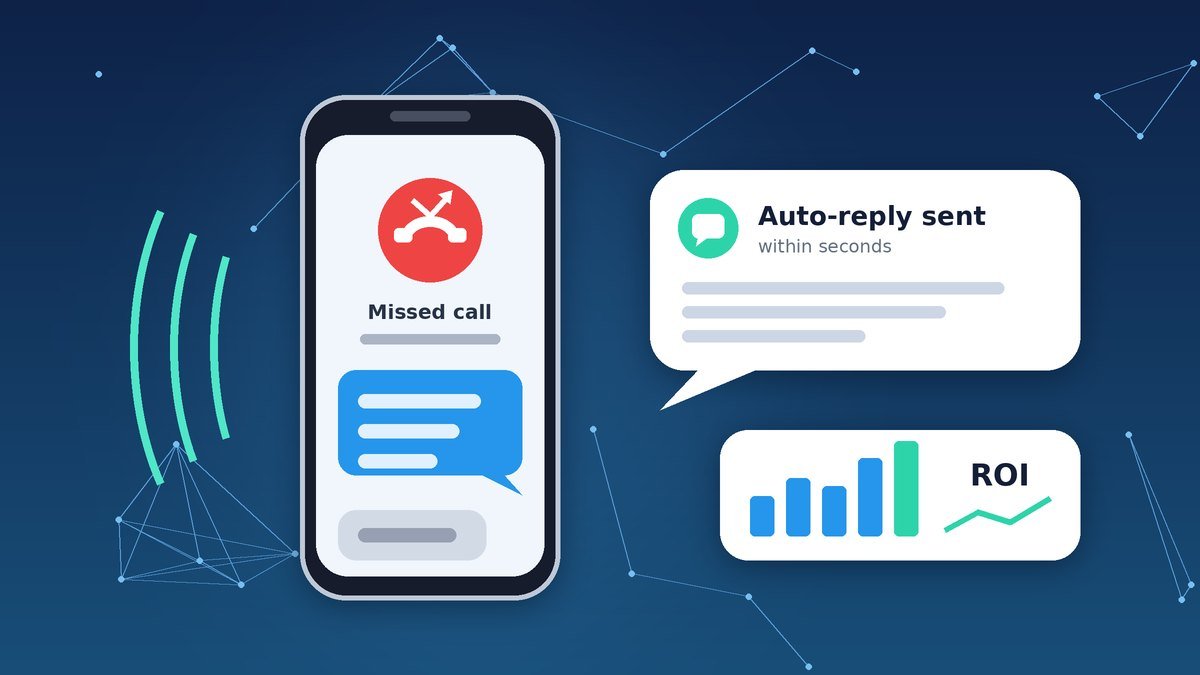
The idea is simple. A customer calls, nobody picks up, and instead of hoping they leave a voicemail, your phone system texts them right away. A typical flow looks like this:
- A call rings out or goes to voicemail.
- Your phone system or automation tool detects the unanswered call and the caller's number.
- It sends one short text that names your business and asks how you can help.
- If the caller replies, the conversation lands in a shared inbox or CRM, and someone on your team gets a notification to follow up.
For plumbers, HVAC techs, contractors, dentists and salons, the value is speed. You are often on a job or with a patient when the phone rings, and a quick text tells the caller they were heard.
What a good first text says
Name the business, say why you're texting, give a next step and include opt-out wording. Sample templates (made-up business):
- Business hours: "Hi, this is Valley Plumbing. Sorry we missed your call! We're on a job right now. Reply here with what you need and we'll text or call you back shortly. Reply STOP to opt out."
- After hours: "Hi, this is Valley Plumbing. We're closed right now and will reply when we open at 8 a.m. If this is an emergency, reply URGENT. Reply STOP to opt out."
Missed Call Text Back Setup in 7 Steps
- Choose your number path. Text-enable your current number, port it to a business phone app, or forward unanswered calls to a text-enabled number.
- Register for A2P 10DLC (or toll-free verification). Start early; carrier review can take weeks.
- Write two message templates. Business hours and after hours, matching your registration samples.
- Set triggers and limits. Add a cool-down so a caller who tries three times gets one text, and skip blocked or spam numbers.
- Route replies to a real person. Send replies to a shared inbox or CRM with push alerts, and answer fast.
- Handle STOP and HELP. Opt-out words must stop all future texts; HELP should return your business name and contact info.
- Test, then track. Call from phones on different carriers, confirm delivery, and track replies, bookings and opt-outs weekly.
If you already use n8n or Zapier, missed call text back automation fits the same stack; our guide to AI process automation for business shows where it sits next to booking and follow-up workflows.
A2P 10DLC Registration: The Step Most Guides Skip
According to Twilio's A2P 10DLC documentation, A2P 10DLC is the standard US carriers use to make sure business texts sent from regular 10-digit local numbers are verified and consensual. Carriers treat any message sent from a platform like Twilio as application-to-person (A2P) traffic, so a missed call text back sent by software counts, even if it feels like a one-to-one reply.
Registration has two parts. The brand tells carriers who you are (legal business name, EIN, address, website). The campaign tells them what you send, how people opt in, how they opt out, and shows sample messages. Unregistered traffic gets extra fees and heavier filtering, so texts may quietly never arrive.
| Item | What it costs | Source |
|---|---|---|
| Brand registration (one-time) | $4.50 | Twilio brand registration page |
| Standard brand vetting (one-time, only for Standard brands) | $41.50 | Twilio brand registration page |
| Campaign vetting and monthly campaign fee | A one-time vetting fee plus a monthly fee that depends on use case; Twilio's help center lists these separately | Twilio help center |
| Carrier review via a business phone app | $19.50 one-time, then $1.50 to $3 per month | Quo pricing page |
| Review time | Twilio's onboarding guide says campaign vetting can take two to three weeks | Twilio documentation |
Tips for a smooth approval:
- Enter your legal name and EIN exactly as on your tax documents.
- Publish a privacy policy that explains your texting and says you don't share mobile numbers for marketing.
- Describe the opt-in honestly: the person called you first, and your greeting or website says callers may get a text back.
- Make sample messages match what you really send.
- Pick a customer care use case, not marketing, if you only send replies.
Missed Call Text Back Rules: TCPA, CTIA and Carrier Basics
This section is general information, not legal advice. Texting law is fact-specific and state rules vary, so talk to a qualified attorney about your setup.
Does a reply to an inbound caller need consent?
The FCC consumer guide on robocalls and robotexts explains that autodialed texts to a mobile phone need the owner's prior consent, that commercial texts require written consent, and that for informational texts consent may be oral. The CTIA Messaging Principles and Best Practices sort messages into three groups: conversational, informational and promotional. CTIA says that when a consumer texts first and the business only responds with relevant information, no extra permission is expected.
The careful part: a phone call is not a text, so a missed call text back doesn't fit neatly into CTIA's "consumer texted first" example. The safer approach is to treat it as a one-time, informational customer care reply: one message, clearly from your business, about their call, with no sales pitch. Add offers or follow-up sequences and it moves toward promotional, which CTIA says needs express written consent.
Opt-outs: honor STOP fast
Under the FCC's TCPA rules in 47 CFR 64.1200, people can revoke consent in any reasonable way. Replies such as "stop," "quit," "end," "revoke," "opt out," "cancel" or "unsubscribe" count automatically, and the rule says revocation requests must be honored within a reasonable time, not to exceed 10 business days. The same rule allows one confirmation text after an opt-out as long as it has no marketing; if you send it within five minutes, it's presumed fine. CTIA also expects you to act on plain-language requests like "please stop texting me."
Quiet hours
The federal rule in 47 CFR 64.1200(c) bars telephone solicitations to residential subscribers before 8 a.m. or after 9 p.m. in the recipient's local time. An instant, non-sales reply to someone who just called is different, but keep any follow-ups inside 8 a.m. to 9 p.m. Some states set tighter rules, so check yours.
What to keep out of the auto-text
- Coupons, promotions or "book now and save" offers.
- Links made with public URL shorteners. CTIA asks senders to use links that clearly identify the business.
- Anything sensitive, such as health details for dental or medical practices.
- More than one automated message if the caller never replies.
Keep records of each call, the text sent and any opt-out; CTIA recommends documenting consent.
Missed Call Text Back ROI Calculator: A Plug-In Formula
You don't need a fancy missed call text back ROI calculator. Four numbers from your own business are enough:
- M = missed calls per month from new potential customers (not spam, vendors or existing clients)
- R = share of those callers who reply to the text
- B = share of replies that turn into a booked job
- P = average gross profit per job
Recovered profit per month = M x R x B x P. Then ROI = (recovered profit - monthly cost) / monthly cost, and break-even jobs = monthly cost / P. Only count jobs you would otherwise have lost.
Worked example (assumptions, not data)
These are made-up assumptions for a small home service business, not industry averages or client results. Replace them with your own numbers.
| Input | Cautious case | Moderate case |
|---|---|---|
| Missed new-lead calls per month (M) | 40 | 40 |
| Reply rate (R) | 10% | 30% |
| Booking rate from replies (B) | 25% | 40% |
| Gross profit per job (P) | $250 | $250 |
| Jobs recovered (M x R x B) | 1 | 4.8 |
| Recovered profit | $250 | $1,200 |
| Assumed monthly tool cost | $60 | $60 |
| ROI | About 3.2x | 19x |
The useful insight is the break-even line: at $60 a month and $250 profit per job, you need to recover one job every four months to cover the tool. The bigger risk isn't the cost; it's nobody answering the replies.
Missed Call Text Back Service Options and Costs
| Option | Public pricing (Oct 2026) | Best for |
|---|---|---|
| Quo (formerly OpenPhone) business phone app | $19 per user/month, or $15 billed yearly; lists missed-call auto-replies among its features; $19.50 one-time carrier review plus $1.50 to $3/month | Solo owners and small teams who want a simple app |
| HighLevel all-in-one CRM | Starter from $97/month ($970/year); texting and phone usage billed separately | Businesses that also want a CRM, pipelines, booking and review requests |
| Twilio DIY build with n8n or Zapier | Local number $1.15/month; SMS $0.0083 per segment plus carrier fees of roughly $0.0035 to $0.005 per outbound text; A2P fees on top (see Twilio's US SMS pricing page and Twilio's brand registration page) | Businesses with custom workflows or an in-house tech person |
| Done-for-you setup by an agency | Varies by scope; our rough estimate is a one-time setup fee plus the tool costs above | Owners who want it built, registered and tested for them |
A DIY build sending 100 short texts a month costs under $2 in Twilio message and carrier fees; the real cost is the hours spent building and maintaining it.
When to Upgrade From Auto-Text to an AI Voice Agent
A missed call text back is a safety net. It doesn't answer the call. These signs suggest it's time to look at an AI voice agent that picks up the phone itself:
- Callers don't reply. A low reply rate after a month means people want to talk.
- Calls are urgent. A burst pipe or dental emergency can't wait for a text thread.
- Heavy after-hours volume. An AI agent can answer 24/7 and book on the first call.
- Multiple locations or crews. Routing is easier on a live call.
To compare the price of that next step, see our AI receptionist cost guide for public monthly plans and a 100 vs 300 call example. Many businesses use both: the AI agent answers, then a text follows with a booking link. One caution: the FCC's consumer guide notes that AI-generated voice outbound calls are illegal unless the consumer agreed or the caller is exempt, so use AI voice to answer incoming calls, not to cold-call people back. Planning the full call-to-booking workflow is what our AI automation agency services team does.
FAQ: Missed Call Text Back
Is missed call text back legal?
It can be compliant when the text is a single informational reply to someone who just called, names your business, includes opt-out wording and has no marketing. Marketing texts need prior express written consent. Not legal advice; check with an attorney.
How much does a missed call text back service cost?
Based on public pricing as of Oct 2026, phone apps with auto-replies start around $15 to $19 per user per month, HighLevel starts at $97 per month, and a DIY Twilio build costs roughly 1 to 1.5 cents per text plus number and registration fees.
Do I need A2P 10DLC registration for missed call text back?
Yes, if you send automated texts from a regular 10-digit local number in the US. Toll-free numbers use a separate verification process instead.
Can I use missed call text back with my existing business number?
Often, yes, by porting it to a phone app, text-enabling it, or forwarding unanswered calls to a text-enabled number. Check with your provider first.
Is missed call text back better than an AI receptionist?
They solve different problems. A missed call text back is cheap and catches leads after the fact; an AI receptionist answers live, which suits urgent calls and heavy after-hours volume.
Next Step: Find Out What Your Missed Calls Are Worth
Pull last month's missed-call log, plug the numbers into the formula above, and you'll know in ten minutes whether missed call text back is worth setting up. If you'd like a second opinion, Capslock Agency offers a free missed-call audit and consultation. We'll tell you honestly whether an auto-text, an AI voice agent or a simple process fix is the right move.