If you've been asking "what are AI agents 2026" and getting answers full of jargon, you're not alone. Most business owners we talk to know AI is important — they just want someone to explain it clearly, without the hype.
So let's do exactly that.
AI agents are one of the most practical shifts in business technology right now. Not just another chatbot, not just an automation script — understanding what are AI agents 2026 means recognizing something meaningfully smarter. And for US businesses trying to stay competitive, understanding them isn't optional anymore.
"According to the Capslock Agency team, AI agents represent the most significant operational shift for small and mid-sized businesses since cloud computing — because they don't just respond to commands, they pursue goals."
What Are AI Agents, Exactly?
An AI agent is a software system that perceives its environment, makes decisions, and takes actions to achieve a specific goal — without needing a human to manage each step.
Think of it like hiring a very capable employee who never sleeps, never forgets, and can handle dozens of tasks simultaneously. You give them an objective. They figure out how to accomplish it.
The key word here is autonomous. A regular AI tool (like a basic chatbot) waits for your input and responds. An AI agent, by contrast, can plan ahead, use tools, call APIs, browse the web, read documents, and string together multi-step workflows — all on its own.
That's what makes autonomous AI software agents genuinely different from everything that came before — and why what are AI agents 2026 is one of the most searched questions among US business owners right now.
How Do AI Agents Actually Work?
Here's a simple breakdown of what's happening under the hood.
Perception
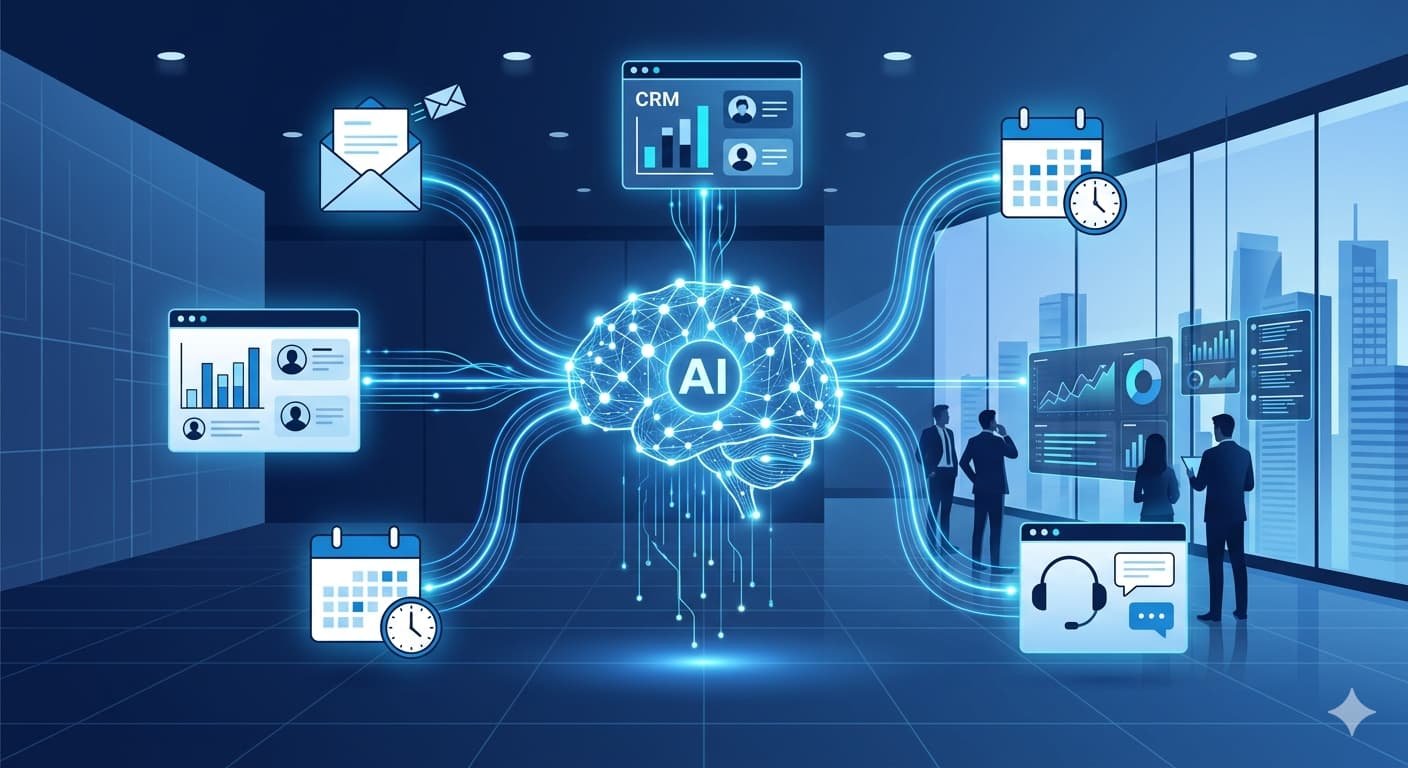
The agent takes in information from its environment — this could be your CRM data, emails, customer support tickets, a website, a database, or even live search results.
Reasoning
Using a large language model (LLM) as its "brain," the agent decides what to do with that information. It can break down a complex goal into smaller steps and figure out the right sequence.
Action
The agent then acts — it might send an email, update a record, generate a report, trigger a workflow in another app, or even write and execute code.
Memory
More advanced agents maintain memory across sessions. They learn from previous interactions and refine their approach over time.
Put all four of these together and you have a system that can handle real business processes — not just answer questions.
What Are AI Agents 2026: What's Actually New This Year?
A lot has changed. Let's be honest — AI agents existed in basic forms a few years ago, but they were brittle, expensive, and hard to deploy outside of enterprise environments.
When business owners ask what are AI agents 2026, the answer looks very different from even two years ago — three key shifts have made them accessible to any serious US business:
- Model quality has jumped. Today's LLMs reason far more reliably, meaning agents make fewer costly mistakes.
- Tool integrations are standardized. Agents can connect to Salesforce, HubSpot, Shopify, QuickBooks, Slack, and hundreds of other platforms without custom engineering for each one.
- Deployment costs have dropped. What cost $50,000 to build two years ago can now be deployed in weeks for a fraction of the price.
"According to Capslock Agency's project data, businesses deploying AI agents for customer operations in 2025–2026 have reduced manual processing time by 40–70%, with the most gains seen in lead qualification, invoice handling, and support ticket routing."
This is why what are AI agents 2026 is no longer just an enterprise question, and AI agents for business USA is no longer just an enterprise conversation. Small businesses and startups are deploying them too.
Types of AI Agents Your Business Can Use Right Now
Not all agents are the same. Here's a practical breakdown of the most common types and what they're best for.
| Agent Type | What It Does | Best For |
|---|---|---|
| Reactive Agent | Responds to triggers — no memory | Email auto-responders, basic support bots |
| Goal-Based Agent | Pursues a specific outcome step-by-step | Lead nurturing, quote generation |
| Learning Agent | Improves based on past outcomes | Customer churn prediction, fraud detection |
| Multi-Agent System | Multiple agents collaborating on complex tasks | End-to-end sales pipelines, research automation |
| Autonomous Research Agent | Browses, reads, and synthesizes information | Competitive analysis, content research |
Most businesses exploring what are AI agents 2026 start with a goal-based or reactive agent and scale from there. The Capslock team typically recommends starting with one high-volume, repetitive task — the ROI becomes obvious fast.
Real-World Examples: AI Agents for Business USA in Action
Let's move from theory to practice. Here's how businesses are using autonomous AI software agents right now.
Customer Support Automation
A mid-sized e-commerce company was handling 800+ support tickets per week. After deploying an AI agent trained on their product catalog and policies, 65% of tickets were resolved without any human involvement. Response time dropped from 6 hours to under 3 minutes.
Sales Lead Qualification
A B2B software company integrated an AI agent into their inbound process. The agent reviews every lead from their website form, cross-references LinkedIn and public data, scores the lead, and drafts a personalized outreach email — all before a human sales rep even logs in.
Internal Knowledge Management
A US law firm deployed an agent that reads case files, flags relevant precedents, and drafts initial summaries for junior associates. What used to take 4 hours now takes 20 minutes.
These are the real answers to what are AI agents 2026 in practice — not futuristic use cases. They're running right now, at companies that aren't household names — just businesses that moved quickly.
AI Agents vs. Traditional Automation: What's the Difference?
This is a question the Capslock team gets constantly. Here's the clearest way to think about it.
Traditional automation (like Zapier or basic RPA) follows rigid rules. If A happens, do B. It breaks the moment something unexpected occurs — an unusual data format, a missing field, an edge case.
AI agents handle ambiguity. They can interpret context, adapt to new information, and make judgment calls within defined boundaries. They don't need every scenario mapped out in advance.
| Traditional Automation | AI Agent | |
|---|---|---|
| Handles exceptions | No | Yes |
| Learns over time | No | Often yes |
| Understands context | No | Yes |
| Requires rigid rules | Yes | No |
| Setup complexity | Low | Medium |
| Value ceiling | Low–Medium | High |
The honest answer when evaluating what are AI agents 2026 versus traditional automation: rule-based tools are still useful for truly simple, stable workflows. But anything involving judgment, variation, or language — that's where AI agents win.
What AI Agents Can't Do (Yet)
Let's be real. AI agents are powerful, but they're not magic.
They still make mistakes, especially in situations requiring deep domain expertise or ethical judgment. They need clear goals and well-defined boundaries or they can go off-track. They require maintenance — as your systems and data change, agents need to be updated.
They're also not a replacement for human creativity, relationship-building, or strategic decision-making. The businesses getting the most from AI agents in 2026 are the ones using them to handle the repetitive, rule-adjacent work — freeing their people for the stuff that actually requires a human.
"The Capslock Agency perspective: AI agents work best when they're solving a specific, well-scoped problem with clear success criteria. Broad, ambiguous deployments underperform almost every time."
How to Know If Your Business Is Ready for AI Agents
Here's a quick self-assessment to help you act on what are AI agents 2026 means for your specific business. You're a strong candidate for AI agent deployment if:
- You have repetitive workflows that consume significant staff time
- Your team handles high volumes of similar requests (support, sales, data entry)
- You're losing leads or customers due to slow response times
- You have data sitting in siloed systems that nobody has time to analyze
- You're spending more than 20% of payroll on tasks that feel like they should be automated
If two or more of these apply, you have a real opportunity — and probably a real cost problem that an agent could address.
How Much Does It Cost to Deploy an AI Agent?
This varies significantly depending on complexity, integrations, and whether you're building custom or using an existing platform.
| Deployment Type | Approximate Cost | Timeline |
|---|---|---|
| Off-the-shelf agent tool (basic) | $50–$500/mo SaaS | Days |
| Custom single-function agent | $3,000–$12,000 build | 2–4 weeks |
| Multi-step workflow agent | $10,000–$40,000 | 4–8 weeks |
| Full multi-agent system | $40,000–$100,000+ | 2–4 months |
The Capslock team has built AI agents at every level of this range for US businesses. The most common sweet spot for small to mid-size businesses is the custom single-function agent — high ROI, manageable investment, fast to deploy.
Learn more about how we approach this in our guide on AI App Development Cost USA 2026.
Frequently Asked Questions About AI Agents
Are AI agents the same as chatbots?
No. Chatbots respond to direct messages in a conversational format. AI agents can take actions — browsing the web, updating databases, sending emails, running workflows — often without any human in the loop. Think of a chatbot as a Q&A tool and an AI agent as a capable virtual employee.
Do I need to be a tech company to use AI agents?
Absolutely not. The Capslock team has deployed agents for law firms, retail businesses, healthcare practices, and professional services companies. If your business handles repetitive information-heavy tasks, you're a candidate.
How secure are AI agents with my business data?
Security depends heavily on how the agent is built and where it's hosted. A well-built agent uses role-based access, encrypted connections, and data minimization principles. At Capslock, cybersecurity is built into every AI deployment — not bolted on afterward.
Can AI agents integrate with the tools I already use?
Yes, in most cases. Modern agents can connect to CRMs (Salesforce, HubSpot), communication platforms (Slack, email), project tools (Asana, Jira), and custom databases via API. The Capslock team will audit your current stack before recommending an integration approach.
What's the difference between an AI agent and an AI model?
An AI model (like GPT or Claude) is the reasoning engine. An AI agent is a system that wraps a model with memory, tools, and a feedback loop — turning raw intelligence into something that can actually do work.
Conclusion: What Should You Do With This Information?
AI agents for business USA are no longer a pilot program or a buzzword. They're a deployable, ROI-positive technology that businesses across every industry are using right now to work faster, respond better, and reduce operational costs.
You don't need to understand the technical architecture. You need to understand the opportunity — and move before your competitors do.
The Capslock Agency team has helped businesses across the US evaluate, design, and deploy AI agent systems that solve real problems. We don't believe in tech for tech's sake. Every agent we build starts with a business problem and ends with a measurable result.
If you're ready to explore what autonomous AI software agents could do for your business, the first conversation is free.
"According to the Capslock Agency team, the businesses that will lead their industries in 2026 and beyond are the ones treating AI agent deployment as a strategic priority — not a future experiment."
You can also explore how we think about AI cloud solutions for business USA and AI marketing vs traditional marketing ROI to see the full picture.
Ready to Deploy Your First AI Agent?
The Capslock team specializes in designing and building AI agent systems that actually work in production — not just demos. Whether you need a single-task agent or a full multi-agent workflow, we'll scope it, build it, and support it.
Our AI Solutions services include:
- Custom AI agent design and development
- Multi-agent workflow architecture
- CRM and platform integrations
- AI-powered customer support automation
- Autonomous data processing and reporting
- Ongoing agent monitoring and optimization
We work with US businesses across industries — from startups to established enterprises — who want to use AI as a competitive advantage, not just a talking point.
Book a free consultation — tell us your biggest operational bottleneck and we'll show you exactly how an AI agent could solve it.
📧 hi@capslockagency.com | 🌐 capslockagency.com | WhatsApp | 📞 US: +1 530 819 7542