If you've been looking for ways to scale your tech team without the overhead of traditional hiring, staff augmentation USA 2026 is a strategy you need to understand — because a growing number of US businesses are already using it to move faster, spend smarter, and build better products.
The talent shortage in American tech isn't slowing down. According to the US Bureau of Labor Statistics, demand for software developers is projected to grow 25% through 2030 — far outpacing supply. That gap is exactly why IT staff augmentation services have become a core hiring strategy, not just a backup plan. If you're also evaluating your broader digital presence, see how US businesses are building websites that rank on Google and AI search in 2026.
Let's break down exactly what staff augmentation is, how it works, and why the smartest companies in the US are treating it as a competitive advantage.
What Is Staff Augmentation?
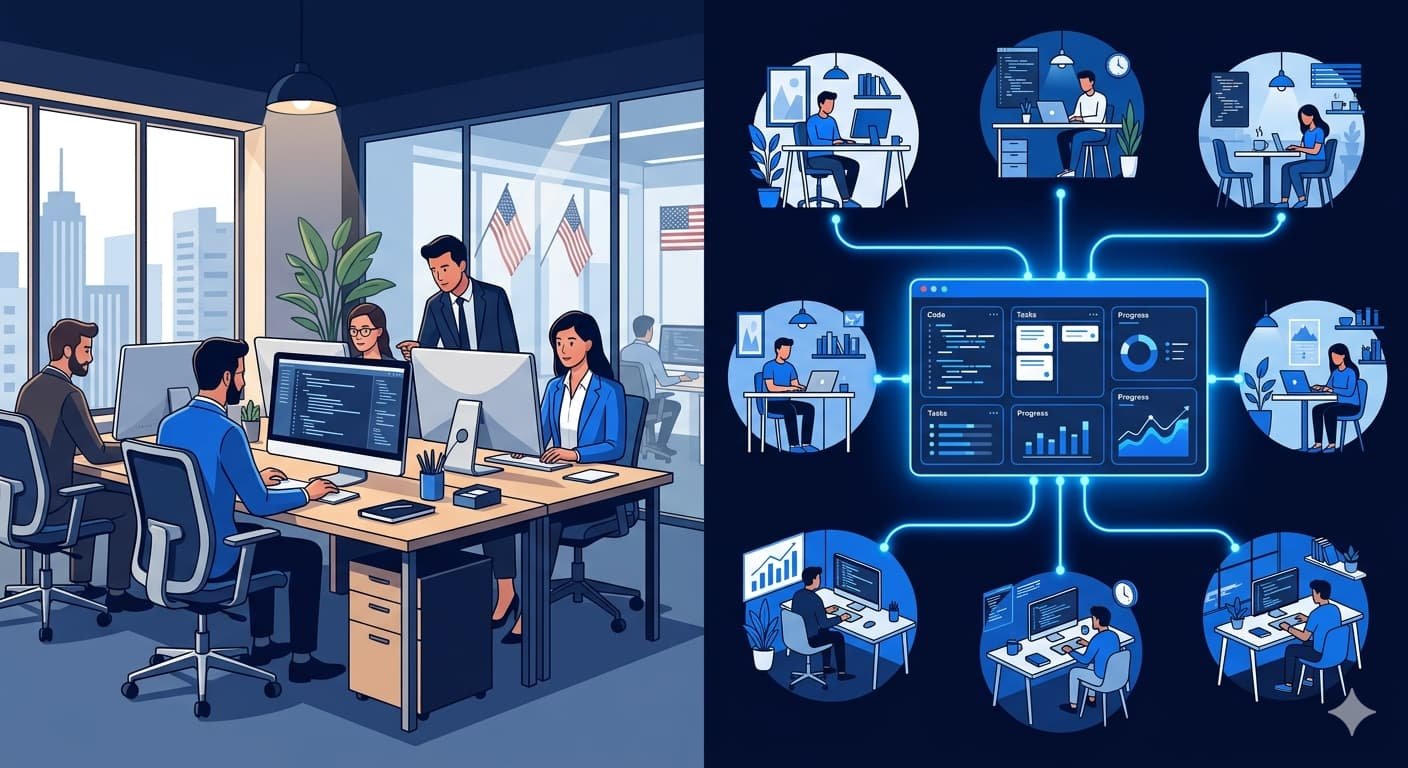
Staff augmentation is a flexible outsourcing model where you bring in external professionals — developers, designers, QA engineers, data scientists — to work as part of your existing team. They report to your project managers, follow your processes, and integrate directly into your workflow.
This is different from traditional outsourcing, where you hand a project to a third party and wait for deliverables. With staff augmentation, you retain full control. The augmented staff are extensions of your team — not a separate vendor running their own show.
Think of it like this: if your in-house team is a restaurant kitchen, staff augmentation is hiring extra line cooks during the dinner rush. They wear your apron, follow your recipes, and work your hours — you just don't carry them on payroll year-round.
Staff Augmentation vs. Outsourcing vs. In-House Hiring
A lot of people confuse these three models. Let's clear it up:
| Model | Control Level | Speed to Hire | Cost | Best For |
|---|---|---|---|---|
| In-House Hiring | Full | Slow (60–90 days) | High | Long-term core roles |
| Traditional Outsourcing | Low | Moderate | Low–Medium | Defined, scoped projects |
| Staff Augmentation | Full | Fast (1–2 weeks) | Medium | Scaling teams quickly |
Staff augmentation sits in a sweet spot. You get the control of in-house hiring with the speed and cost savings of outsourcing. For most US companies running agile sprints or product launches, that's a hard combination to beat.
Why US Companies Are Choosing Staff Augmentation in 2026
1. The US Tech Talent Market Is Still Tight
Despite layoffs at large tech firms in 2023–2024, mid-market and enterprise companies are still struggling to hire specialized developers — especially in areas like AI/ML, cloud-native architecture, and cybersecurity. Salaries for senior engineers in cities like San Francisco, New York, and Seattle have climbed back up, making in-house teams expensive to build and maintain.
IT staff augmentation services let companies access pre-vetted, skilled professionals without the six-figure salary commitments and benefits packages.
2. Project Demands Are Inconsistent
Software development isn't a flat line. One quarter you're in maintenance mode; the next you're sprinting to ship a new product or integration. Keeping a full bench of developers on payroll for peak demand makes no financial sense for most businesses.
Staff augmentation gives you elastic capacity. You scale up when you need it, scale back when you don't. No layoffs, no severance, no awkward conversations.
3. Speed-to-Market Is a Real Competitive Advantage
When you hire remote developers USA through a staff augmentation model, you can often onboard a qualified engineer in as little as 5–10 business days. Compare that to the 45–90 day average for a full-time in-house hire — including job posting, screening, interviews, offer negotiation, and notice periods.
For companies racing to ship before a competitor, that time difference is significant.
4. Access to Niche Skill Sets
Need a Flutter developer for a 4-month mobile sprint? A Salesforce integration specialist for a CRM overhaul? A DevOps engineer who knows AWS cold? These aren't easy hires in any US city.
Staff augmentation gives you access to a global bench of specialists without committing to permanent headcount for skills you may only need occasionally.
5. Cost Efficiency Without Sacrificing Quality
This is where the staff augmentation model really earns its place. When you hire remote developers USA through an established agency, you're getting talent that has already been vetted, tested, and placed on real projects. You skip the recruitment risk.
And the cost differential is real. A senior developer in-house in California might cost $150,000–$180,000 per year in base salary alone — before benefits, equity, and office overhead. A comparable augmented resource through a Pakistan-based team, for example, typically runs $25,000–$55,000 annually. That's not a cut in quality — it's a structural cost advantage built on geography and purchasing power.
"According to the Capslock Agency team, US businesses that switch from in-house-only staffing to a hybrid staff augmentation model typically reduce their development costs by 35–55% without compromising technical quality, provided they work with a vetted augmentation partner."
How IT Staff Augmentation Services Actually Work
Here's what the process looks like when you engage a staff augmentation partner:
Step 1 — Define Your Needs
You outline the role, required skills, experience level, time zone preferences, and project context.
Step 2 — Candidate Matching
Your augmentation partner presents 2–5 pre-vetted candidates, typically within 3–7 business days.
Step 3 — Interviews & Selection
You interview candidates just like you would for an in-house role. You choose who you want to work with.
Step 4 — Onboarding
The selected developer joins your Slack, your Jira board, your stand-ups. They work your hours, follow your sprint cycles, and integrate into your team's culture.
Step 5 — Ongoing Management
Your project managers direct the work. The augmentation partner handles HR, contracts, payroll, and compliance on their end.
Step 6 — Scale or Wind Down
When your project phase ends or requirements change, you adjust the engagement. No termination packages, no awkward layoffs.
What Roles Are Most Commonly Augmented?
Not every role translates well to staff augmentation. Here's where it works best:
- Frontend developers — React, Angular, Vue.js
- Backend developers — Node.js, Python, PHP, Java, .NET
- Mobile app developers — iOS (Swift), Android (Kotlin), Flutter, React Native
- DevOps / Cloud engineers — AWS, Azure, GCP, Kubernetes, Terraform
- QA engineers — Manual and automated testing
- UI/UX designers — Figma, product design, research
- Data engineers / ML engineers — Python, TensorFlow, data pipelines
- Cybersecurity specialists — Penetration testing, compliance, SIEM
If the role requires deep institutional knowledge or heavy strategic involvement, full-time hiring still makes more sense. But for execution-level roles, staff augmentation is often the smarter call.
Real-World Example: How a Mid-Size SaaS Company Used Staff Augmentation
Consider a scenario the Capslock Agency team has seen play out many times: a SaaS company based in Austin, Texas needed to rebuild their mobile app from scratch while their two in-house developers continued maintaining the existing platform.
They had two options — hire two additional full-time mobile developers (estimated 75–90 day ramp time and $280,000+ in annual combined cost) or bring in augmented Flutter developers through a staff augmentation partner.
They chose staff augmentation. Two Flutter developers were onboarded within 10 days, worked inside the company's existing sprint structure, and delivered a production-ready MVP in 14 weeks. Total engagement cost: approximately $38,000. The in-house team stayed focused on core product maintenance throughout.
That's the practical case for IT staff augmentation services — not a theory, but a repeatable outcome when the model is applied correctly.
"The Capslock Agency team consistently finds that the highest ROI from staff augmentation comes when companies treat augmented staff as true team members — not external vendors — from day one of onboarding."
Common Concerns About Staff Augmentation (And Honest Answers)
"Will communication be a problem with offshore teams?"
Time zone gaps are a real consideration, not a dealbreaker. Many effective staff augmentation arrangements use a 4-hour daily overlap window for stand-ups and collaboration, with async work handling the rest. Tools like Slack, Notion, Linear, and Loom have made this increasingly manageable. Harvard Business Review notes that structured async communication is now a core competency for high-performing distributed teams.
The bigger factor is how the augmentation partner vets for communication skills, not just technical skills.
"How do I protect my IP and data?"
Reputable IT staff augmentation services will have NDAs, IP assignment agreements, and data security policies in place. Always verify this before signing. At Capslock, every engagement includes formal IP protection documentation as a standard step.
"What if the developer doesn't work out?"
This is where a good augmentation partner earns their keep. Most established partners offer replacement guarantees — if a resource isn't performing, you're not locked in. This is a significant advantage over a full-time hire, where a bad fit costs months of lost productivity and a painful exit process.
Staff Augmentation vs. Managed Services: Which Do You Need?
These two are often confused. Here's the key difference:
Staff augmentation = You direct the work. External talent, your management.
Managed services = The vendor manages the work and delivers outcomes. Less control, less overhead for you.
For companies with strong internal project managers and a clear development roadmap, staff augmentation gives you more control and typically better cost transparency. If you don't have strong internal tech leadership, a managed services model may be the better fit.
The Capslock Agency team offers both — so this isn't a pitch for one over the other. It's about matching the right model to your actual situation.
What to Look for in a Staff Augmentation Partner
Not all staff augmentation providers are created equal. Here's what separates the good ones from the ones you'll regret:
- Technical vetting process — Do they test candidates on real code, or just screen CVs?
- Communication standards — English proficiency, responsiveness, and transparency
- Replacement policies — What happens if a resource underperforms?
- Contract clarity — Clear rates, no hidden fees, straightforward scope
- Domain experience — Have they placed developers in projects like yours before?
- Time zone availability — Can they offer meaningful overlap with your working hours?
"According to Capslock Agency's experience across 50+ client engagements, the most common failure in staff augmentation is poor onboarding — not poor talent. Companies that invest in a structured first two weeks see dramatically better outcomes."
FAQ: Staff Augmentation USA 2026
What is the difference between staff augmentation and a staffing agency?
A traditional staffing agency places contractors for general roles. Staff augmentation — especially in IT — focuses on highly skilled technical talent that integrates into your existing development team and works under your direction.
How quickly can I hire remote developers USA through staff augmentation?
Most reputable partners can present pre-vetted candidates within 3–7 business days. Onboarding typically follows within another week. Total time-to-productivity: 2–3 weeks, compared to 60–90 days for traditional hiring.
Is staff augmentation suitable for startups or only enterprises?
Both. Startups often benefit the most because they can access senior-level talent without committing to full-time overhead during a phase when funding and burn rate are critical variables.
What is the typical cost of IT staff augmentation services in 2026?
Costs vary by role, seniority, and geography. Broadly: junior developers may start at $15–$25/hour, mid-level at $30–$45/hour, and senior developers at $50–$80/hour through a quality augmentation partner. US-based augmented talent runs higher.
How do I manage augmented staff effectively?
Treat them like members of your team from day one. Include them in stand-ups, give them access to your tools, and assign a dedicated internal point of contact. Staff augmentation works best when it's genuinely collaborative — not transactional.
Conclusion: Staff Augmentation Is a Strategy, Not a Shortcut
Staff augmentation USA 2026 is not about cutting corners. The companies using it well are doing so because it gives them genuine strategic advantages — speed, flexibility, access to specialized skills, and cost efficiency that traditional hiring simply can't match at scale.
It works best when you approach it as a long-term hiring strategy, not a one-time patch. That means choosing the right partner, onboarding augmented staff properly, and treating them as real members of your team.
The Capslock Agency team has helped US companies across SaaS, healthcare, retail, and fintech build and scale their tech teams through staff augmentation — from single-developer engagements to full product squads. If you're evaluating whether this model fits your business, we're happy to walk you through it with no obligation.
You might also find it useful to read our breakdown of AI Cloud Solutions for Business USA 2026 if you're also exploring infrastructure decisions alongside your staffing strategy.
Ready to Scale Your Tech Team Without the Overhead?
The Capslock Agency team helps US businesses hire remote developers and build high-performing product teams through a proven staff augmentation model — with full transparency on vetting, rates, and fit. Explore our AI Solutions and Web Development services if you're also looking to build or modernize your digital products.
Our IT staff augmentation services include:
- Pre-vetted frontend and backend developers
- Mobile app developers (iOS, Android, Flutter, React Native)
- DevOps and cloud engineers
- QA engineers and automation specialists
- UI/UX designers and product designers
- AI/ML engineers and data specialists
We work with US startups, mid-market companies, and enterprises across all major industries.
Book a free consultation — tell us what role you need to fill and we'll send you matched candidates within 5 business days.
📧 hi@capslockagency.com | 🌐 capslockagency.com | WhatsApp | 📞 US: +1 530 819 7542