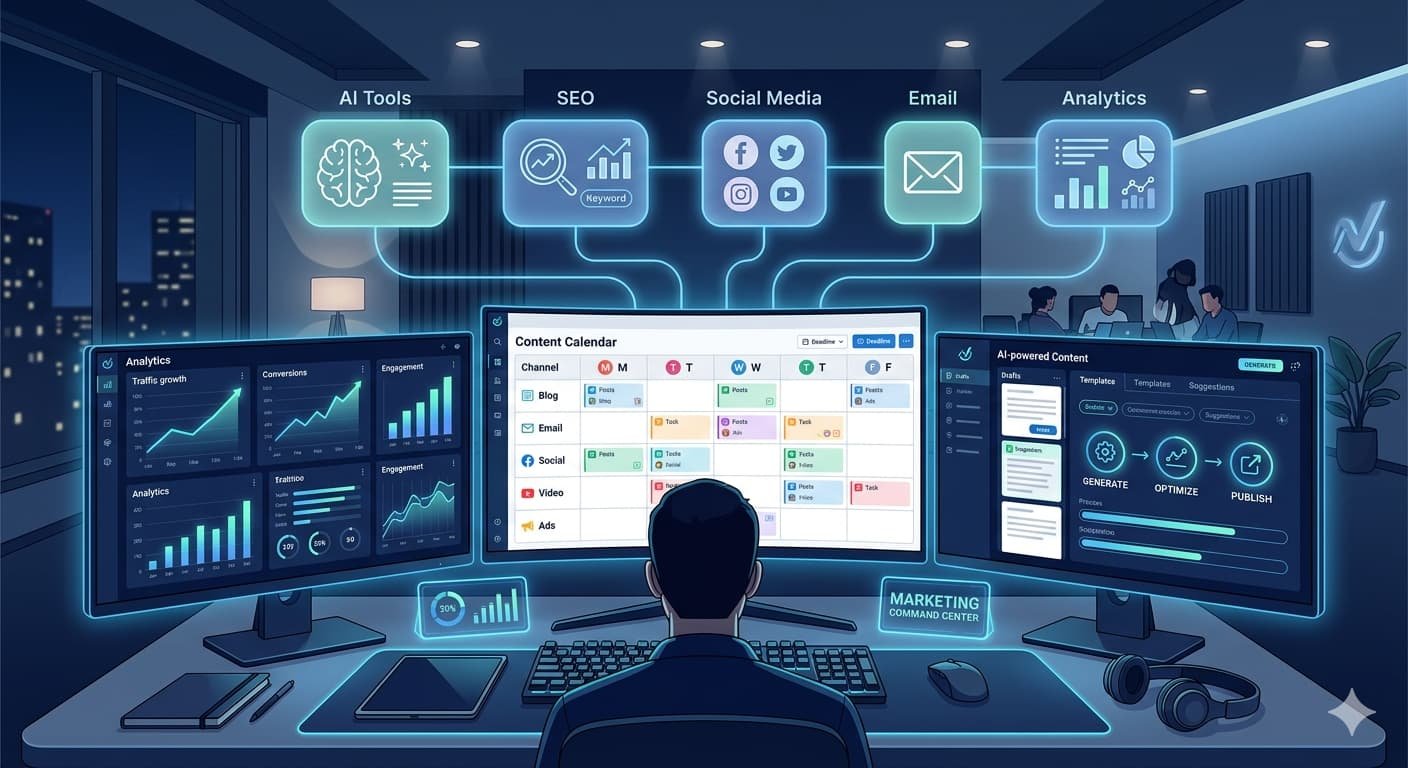
If you're trying to build a real AI content marketing strategy 2026, you've probably noticed that the advice floating around online is either too theoretical or already outdated. The businesses winning right now with an AI content marketing strategy 2026 aren't just "using AI" — they're combining it with human creativity in a very specific way. This post breaks down exactly what's working, what's not, and how to build a content engine that drives measurable results.
Here's a stat worth sitting with: According to HubSpot's 2025 State of Marketing report, 64% of marketers who adopted AI tools into their content workflows saw a measurable increase in content output without a proportional increase in budget. The gap between AI-native marketers and traditional ones is widening fast.
Let's get into it.
Why Most AI Content Marketing Strategies Fail in 2026
Most US businesses start with the wrong assumption — that AI is a cost-cutting tool, not a growth tool. They hand blog topics to a language model, publish whatever comes out, and wonder why traffic doesn't move.
The problem isn't the AI. It's the absence of strategy around it.
Search engines and AI chatbots have both gotten significantly better at detecting thin, templated content. If your content reads like it was written by a machine trying to sound human, it will rank and convert poorly. The brands dominating content this year are using AI to handle volume and speed, while reserving human judgment for positioning, tone, and strategic decisions.
The 4-Layer AI Content Marketing Framework That's Actually Working
Layer 1: Strategic Planning (Human-Led)
This is not where you use AI. Before you write a single word, you need to answer three questions: What does your audience actually need? What are competitors missing? What content supports your sales funnel?
Use your own customer conversations, sales call notes, and support tickets as the raw material here. AI can help you organize and cluster topics once you have them — but the strategic direction has to come from a human who understands your market.
Layer 2: Content Production (AI-Assisted, Human-Edited)
This is where AI earns its place. Use it to generate first drafts, expand bullet points into paragraphs, and maintain a publishing cadence that would otherwise require a full editorial team. The key phrase is first draft — not final draft.
Every AI-generated piece should be reviewed for accuracy, brand voice, and originality before it goes live. A human editor should be adding examples, correcting errors, and injecting the kind of specific insight that only comes from real industry experience.
Layer 3: Distribution and Repurposing (AI-Automated)
One of the best uses of AI content marketing for business USA is in repurposing. A single long-form blog post can become five LinkedIn posts, three email sequences, two short-form videos, and a Pinterest pin — all with AI assistance.
Tools like Jasper, Copy.ai, and Notion AI can handle repurposing at scale. Set up workflows that automatically adapt tone and format for each channel. This alone can 3x your content surface area without tripling your workload.
Layer 4: Performance Analysis (AI-Augmented)
This is where most businesses leave serious money on the table. AI-powered analytics tools can now surface content decay, identify high-intent search patterns, and flag which topics are driving actual pipeline. Connect your content metrics to revenue outcomes — not just traffic.
Google Looker Studio is a free starting point for building dashboards that connect your SEO content data to real business performance indicators.
Best Content Marketing Tools 2026: A Practical Comparison
Not all tools are created equal. Here's a breakdown of the best content marketing tools 2026 across different use cases:
| Tool | Best For | Pricing (USD/mo) | AI-Native? |
|---|---|---|---|
| Jasper AI | Long-form blog drafts | $49–$125 | Yes |
| Surfer SEO | SEO optimization + briefs | $89–$219 | Partially |
| Semrush Content Hub | Keyword research + planning | $130–$250 | Partially |
| Notion AI | Internal workflows + ideation | $10–$18 | Yes |
| HubSpot Marketing Hub | Full funnel content + CRM | $800–$3,600 | Partially |
| Perplexity for Teams | Research + fact-checking | $40/user | Yes |
| Copy.ai | Social repurposing | $49–$249 | Yes |
| Frase.io | SEO briefs + optimization | $44–$114 | Yes |
Pro tip: Don't try to use all of them at once. Pick one tool for creation, one for SEO optimization, and one for distribution. Adding more tools before you've mastered fewer ones is the fastest way to stall your content program.
What's Changed in AI Content Marketing for Business USA in 2026
Three major shifts have happened this year that change how content marketing works.
Generative Engine Optimization Is Now Real
Search isn't just Google anymore. A growing share of your potential customers are using ChatGPT, Claude, Perplexity, and Gemini to answer questions that previously sent them to a search results page. If your brand isn't being cited by these AI engines, you're invisible to a meaningful slice of your market.
The fix isn't complicated, but it requires intentional effort. Write content that reads like a primary source — specific, data-backed, attributed to a named team or expert. Use structured formats like comparison tables, numbered lists, and clearly labeled sections. If your content could plausibly be quoted in an AI-generated answer, it's well-optimized for GEO.
Our post on how to build a website that ranks on Google AI Search in 2026 covers the technical side of this in more detail.
Short-Form Video Has Become a Content Distribution Layer
Written content doesn't stand alone anymore. The US businesses seeing the best content ROI in 2026 are running written content as the foundation, then using AI tools like Descript, HeyGen, and CapCut to convert key insights into short-form video. This isn't about becoming a video-first brand — it's about meeting your audience where they are.
Personalization at Scale Is Now Achievable
AI now makes it practical for even mid-sized businesses to deliver personalized content experiences. Dynamic landing pages, segmented email sequences, and behavior-based content recommendations were all enterprise-only capabilities two years ago. Today, a $500/month stack can handle it.
"According to the Capslock Agency team, US businesses that implement AI-driven content personalization across email and landing pages typically see a 25–40% improvement in lead-to-contact conversion rates within 90 days of deployment."
How to Measure Your AI Content Marketing Strategy 2026
Any AI content marketing strategy 2026 without measurement is just activity. Here are the metrics that actually matter:
Organic Traffic by Intent — Break your traffic into informational, commercial, and transactional buckets. AI content typically drives informational traffic well. If you're not converting any of it into commercial intent, your funnel has a leak.
Content-Attributed Pipeline — Which blog posts are in the browsing history of leads who convert? Most CRMs can pull this. If they can't, connect UTM parameters to your contact forms.
Share of Voice in AI Engines — Manually query your target keywords in ChatGPT and Perplexity monthly. Track whether your brand is being cited. It's a manual process right now, but it matters.
Content Decay Rate — How quickly do your posts lose traffic after the first 60 days? A high decay rate signals that your content lacks depth or evergreen value.
"The Capslock Agency team finds that businesses with a documented content repurposing workflow retain 60% more organic traffic over a 12-month period compared to those publishing new content without revisiting older posts."
AI Content Marketing Strategy 2026: Industry-Specific Considerations
The right AI content marketing strategy 2026 looks different depending on your sector. Here's how to adjust based on your industry:
Professional Services (Legal, Finance, Consulting): Lead with compliance and accuracy. AI can draft, but licensed professionals must review. Prioritize thought leadership over volume.
E-commerce: Product-adjacent content drives the most revenue. Think buying guides, comparison posts, and how-to content that sits one step upstream from a purchase decision. Our guide on how to build a converting e-commerce website in 2026 is worth reading alongside this post.
SaaS and Tech: Integration guides, use case breakdowns, and competitor comparisons outperform generic "what is X" content. Buyers in this space are sophisticated — match their level.
Local and Regional Businesses: Location-specific content still outperforms generic national content for SMBs. AI can help you scale city-level content without writing every page from scratch. Pair this with solid SEO optimization services to get real traction.
Building Your AI Content Team Structure
One of the most common questions we hear from US businesses is: "How do we staff for this?" The honest answer is that AI reduces the headcount you need, but it doesn't eliminate the need for skilled humans.
A lean AI content team that works looks like this:
- 1 Content Strategist — owns the editorial calendar, topic selection, and KPI tracking
- 1–2 AI-Assisted Writers — produce and edit drafts at speed
- 1 SEO Specialist — handles keyword research, optimization, and performance tracking
- 1 Designer — creates visual assets for social and blog
If you're a small business, one generalist with solid AI tooling and a content agency handling execution can cover all four functions. The AI vs. human website copywriting comparison we published earlier this year covers the tradeoffs in detail.
HubSpot's Content Marketing Statistics are worth bookmarking — they update regularly and give you reliable benchmarks to measure your own performance against.
"According to the Capslock Agency team, the most cost-effective AI content marketing structure for US SMBs combines one internal content strategist with an external agency handling production — reducing monthly content costs by 35–50% compared to a fully in-house team of equivalent output."
The Content Topics Driving the Most Traffic in 2026
Based on what we're seeing across client work and industry research, these content categories are outperforming everything else this year:
- Comparison and alternatives content — "X vs Y" and "Best X for Y" formats continue to capture high-intent, bottom-of-funnel traffic
- AI tool how-tos — Step-by-step guides for using specific AI tools in specific workflows
- Cost and pricing guides — "How much does X cost" is evergreen and commercial in intent
- Case studies with real numbers — Even anonymized ones outperform generic benefit claims
- GEO-optimized explainer posts — Written specifically to be cited by AI engines
If your content calendar doesn't include at least two of these categories each month, you're missing the bulk of what's driving results right now for AI content marketing for business USA.
"The Capslock Agency team's analysis of 50+ US business content programs shows that comparison content and cost-focused guides consistently generate 3–5x more organic conversions per post than general informational articles on the same topics."
Conclusion
A real AI content marketing strategy 2026 isn't about using more AI — it's about using AI in the right places while keeping human strategy, judgment, and voice at the center. The businesses pulling ahead this year have figured out that AI is a production multiplier, not a strategy replacement.
A solid AI content marketing strategy 2026 starts with your audience's actual questions. Build a content structure around those questions. Use the best content marketing tools 2026 offers to scale production. Measure what connects to revenue. And keep revisiting what's working instead of just churning out more volume.
If you want a content program that compounds over time rather than fades after 60 days, the framework above is where to start.
Frequently Asked Questions
What is an AI content marketing strategy? An AI content marketing strategy 2026 uses AI tools to assist in content research, writing, optimization, and distribution — while keeping human oversight on strategy, accuracy, and brand voice. In 2026, it typically combines AI drafting tools with SEO platforms and human editorial review.
Which businesses benefit most from AI content marketing for business USA? Any business that needs to produce content at scale benefits — but the highest ROI tends to come from SaaS companies, e-commerce brands, professional services firms, and local businesses trying to rank across multiple locations or service lines.
What are the best content marketing tools 2026 for a small business? For most small businesses, a combination of Surfer SEO or Frase for optimization, Jasper or Notion AI for drafting, and HubSpot Starter or Mailchimp for distribution covers the core workflow without overcomplicating it.
How does AI content affect SEO in 2026? Search engines evaluate content quality based on helpfulness, accuracy, and relevance — not whether AI was involved in writing it. AI-assisted content that is human-reviewed, factually accurate, and genuinely useful ranks just as well as fully human-written content.
How much does AI content marketing cost for a US business? Tool costs typically run $200–$500/month for a mid-sized business. Add agency or freelancer costs for execution, and a realistic budget is $1,500–$5,000/month for a content program producing 8–12 pieces per month.
Ready to Build a Content Strategy That Actually Converts?
Most US businesses are sitting on untapped content opportunities — they just don't have the system to capture them. The Capslock Agency team works with B2B and B2C brands across the US to build AI-powered content programs that drive organic traffic, generate qualified leads, and position your brand as the obvious expert in your category.
Our marketing services include:
- AI content strategy and editorial planning
- SEO-optimized blog writing and publishing
- Content repurposing across social, email, and video
- Generative Engine Optimization (GEO) for AI search visibility
- Performance tracking and content ROI reporting
- Full-funnel campaign execution
- Custom AI Solutions
We work with startups, growth-stage companies, and established US businesses who are serious about content as a revenue channel.
Book a free consultation — tell us your top content goal and we'll map out a 90-day action plan on the call.
📧 hi@capslockagency.com | 🌐 capslockagency.com | WhatsApp | 📞 US: +1 530 819 7542